




Adani Enterprises (NSE: ADANIENT) shares are down only 2% today. ADANIENT shares might react a little more as a new story spreads around the world. For the Financial Times and The Guardian have built up a story which seems to confirm - at least the newspapers claim it confirms - some of the accusations made by Hindenburg in that short sellers report on the Adani Group as a whole. Whether these new claims are true is of course something that we’ll find out in the fullness of time. Adani Group stoutly denies them. What matters rather more though is whether the claims actually matter at all? Which is a more complicated question than many might think. If the claimed activity is still going on then yes. If it’s all in the past then not so much really.
The Guardian: “According to offshore financial records seen by the Guardian, associates of the Adani family may have spent years discreetly acquiring stock in the Adani Group’s own companies during its meteoric rise to become one of India’s largest and most powerful businesses.” The Financial Times: “The two men — Nasser Ali Shaban Ahli from the United Arab Emirates and Chang Chung-Ling from Taiwan — are associates of Vinod Adani, brother of the conglomerate’s founder Gautam. Their investments were overseen by a Vinod Adani employee, raising questions over whether they were front men used to bypass rules for Indian companies that prevent share price manipulation.
The intricate paper trail that shielded their identity from regulators and the public is laid bare in documents shared with the Financial Times by the Organized Crime and Corruption Reporting Project, a network of investigative journalists.”
All very similar to the Hindenburg allegations about Adani Group: “It’s possible to take a number of different views about all of this. One is the obvious corporate one. Hindenburg are vile, attempting to profit by telling lies and no one should believe them in the slightest. That’s also, quite clearly, not what the market as a whole believes. For the share price movement has been such that at least some of the market does think there might be something there. Another view could be that Hindeberg are right and that we should all await the collapse of the empire in toto. That mjight not be quite right either given that the longer the survival of the group - even assuming the analysis is correct - then the more can be done to prevent that happening.”
OK, today’s newspapers claim to have documentary evidence suggesting that the share purchases really were taking place. That would be bad, obviously. But the bigger question is how bad?
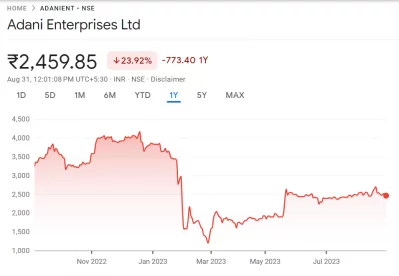
Adani Enterprises share price from Google Finance
Think this through in two different ways. One is that Hindenburg is right, as are the papers here. There’s been a lot of money borrowed - probably from within the group - to buy shares in parts of the group. This creates a pyramid of paper and as soon as those loans have to be called in then the pyramid collapses. The important point here is that those loans, those purchases, must still be outstanding for this to be true.
The second is that, well, OK, some stuff happened. That’s what the papers have found. Perhaps there was some support of stock prices. Maybe it was all a method of getting money out of India, thus out of the tax net, to then invest back into India tax free. This is not, after all, entirely unknown. This might mean that there are stock exchange inquiries to answer, tax questions to answer. But what if the system has already been unwound? At that point the danger to the basic solvency of the Adani companies is gone and past.
No, we do not know the answer. We have no more information than anyone else here. We just want to make clear that there are two very different levels of risk here. Assume, just for a moment, that the latest claims are true. What matters to the valuation of the Adani Group companies - in the catastrophic sense - is whether the share price support scheme is still operating with cash from inside the companies themselves. If this is all historic and over then it’s something different.
