



Judo Capital (ASX: JDO) (OTCPK: JDCHF) shares are down 20%. JDO shares fell on the announcement of the results which is perhaps a little odd, for the results were good. What worries is the future - and in banking that does matter significantly. Judo Capital is usually classed as a “challenger bank” - someone trying to grow in order to challenge the seeming oligopoly of Australian banking. That’s fine, obviously, but it does bring to mind that major issue about banking that we’ve known for centuries (and yes, really, Adam Smith himself pointed it out). Which is that lending money is easy, so is lending money at decently high interest rates. The difficult thing is finding the people who are worth lending money to.
Judo’s results as announced: “(“Judo Bank” or “Judo”) on Thursday announced FY23 Profit Before Tax (PBT) of $107.5 million, a sevenfold increase on its FY22 pro forma PBT of $15.6 million. Judo Bank has achieved or exceeded all of its FY23 guidance metrics, with Gross Loans and Advances (GLA) today exceeding $9 billion, and Underlying Net Interest Margin (NIM) of 3.53%, up 74 basis points.” Those are nice results. Any bank would be happy to have them. That net interest margin rivals most of the London based banks for example. So, why the fall in the share price, why not a decent rise?
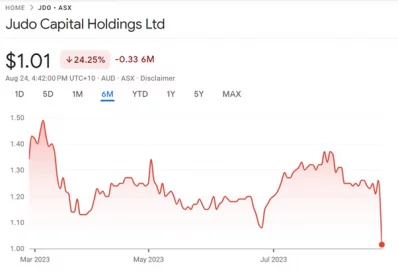
Judo Capital share price from Google Finance
The worry is: “Judo Bank says its margins will shrink this financial year as cheap funding rolls off, and it is adopting a more cautious approach to companies exposed to consumer spending given interest rate pressures. The bank expects lending to small businesses to grow after delivering a full-year net profit eight times higher than a year earlier, but its shares fell sharply as analysts flagged a tougher outlook for revenue, competition and rising bad debts.” It’s that last that worries.
Sure, there’s been significant growth. But those marginal new customers - just how marginal are they? How badly are they going to suffer in the new higher interest rate environment? Don’t forget that the higher interest rate margin stems from exactly the same background event - higher interest rates more generally. History does tell us that banks which dash for growth can end up making more loans that go bad. Especially if that growth is in the period before tougher economic times then arrive.
Of course, it’s also possible that lending standards were maintained - every big bank did become a big bank by picking up marginal business over the years and decades after all.
At Judo Capital the outcome is, as yet, unknown. So, thus the weakness in the Judo share price.
