



OD6 (ASX: OD6) shares are up 42% on Tuesday on the back of their release of the drill results at Splinter Rock. Those results are good - solid rare earth numbers and high in the desired magnet rare earths. Nothing wrong with these OD6 drill results at all. In fact, a lot good with them.
To grasp this we need the background economics of rare earths. Finding a mineral containing them is child's play. No, really, or anyone competent can find you a few thousand tonnes in a few phone calls. Processing the rare earth concentrate out is a well known and cheap enough process. It's then separating that into the different elements which is expensive. That costs around $20,000 a tonne material. Unfortunately, the bulk of that concentrate, from the traditional mineral sources, will be cerium and lanthanum (the “light” rare earths) and they sell for perhaps $500 a tonne. So, $19,500 per tonne is lost on 50% or more of the concentrate. That's made up on the minority of the concentrate, the magnet metals, which sell for $100s to $1,000s per kg.
What matters for the profitability of the process therefore is the relationship between lights and heavies, between La, Ce and the magnet metals, in the concentrate produced. A concentrate which is 5% magnet metals is in fact worth nothing, as one example.
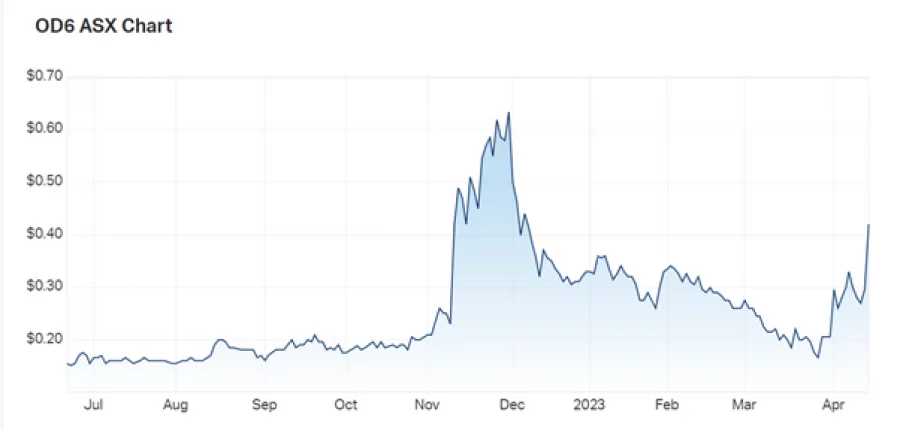
OD6 share price from ASX
Which brings us to the real point here. OD6 has, as we've said before, an ionic clays deposit. So does Australian Rare Earths, so does Larvotto. Ionic clay deposits are much higher in the magnet rare earths, much lower in the lights, than the more traditional sources. Given those concentrate processing costs that means they're objectively more profitable.
Now, whether that means that all of these ionic clay deposits are going to be profitable is another matter. The more of them there are the less well any single one of them will do. But what this does mean is that those traditional producers are going to come under ever-increasing pressure. The geology of the world is not as we thought it was - that's clearly going to change a business like rare earths that relies upon geology. That's the real lesson here - the old ways are going to die. It might be slowly, but they will.
