




To read Calcutta Kebabs and Christmas Cake is not simply to read an autobiography. It is to enter a world. It is to wander through the streets, drawing rooms, restaurants, racecourses, libraries, shrines and music gatherings of a Calcutta that was vibrant, cosmopolitan and endlessly fascinating. More than a memoir, the book becomes a journey through history, culture, cuisine and memory, seen through the eyes of a young girl whose curiosity about the world around her never seems to diminish.
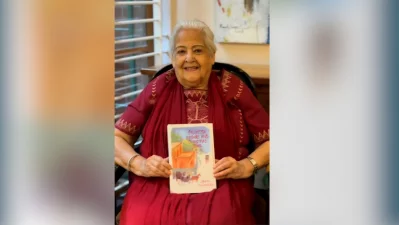
The author, Zeena Chowdhury, possesses a remarkable gift for observation. From childhood she wanted to understand everything she encountered. She questioned, listened, learned and carefully recorded details in what she affectionately called her “Zeenapedia,” a personal notebook of facts, experiences and discoveries. Through her eyes, readers experience not only the gradual transformation of Calcutta into a bustling metropolis, but also the rich social and cultural diversity that defined the city during her childhood and adolescence.
One of the book’s greatest strengths is its portrayal of a truly multicultural upbringing. Zeena moved comfortably through Muslim, Hindu, Christian, Sikh, Chinese, Parsi and Western social circles, absorbing customs, traditions and values from each. Religious identity was not presented as a boundary but as an invitation to learn. The result is a memoir that quietly but powerfully celebrates tolerance, coexistence and mutual respect.
At the centre of her childhood stood two extraordinary women—“The Two Queens” of the opening chapter.
The first was her maternal grandmother, Nanna, who lived on the upper floor of 7 Park Lane. The second was Maggie, Nanna’s tenant on the ground floor. Zeena divided her time equally between them, and both left an indelible mark on her life.
Nanna emerges as one of the book’s most unforgettable characters. She embodies everything associated with the traditional Begum Sahiba—cultured, dignified, charitable and resilient in the face of adversity. Yet beneath this respectable exterior lay a wonderfully unconventional spirit. Her passion for horse racing repeatedly led her into financial peril. She gambled recklessly, lost fortunes and continued living life on the edge with remarkable determination. What could have been a portrait of aristocratic respectability becomes instead the story of a vibrant, flawed and thoroughly entertaining woman. Her Saturdays at the races are among the most delightful passages in the book and transform the narrative into a genuine page-turner.
Maggie’s influence was equally important, though very different. Through daily interactions with Maggie and her family, Zeena became intimately familiar with Christian customs and religious observances. This complemented her education at Loreto Convent in Darjeeling, a Catholic missionary boarding school where she had already been introduced to Christian teachings.
Her closest friend Krishna opened another door, introducing her to Hindu rituals and festivals throughout the year. Nanna, meanwhile, took her to dargahs and qawwali gatherings, ensuring that Islamic traditions remained a central part of her experience. Sunni and Shia rituals both found a place in her life. The Quranic verses and surahs quoted throughout the memoir add a note of reverence and spiritual conviction.
Taken together, these experiences create one of the book’s most important themes: faith is not presented as a source of division but as a source of understanding.
Not all of Zeena’s adventures were spiritual, however.
A considerable portion of her evenings was spent watching Hollywood and Hindi films or dining at Calcutta’s famous restaurants and cafés, where proprietors eagerly welcomed distinguished patrons such as Nanna and her family.
Among the colourful cast of supporting characters, none is more memorable than Mukmul Khala.
Part housekeeper, part family historian and part neighbourhood intelligence agency, Mukmul Khala knew every secret, every scandal and every rumour circulating within and beyond 7 Park Lane. Her loyalty to the family was absolute. Her confidence in her culinary skills was unmatched. Her opinions on her daughters-in-law and their families were delivered with a wit that frequently borders on comic genius. If a piece of jewellery went missing, Mukmul Khala always knew who was responsible—or at least believed she did. Readers cannot help but be charmed by her.
Food occupies an equally important place in the memoir.
The title itself signals the author’s affection for cuisine, and the pages overflow with descriptions of meals, recipes and restaurants. The family table reflected a blend of Western, Mughal and Bengali influences, while meals outside the home ranged from humble roadside eateries to legendary establishments such as Flury’s, Firpo’s, Trincas and Nizam’s.
By the time one finishes reading the book, one learns not only how Christmas cakes are prepared with brandy-soaked fruits, but also develops a craving for galouti kebabs, kakori kebabs and countless other delicacies. More than a hundred different foods appear throughout the narrative. At one memorable lunch, no fewer than eighty-one dishes are served.
Eighty-one.
The number seems unbelievable until one remembers that excess itself was part of the culture being described.
Yet beneath the food, humour and family anecdotes lies a serious engagement with history.
One of the book’s most valuable achievements is the way it weaves historical events into personal memory. Readers repeatedly encounter moments where family stories intersect with larger national and international developments.
We learn about the East India Company’s policies, the social consequences of colonialism and the experiences of communities that shaped Bengal’s identity. The book discusses the arrival of Armenians fleeing Ottoman persecution and their contributions to education, journalism and commerce. It examines the influence of Parsis and explains Zoroastrian customs such as excarnation. It explores the founding ideals of the Brahmo Samaj and the reformist visions of Raja Ram Mohan Roy and Dwarkanath Tagore.
The narrative also revisits the Indigo Revolt through the history of Nanna’s ancestors, whose prosperity was linked to indigo plantations. The author does not shy away from acknowledging the suffering endured by cultivators whose exploitation eventually sparked rebellion.
Particularly compelling is the discussion of Mahatma Gandhi’s assassination and its impact on ordinary families. The author uses the event as a starting point for wider reflections on communal politics, Hindutva and the future of Hindu-Muslim coexistence in India.
One of the most emotionally devastating episodes in the memoir concerns Ram and Shabnam.
Their love story becomes a horrifying illustration of religious intolerance. Ram’s family attempts to burn both him and his pregnant Muslim lover on a funeral pyre because of their relationship. Ram dies. Shabnam survives. Her own family, ashamed of the scandal, struggles to accept her. Nanna ultimately intervenes, taking responsibility for Shabnam and her child.
The story remains deeply disturbing because it demonstrates how religious fanaticism can destroy lives regardless of whether it emerges from Hindu or Muslim communities. The author’s own emotional response to the tragedy is palpable and impossible to ignore.
Literature and music enrich every corner of the memoir.
Nanna’s library becomes a wonderland containing Dickens, Austen, Wilde, Tolstoy, Hemingway, Steinbeck and Margaret Mitchell. Literary quotations appear naturally throughout the narrative. William Blake’s poetry is recited during family outings. Charles Dickens introduces chapters. Characters from Gone With the Wind become affectionate family nicknames.
Rabindranath Tagore occupies a particularly prominent place. Discussions of his life, relationships and creative process are detailed and engaging. The author explores Gora and Ghare Baire with genuine enthusiasm while also questioning the contradictions within the Tagore family’s progressive image, particularly their acceptance of child marriage.
Urdu poetry receives equally loving treatment. The verses of Allama Iqbal, Faiz Ahmed Faiz, Mirza Ghalib and Mir Taqi Mir appear throughout the memoir, enriching its philosophical and emotional landscape. Discussions of Sufism, divine love and spiritual equality add another layer to the book’s exploration of culture and faith.
Much of Zeena’s intellectual growth came through her beloved Bangla teacher, Dipankar Chowdhury, whom she affectionately calls Master Moshai. Educated at Oxford, stylish enough to drive a Bugatti and passionate about Bengali culture, he introduced her to jatras, kirtans and folk traditions including baul, bhawaiya, jari and shari songs.
Monthly jalshas further expanded her horizons. Through these musical evenings she entered what she beautifully describes as a world of “ragas and raginis, of colours and passion, of tones and semitones, of melody and harmony.” These chapters are among the most evocative in the book.
The memoir also offers fascinating insights into the evolution of bhadralok culture, the growing influence of Western education, Victorian aesthetics, club culture and the arrival of jazz in Calcutta. African American musicians performing in hotels and nightclubs, the emergence of Indo-jazz and the musical experiments that followed all become part of the city’s evolving identity.
And then there is Kishwar—the family’s resident femme fatale.
No great family saga is complete without a villain, and Kishwar fulfils the role magnificently. Her dramatic confrontations with her mother-in-law, Bhiki Nani, provide some of the book’s most entertaining scenes. At one point, Bhiki Nani reportedly chases her with a grinding stone after discovering salt sprinkled into a dessert where sugar should have been.
The scene is worthy of theatre.
Ultimately, the encyclopedic richness of Calcutta Kebabs and Christmas Cake is undeniable. History, religion, cuisine, literature, music and family life are woven together so seamlessly that the autobiography becomes something larger than the story of one individual.
It becomes a portrait of a city.
A city of kebabs and Christmas cakes, of Tagore songs and qawwalis, of horse races and rooftop discussions, of libraries and jalshas, of tolerance and contradiction, of memory and loss.
The book informs, entertains and enriches in equal measure. By the final page, readers do not simply feel they have learned about Calcutta.
They feel they have lived there.
That is perhaps the memoir’s greatest achievement—and the reason it deserves to be read, remembered and celebrated.
