



It was a rather cursory visit—a quick stop at Sonadia, a Bay of Bengal island rich in biodiversity.
During my visit to the island earlier this month, I couldn’t do justice to the serene beauty of Sonadia, which has so much to offer.
Alighting from a boat, I jumped into knee-deep water along Sonadia’s shore and waded towards the sandy beach. One of my co-visitors, Zia Bhai, had already made his first few captures. With professional camera equipment and a powerful lens, he managed to take some beautiful photographs of red ghost crabs and hoopoes.
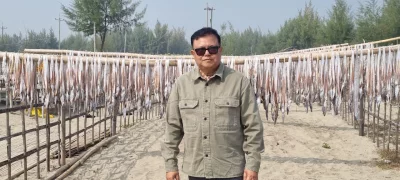
Right from the shoreline, we could smell Sonadia’s famous dried fish being sun-dried in the open. There were stocks of dried fish (shutki) from many species, with Chhurimach (Ribbonfish), Shamudrik Chepa (Faissa), Baspata, and Chingri (shrimp) among the most in demand.
Sonadia is considered a hub of dried fish, where fish are preserved through sun-drying—a natural, chemical-free process—with markets in Cox’s Bazar, Chittagong, and beyond, across the country. Dried fish is a South Asian delicacy and a vital low-cost source of protein. However, hygiene remains a concern, as traditional sun-drying can expose fish to germs, pests, and pollution, and harmful pesticides are sometimes used.
Sonadia, a small island of about 9km² off the Cox’s Bazar coast, is part of Maheshkhali Upazila, located 15km northwest of the Cox’s Bazar district headquarters. Sonadia and Maheshkhali are separated by a waterway locally known as the Baddar Channel. Starting from Cox’s Bazar Jetty No-6, I stopped at Sonadia briefly before heading to Maheshkhali.
With its mangrove forests, diverse birdlife, red ghost crabs, marine turtles, and commercially important fish stocks, Sonadia is undoubtedly a biodiversity hotspot in Bangladesh and also acts as a natural shield against disasters. Its unique ecosystems clearly deserve better conservation.
In 1999, Sonadia was declared an Ecologically Critical Area (ECA) to protect the island’s biodiversity. However, later efforts to develop various infrastructures in the name of tourism parks severely compromised the ECA initiative. Fortunately, the government has recently revoked the park initiative.
Even a short stay on Sonadia Island offers opportunities to spot birds such as sandpipers, plovers, herons, geese, and various waterfowl. Many migratory birds on long-distance flights also use Sonadia as a critical stopover.
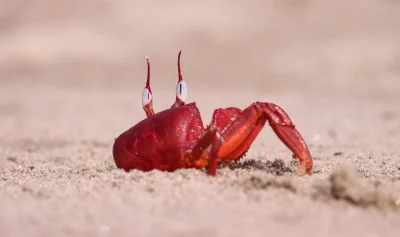
During our brief stay, we managed to spot several casts of red ghost crabs, a colourful hoopoe, and a sandpiper.
Red ghost crabs are a vital part of Sonadia’s coastal ecosystem. Found crawling along sandy beaches, they are known for their long, stalked eyes and vibrant red coloration. Omnivorous by nature, they consume worms, small shellfish, fish, and detritus. Living in burrows dug into the sand, they are active both day and night, playing an important ecological role by aerating the sand and serving as prey for other animals.
One of my co-visitors, Ziaur Rahman, is a journalist specializing in stock market and economic analysis, as well as a wildlife photographer. As we admired the island’s natural endowments, Zia Bhai managed to capture an excellent shot of a stationary Eurasian Hoopoe on the ground.
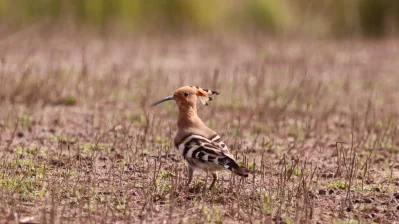
In our part of the world, hoopoes are also known as Mohonchura and Hudhud. Another common name, linked to Islamic tradition, is Suleiman Pakhi (Bird of Solomon), referring to its role as a messenger of Prophet Suleiman. It is a distinctive bird, with a tall, erectile crest, a cinnamon-coloured body, and black-and-white wings and tail.
In the Quran, the hoopoe is described as a messenger who brings crucial news about the Queen of Sheba to Prophet Suleiman. Across Arabic, Greek, and Persian cultures, the hoopoe appears as a mythological figure, often portrayed as a wise messenger or guide.
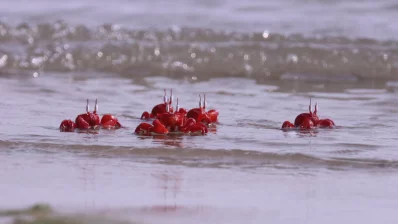
Zia Bhai also took a beautiful photograph of a resting Common Sandpiper (Pati Batan in Bengali), with a cast of red ghost crabs in the background. Sandpipers are wading birds characterised by their long legs for feeding in shallow water and their ability to thrive in diverse habitats, from coastal areas to wetlands.
