



Bangladesh is preparing to roll out the National Equipment Identity Register (NEIR), a long-overdue system designed to curb the import and use of illegal mobile phones, protect government revenue, and bring order to a market that has long operated in the shadows.
The intent is sound. The timing, however, raises a question that policymakers would do well to answer before January 2027 arrives: if smartphones remain among the most heavily taxed consumer goods in the country, who exactly will NEIR bring into the formal market?
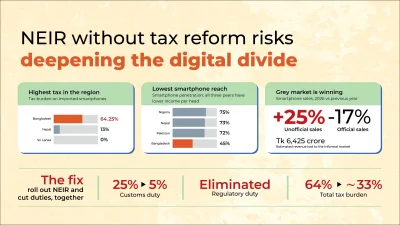
The numbers tell a troubling story. Bangladesh currently imposes a combined tax burden of 64.25% on imported smartphones, one of the highest in the region.
Sri Lanka charges zero customs duty on smartphones. Nepal charges 13%. Pakistan's total duty burden, though recently reduced, remains a fraction of Bangladesh's.
Yet Bangladesh, a country that aspires to build a digitally inclusive economy, taxes a smartphone at a rate that adds over Tk60,000 in duties alone on a device assessed at Tk1 lakh.
The result is predictable.
Consumers who cannot afford the official price or who simply recognize the arbitrage turn to the grey market.
In 2026, unofficial smartphone sales are estimated to have risen 25% over the previous year, while official sales fell by nearly 17%.
The government lost an estimated Tk6,425 crore in revenue from that informal market alone.
These are not the numbers of a system working as intended.
NEIR, in theory, should change this calculus.
By blocking unregistered devices from accessing mobile networks, the system removes the primary utility of a grey market phone.
But this logic only holds if the official market offers a viable alternative.
At present, it does not, not at current prices, not in a year when the IMF projects Bangladesh's inflation at 10.9% and global memory chipset prices show no sign of declining.
Implementing NEIR while keeping the existing duty structure intact does not simply fail to solve the grey market problem; it actively worsens it.
When official phones become more expensive and grey market phones get blocked, consumers do not disappear; they find another way. Some will travel.
Some will carry phones in through personal baggage allowances.
Some will simply defer the purchase entirely, which may be the worst outcome of all for a country where smartphone penetration stands at just 45%, a figure that lags far behind Nepal at 73%, Pakistan at 72%, and Nigeria at 75%, all countries with lower per capita incomes than Bangladesh.
That last comparison deserves more attention than it typically receives.
The standard defense of high smartphone tariffs is that they protect domestic manufacturing and generate revenue.
Both arguments have merit in isolation, but neither holds up well against the evidence.
The revenue argument is weaker still: a tax so high that it drives consumers into an unregistered grey market does not maximize revenue; it simply relocates the transaction beyond the government's reach.
The Tk6,425 crore in estimated annual revenue loss from informal sales is not an abstract figure.
It represents the direct fiscal cost of a duty structure that prioritizes the appearance of protection over the reality of collection.
What Bangladesh needs is not a choice between NEIR and lower duties, but both, implemented together.
Reducing customs duty from 25% to 5% and eliminating the regulatory duty entirely, bringing the total tax burden closer to 33%, would not undermine domestic producers.
Domestic manufacturers retain a significant cost advantage even under a rationalized import duty structure, as the gap between locally assembled devices and fully imported ones, accounting for shipping costs, would remain between 12 and 23 percentage points in favor of local production.
It would, however, make official channels meaningfully competitive with informal ones, give NEIR a market it can actually serve, and begin to close the smartphone penetration gap that is quietly widening Bangladesh's digital divide.
Every percentage point of that gap represents households, students, freelancers, and small business owners unable to access the digital economy on its own terms.
Bangladesh has articulated ambitious targets for digital transformation.
Achieving them requires a population that can actually afford the device through which that transformation happens.
A registration system that locks out grey market phones while keeping official prices out of reach does not advance that goal.
It simply moves the barrier from one side of the border to the other.
The more consequential reform, the one that would actually expand the formal market, grow government revenue, and accelerate digital inclusion, is the one being treated as secondary.
It should be first.
Md Abbas worked as a journalist for more than a decade, covering different issues including the rights of marginalized communities, and overseas employment and migration. After August 5, 2024, he also reported on Bangladesh’s reform process and the political and social developments surrounding it.
