




Climate change in Bangladesh is no longer a projection of future vulnerability; it is a lived crisis shaping everyday survival across rivers, coastlines, farmlands, and cities. Salinity intrusion has rendered freshwater undrinkable in large coastal belts, forcing households to purchase water at increasing cost. Erratic rainfall has destabilized crop cycles, while extreme heat has reshaped rural labor productivity. Riverbank erosion continues to eliminate entire villages within days. Cyclones arrive with greater intensity as recovery windows shrink. These hazards are not isolated shocks but overlapping expressions of a climate system in chronic distress. According to GRID (2025), in 2024 alone, more than 2.4 million people were newly displaced by climate- and disaster-related hazards, placing Bangladesh among the most displacement-affected countries globally.
Yet climate displacement does not end at the shoreline or the eroding riverbank. It migrates inland, into cities, and mutates into new forms of insecurity. Families fleeing salinity-poisoned wells, failed crops, and washed-out homesteads arrive in Dhaka with expectations of safety and opportunity. Instead, they enter a second risk landscape shaped not by natural forces but by the infrastructures of urban inequality: unsafe housing, illegal electrification, contaminated water networks, fire hazards, predatory informal markets, political exploitation, disease exposure, and threats of eviction. These vulnerabilities align with Ulrich Beck’s (1986) concept of the Risk Society, where modern systems, not nature, create and unevenly distribute risk.
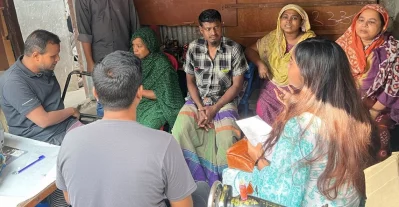
Climate injustice thus becomes multilayered. Rural climate shocks destroy livelihoods; urban displacement erodes identity, protection, and dignity. Displaced households become citizens without documents, workers without contracts, and residents without tenure. Vulnerability is not transferred; it is reshaped and reproduced. Political ecology helps explain this shift: informal settlements are intentionally excluded from planning, urban governance lacks any mechanism to recognize climate-induced mobility, and national safety nets stop at rural administrative boundaries. Once families cross into cities, the state’s responsibility dissolves, and informal power brokers fill the gap.
As one displaced female resident living at the Korail slum shared,
“The river washed away our home, but Dhaka washed away the rest of our lives. Here we are trapped in a water crisis, extreme heat, fires, loans, threats, and fear; my husband pulled into illegal work, and two of my children were forced out of school. No institution has stood beside us. We escaped one disaster only to live inside another, with no way back.”
Furthermore, gender, disability, and age deepen this injustice. Women shoulder unpaid care, unsafe sanitation, low-paid work, and debt pressure. Microfinance often functions less as resilience and more as coercion. Persons with disabilities confront inaccessible environments and disappearing livelihood options in a digitalizing economy. Children experience truncated education and premature entry into survival labor. The underlying issue is not poverty; it is the absence of inclusive safety nets. Urban IDPs remain uncounted in national disaster financing. Global climate finance expands, yet those most affected by climate impacts rarely receive direct support. Investments favor infrastructure, mitigation technologies, and large-scale adaptation, but not the human aftermath of climate loss: drainage, freshwater access, disability inclusion, women’s safety, or eviction protection.
The outcome is a regressive adaptation economy where displaced families self-finance survival through inflated utility payments, high-interest loans, and informal brokerage fees. Private actors’ profit from precarity, while formal private investment in resilient, inclusive urban systems remains minimal.
In the short term, climate justice demands recognition of urban IDPs, expansion of safety nets into cities, regulation of exploitative survival markets, protection from eviction, and targeted climate finance to WASH, health, livelihoods, and drainage systems. In the long term, justice requires reorienting climate finance toward social recovery, accountability for private-sector resilience commitments, decentralization of development, and meaningful participation of displaced communities in adaptation planning.
In international conferences like Conference of the Parties (COP), this central truth must be acknowledged: displacement is not a humanitarian anomaly; it is a structural outcome of a warming world. As COP30 moves from promises to accountability, climate justice must be measured not by targets negotiated, but by whether the displaced are finally counted, financed, and protected in the world’s climate response. Addressing it demands coordinated action across government, the private sector, NGOs, INGOs, development partners, and academia. Governments must ensure recognition and rights (SDGs 1, 3, 10, 11); private actors must invest ethically in inclusive infrastructure (SDGs 6, 7, 8, 9); development partners must channel finance toward people, not only projects (SDGs 13, 17); and researchers must generate evidence that centers on lived experience.
On a critical note, climate justice is not achieved when emission curves bend or pledges grow. It is achieved when displaced families regain dignity, security, and the right to rebuild, when survival is no longer a debt, a danger, or a punishment for being poor. Until climate finance, urban governance, and development planning structurally include the displaced, global negotiations will continue to succeed on paper and fail where justice matters most: in the everyday lives of people navigating the age of climate displacement.
