



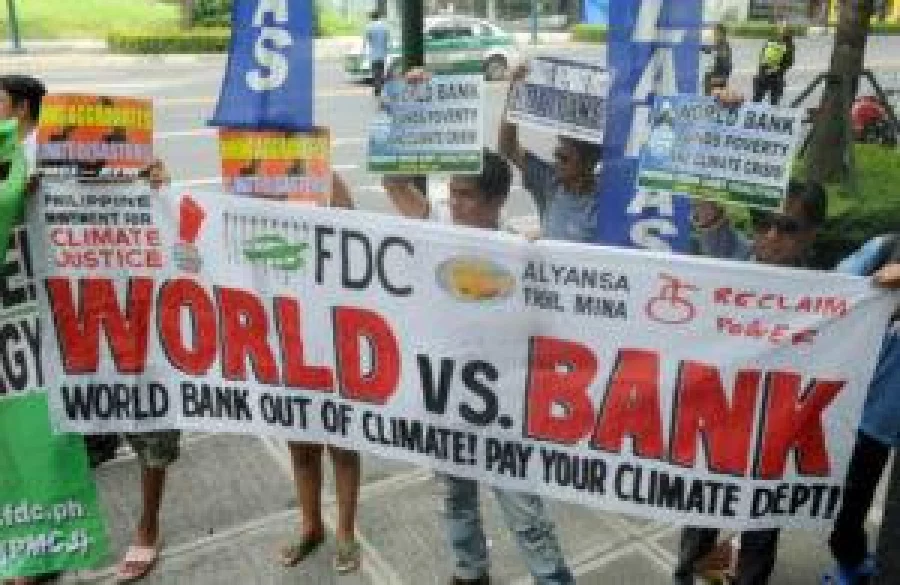
 Members of the Freedom from Debt Coalition lead a protest in front of the World Bank office in Bonifacio Global City in suburban Manila, in 2014 Collected
The World Bank is indirectly financing a boom in some of Asia's dirtiest coal-fired power generation despite commitments to end most funding for the sector, a development advocacy group charged Monday.
The power plants, which contribute to climate change and deforestation as well as premature deaths due to illness, are cropping up from Bangladesh to the Philippines, all with financing provided by financial intermediaries supported by the Bank, said a report produced by the organisation Inclusive Development International, reports AFP.
In a policy shift in 2013, the Bank said it would end virtually all support for the creation of coal-burning power plants, supporting them only in "rare circumstances" where there are no viable alternatives.
However, since that pledge, 41 coal projects have received funding from banks and investment funds supported by the World Bank's private-sector arm, the International Finance Corporation, according to the report.
[youtube id="EDB7jwoslqM"]
In response to questions from AFP, Frederick Jones, an IFC spokesman, said the global lender took the report seriously.
"It raises important long-term questions about how we need to create stronger markets for clean energy and create incentives for countries and the private sector not to invest in coal, but rather in renewable energy," he said.
Jones added that since 2005 the IFC had already invested more than $15bn in renewable energy, energy efficiency and other areas, and had mobilised $10bn more.
However, Jones conceded that IFC policy did not prohibit equity clients from funding coal plants, meaning the institution might be indirectly exposed to the industry.
This is despite the fact that IFC loans to financial services industry players are not intended to finance coal-related projects and targeted lending is "ring-fenced" to prevent this, according to Jones.
The report's release coincided with the start of this week's high-profile annual meetings of the Bank and the International Monetary Fund, as the world's finance chiefs gather to discuss efforts at poverty reduction.
Campaigners in recent years have been sharply critical of the IFC's support for third parties in the financial services sector, such as banks and investment funds, saying they can represent an end-run around environmental and social safeguards that apply to projects directly supported by the IFC.
Financial-sector lending now accounts for 52% of the IFC's long-term commitments, according to IDI, which jointly produced the report with other advocacy organizations including the Bank Information Centre and Accountability Counsel. Founded in 2011, IDI is an advocacy organisation focusing on human rights and ethics in development. Members of the Freedom from Debt Coalition lead a protest in front of the World Bank office in Bonifacio Global City in suburban Manila, in 2014 Collected
Members of the Freedom from Debt Coalition lead a protest in front of the World Bank office in Bonifacio Global City in suburban Manila, in 2014 Collected