



Inflation rose due to the central bank permitting a 28.2% depreciation of the Taka in the 2022 and 2023 calendar years to mitigate foreign exchange reserve losses and restore external balance along with Bangladesh's reliance on food imports.
According to the "World Food and Agriculture Annual Statistical Booklet 2023" by the Food and Agriculture Organization (FAO), Bangladesh holds the third position among food-importing nations, having imported approximately 12.5 million tons of food products from the global market in 2021.
Analyzing the vulnerability of food imports in 2021 alongside the devaluation of the taka over the past two calendar years provides insight into the inflationary impact of imported goods in Bangladesh.
On January 2, 2022, the official exchange rate for the US dollar was Tk85.8. Exactly one year later, it increased to Tk104.35, and by December 26, 2023, it had reached Tk110.
However, in April 2022, Bangladesh Bank initiated stricter restrictions on the importation of luxury goods and non-essential items, excluding food and other essential commodities.
Despite these measures, the fundamental inflationary pressures persisted.
According to the Bangladesh Bureau of Statistics (BBS), food inflation in Bangladesh soared to 12.54% in August 2023, marking the highest level in the past 12 years.
This is up 278 basis points from October 2011, when food inflation was 12.82%.
In FY23, the Consumer Price Index (CPI) rose 9.02%, the highest average inflation rate in 12 years.
However, the price trend has continued in the current fiscal year of 2023-24, averaging 9.42% in November, BBS figures have shown.
Recently, the International Monetary Fund (IMF) said in a report that at least half of this increased inflationary pressure in Bangladesh is attributed to the exchange rate depreciation.
“The pass-through of a sharp depreciation of the local currency accounted for half of the inflation surge seen in Bangladesh in the last financial year,” according to the report.
In response to the FAO and IMF reports, Zaidi Sattar, chairman of the Policy Research Institute of Bangladesh (PRI), penned an op-ed published in Dhaka Tribune in November of last year titled, "Taming the Imported Inflation Bug."
In the article, he highlighted the longstanding concern about the significant impact of the high exchange rate of the dollar on inflation. “Despite previous warnings, there was no action taken at that time. Now, with the IMF echoing these concerns,” Sattar expressed hope that policymakers would finally grasp the severity of the situation.
He also pointed out that the IMF report failed to address the issue of rising tariffs on imported goods, which contributes to the overall increase in import and goods prices.
Emphasizing the issue, he explained that the demand for the greenback is driven by imports of goods and services. As long as the perception of a dollar shortage persists in the foreign exchange market, speculative behavior will continue to dominate.
Sattar advocated for the increasing of sufficient dollar supply by boosting export and remittance inflows, along with maximizing Official Development Assistance (ODA).
In an earlier statement, Sattar underscored that the surge in domestic prices is not a result of crop failures or disruptions in industrial production within Bangladesh. Instead, external events, labeled as "imported inflation," have caused this economic situation.
Consequently, the economy has witnessed an increase in the prices of both traded and non-traded goods, such as services and transportation. He clarified that this inflation is import-induced.
Sattar delved into the factors triggering inflation, noting the supply chain disruption caused by the Russo-Ukraine war, leading to a spike in commodity prices—referred to as the "3Fs": food, fuel, and fertilizer.
Additionally, the sharp depreciation of the Taka against the US dollar, reaching nearly 30% as of September 2023, played a significant role. Although international commodity prices have somewhat stabilized, the second-round effects of these triggers, combined with a 50% hike in fuel prices by the government in August 2022, continue to impact the economy.
Concluding his analysis, Sattar emphasized the urgent need to address inflation, likening it to a regressive tax that disproportionately affects the wider population, particularly the poor. He called for prompt measures to tame inflation and mitigate its adverse effects.
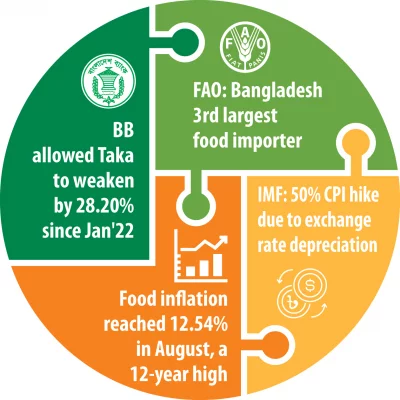
Bangladesh is the third largest food importer
As per the latest report from the Food and Agriculture Organization (FAO), Bangladesh is in third position among nations reliant on food imports, having imported approximately 12.5 million tons of food products from the global market in 2021. This is noteworthy, especially when considering that Bangladesh concurrently produced a substantial 93.3 million tons of agricultural produce in the same year.
Commenting on the data, Agriculture Minister Abdur Razzaque told the media: “We have taken the initiative to increase the production of import-dependent food products. Production of edible oil, onions, and lentils is increasing as a result of innovating new varieties and providing incentives to the farmers. We hope these agricultural products will curb Bangladesh's dependence on imported agricultural products.”
In 2010, Bangladesh met 9.3% of its overall food demand through imports, and by 2022, this figure had increased to 11.2%.
Throughout this timeframe, the importation of rice, wheat and edible oil in Bangladesh experienced an upward trend.
The Director General of Bangladesh Institute of Development Studies (BIDS), Binayak Sen also told the media: “Bangladesh depends on India for food grains like wheat. But in recent times India has clamped down on its export of wheat, onions and some other food products. Some countries are exporting these on a quota basis. Diplomatic efforts are required to ensure Bangladesh is included in this quota and can import food in times of emergency.”
Taka depreciation vs inflation
The IMF employs the Quarterly Projection Model (QPM) in a paper to assess how exchange rate depreciation influences inflation. This involves breaking down inflation using individual shocks and estimating the exchange rate pass-through (ERPT) as the relative contribution of uncovered interest rate parity (UIP) premia shocks to overall inflation during FY23.
In simpler terms, the IMF, in its report on inflation and exchange rate policy, states that nearly half of the total Consumer Price Index (CPI) increase, which approaches 10% in FY23, can be linked, both directly and indirectly, to exchange rate depreciation. However, the short-term ERPT ratio is calculated at 0.25, indicating that the 20% depreciation of the Taka in FY23 contributed to an approximately 5% rise in the overall price level.
