




The World Bank on Tuesday said Bangladesh’s economy may grow at a slower pace in the current FY24 than it did in the previous fiscal year as it faced economic headwinds such as high inflation, external payment pressure, financial sector vulnerabilities and uncertainty.
In their latest report, "Bangladesh Development Update- New Frontiers in Poverty Reduction", it also stated that Bangladesh has had a good recovery record, especially post-Covid-19 pandemic period.
To bring that space again and to overcome these challenges, Bangladesh should not delay in reforming its financial sector, and must adjust monitoring of its fiscal policies amid the uncertainty surrounding the upcoming general election.
However, the report also forecast that if Bangladesh delayed in making reforms, Bangladesh’s economy would grow at a slower pace in FY24.
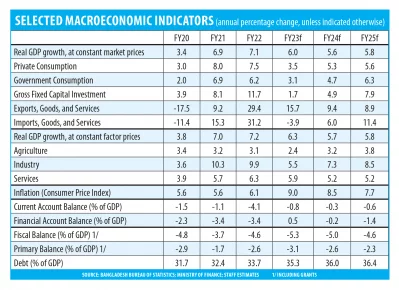
Due to persistent inflationary pressures and external sector challenges, the global lender projected a 5.6% economic growth in Bangladesh for the current fiscal, in its update, which it publishes twice a year.
In April, the World Bank had projected a 6.2% GDP growth for Bangladesh in FY24.
The government, on the other hand, has set a 7.5% GDP growth target for FY24.
Elevated inflation will continue to limit real wage growth, reducing private consumption growth. Investments are expected to remain constrained by foreign exchange, import suppression measures, growing financial sector vulnerabilities, and energy shortages.
Government investment is likely to stay resilient due to mega project implementation, while industrial and services growth is expected to remain below historical averages.
Growth in agriculture is expected to recover, unless disrupted by floods and other natural disasters. GDP growth is projected to gradually rise to 5.8% in FY25, driven by easing inflationary pressures, alleviation of complementary input shortages, gradual external sector normalization, and reduced uncertainty.
“Bangladesh’s progress in reducing poverty is multidimensional - it has improved poor people’s wellbeing, including in reduced infant mortality and stunting, and improved access to electricity, sanitary toilets, and education. The rural areas witnessed faster poverty reduction than the cities and towns,” said Abdoulaye Seck, World Bank country director for Bangladesh and Bhutan.
Asked why it was important to continue reforms, given the looming election and economic condition in Bangladesh, he responded: “Inflation has almost reached double digits. Poor people have to consume 90% of what they earn. So inflation should be brought down. And for this, policy adjustment should be continued.”
There are elections ahead, reforms generally stop at this time in many countries. However, in this consideration and in this condition, financial reforms in Bangladesh should not be delayed.
“Despite these gains, inequality has slightly narrowed in rural areas and widened in urban areas. The World Bank stands ready to support Bangladesh to take on urgent reforms to accelerate inclusive economic growth.”
Managing inflation
The report also added that reforms to address inflation, through monetary and fiscal policies, as well as financial sector vulnerabilities will be critical for the country to sustain growth and poverty reduction.
A single market-based exchange rate would help attract foreign currency inflows through formal channels and support the balance of payment and reserve accumulation.
Nazmus Sadat Khan, economist at the World Bank Dhaka office, and Bernard James Haven, senior economist at the World Bank, presented the keynote paper, which mentioned that inflation was expected to decline gradually in the medium term.
High administered energy prices and their spillover effects on other sectors, the continued depreciation of the Taka, continued restrictions on imports, insufficient US dollars in the banks, and sluggish monetary tightening are expected to keep inflation at an elevated level in FY24.
Despite the government's efforts to provide essential food items to low-income groups at subsidized rates, inflation is anticipated to disproportionately affect the poor.
Improved transmission of monetary policy through the relaxation of interest rate caps, easing of foreign exchange shortage through exchange rate flexibility and the consequent normalization of imports are likely to help ease inflationary pressure gradually in the medium term.
Regarding Bangladesh’s monetary policy, the WB report said: "Monetary policy needs to be contractionary until inflation recedes to the target. Monetary policy transmission would be improved by greater interest rate flexibility and reduced use of non-market national savings certificate instruments for government borrowing.
“However, the continued reliance on bank borrowing to finance the government budget deficit as envisioned in the FY24 budget would continue to pressure banking sector liquidity, potentially crowding out of the private sector. BB has lowered its private sector credit growth target and increased the public sector credit growth target for FY24."
It also said that supported by economic growth, Bangladesh improved living conditions and reduced extreme poverty to 5.0% in 2022 from 9.0% in 2016, which is comparable to Latin America and the Caribbean countries and fares better than the South Asian average.
The new poverty numbers are based on the international poverty line of $2.15 a day (using 2017 Purchasing Power Parity) and the Bangladesh Bureau of Statistics (BBS)’s Household Income Expenditure Survey 2022 and re-estimation for 2016.
The report also mentioned that addressing long standing structural reforms could accelerate the pace of the recovery and strengthen resilience to future shocks. Bangladesh’s expected graduation from the UN’s Least Developed Country (LDC) status in 2026 will present new challenges.
Bangladesh will need to strengthen its trade competitiveness, expand bilateral and multilateral free trade agreements, strengthen financial sector stability and soundness, improve business climate to attract investment, improve domestic resource mobilization, address climate change adaptation and mitigation, and improve the governance framework.
Reforms in these priority areas would promote Bangladesh’s development and accelerate poverty reduction.
South Asian development
The report’s companion piece, the latest "South Asia Development Update - Toward Faster, Cleaner Growth," also released today, said South Asia is expected to grow by 5.8% this year - higher than any other emerging and developing region in the world, but slower than its pre-pandemic pace and not fast enough to meet its development goals.
The regional report forecasts growth to slow to 5.6% in 2024 and 2025 in South Asia, as post-pandemic rebounds fade and a combination of monetary tightening, fiscal consolidation, and reduced global demand weigh on economic activity.
Growth prospects are subject to downside risks, including due to fragile fiscal positions.
Government debt in South Asian countries averaged 86% of GDP in 2022, increasing the risks of defaults, raising borrowing costs, and diverting credit away from the private sector.
The region could also be affected by a further slowdown in China’s economic growth and natural disasters made more frequent and intense by climate change.
“While South Asia is making steady progress, most countries in the region are not growing fast enough to reach high-income thresholds within a generation,” said Martin Raiser, World Bank vice-president for South Asia.
“Countries need to urgently manage fiscal risks and focus on measures to accelerate growth, including by boosting private sector investment and seizing opportunities created by the global energy transition.”
Constrained by fiscal challenges, South Asian governments have limited room to help their economies fully capitalize on the global energy transition.
For South Asia, the energy transition could present an opportunity for future growth and job creation - if it leads to more investments by firms, cuts air pollution, and reduces the reliance on fuel imports.
“South Asia’s energy intensity of output is about twice the global average and the region lags in the adoption of more advanced energy-efficient technologies,” said Franziska Ohnsorge, World Bank chief economist for South Asia.
“Improvements in energy efficiency, in the context of a rapid global energy transition, are an opportunity for South Asia to make progress toward both environmental and economic goals.”
