




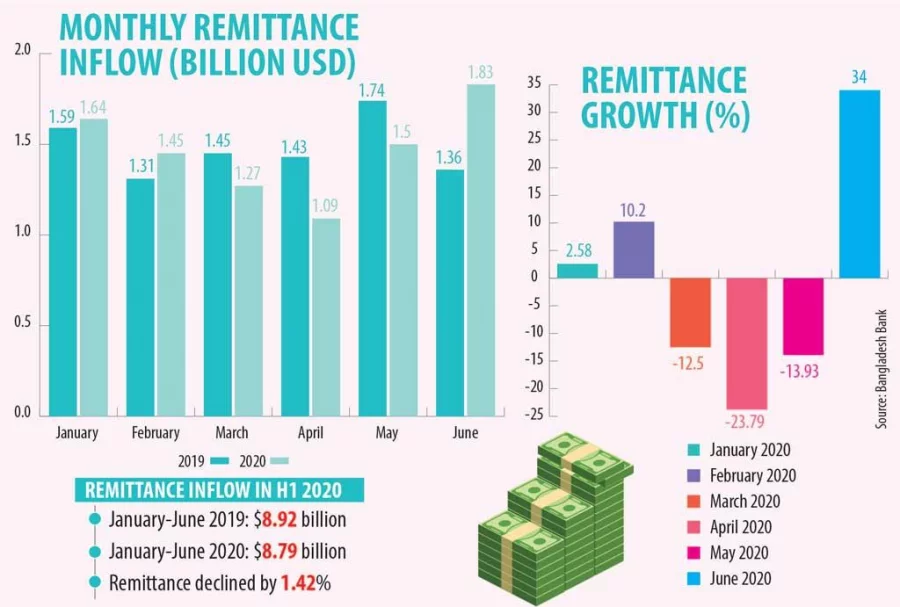
The inflow of remittance has declined by 1.42% to $8.79 billion in the first half (January to June) of this year as Covid-19 pandemic battered most of the global economies.
The country received $8.92 billion between the January to June period of the previous year.
According to the Bangladesh Bank data, the remittance inflow rose 2.58% to $1.64 billion in January of this year; the inflow registered 10.20% growth to $1.45 billion in February.
The inflow started to decline from March this year when the Covid-19 pandemic spread to different countries of the world and lockdowns were imposed.
Remittance inflow declined by 12.50% to $1.27 billion in March; the inflow fell 23.79% to $1.09 billion in April; remittance inflow also went down 13.93% to $1.50 billion in May, as per central bank data.
Bankers say restriction on international travel, enforcing complete lockdown, and shutting down remittance houses, banks, and business centres in countries where most Bangladeshis are employed could be the key factors behind the downward trend of remittance inflow.
However, the inflow of remittance rose 34% to $1.83 billion in June, which is the highest in a single month. Previously, the highest amount of remittance amounting to $1.74 billion was in May last year, as per BB data.
Also Read - Remittances, forex reserves hit record highs
“Although the Bangladeshi expatriates are facing various disruptions due to the struggling economies they reside in, they did not stop sending money to their relatives in the country. As a result, the inflow of remittance has increased in June,” Dr Zaid Bakht, Chairman, Agrani Bank Limited, told Dhaka Tribune.
Between January to June, remittances have been steadily declining from January to April, then the inflow picked up in May to June, as per the central bank data.
Remittance inflow hit a new record of $18.20 billion in the just concluding fiscal year. The inbound remittance surged by 10.87% to $18.20 billion in the last fiscal year.
Talking to Dhaka Tribune, Policy Research Institute (PRI) Executive director Ahsan H Mansur, said: “The amount of money Bangladeshi expatriates sent during this pandemic was not of their recent income.”
“The reason they sent such a huge sum of remittance was out of their fear that they might have to return home in the near future as many of those who work in the Middle Eastern countries have lost their jobs due to significant decline in oil prices,” he added.
“A good number of migrant workers will lose their jobs and return to Bangladesh from different countries owing to the worldwide crisis created by the Covid-19 pandemic,” he said.
According to government estimation, over 0.1 million Bangladeshi workers returned home jobless, so far, since the outbreak of coronavirus in early March.
A large number of Bangladeshi migrants became jobless in Saudi Arabia, the UAE, Kuwait, Oman, Bahrain, and the Maldives due to the economic recession brought over by the pandemic.
Besides, many Bangladeshi migrants in European countries also became jobless due to the coronavirus pandemic, industry insiders said.
Currently, there are over 10.2 million Bangladeshis working in 174 countries across the world.
