



 Meanwhile, the board of the bank has been requesting Bangladesh Bank for long time to allow the bank to maintain high Advance Deposit Ratio (ADR) because of releasing some big deposits, said a senior executive of the central bank.
It is noted here that if the deposit figure of a bank decrease and the loan goes up, the ADR will be higher.
In response to the bank’s request, the central bank has relaxed the ADR limit for the BASIC Bank recently, so the bank can come out from the loss.
The ADR of BASIC Bank went up to 91.90% as of September this year which is beyond the authorised limit of 80%, according to the central bank data.
The total deposit of the bank stood at Tk13,626 crore as of September which was Tk14,066 crore in December last year.
The top boss of BASIC bank has, however, identified higher administrative cost as a major cause behind the huge loss.
“We are trying to reduce our administrative costs by cutting extra benefits offered to the high officers. But the high number of employs is still major concern for the bank,’’ said Majid.
The capital shortfall of the bank stood at Tk2,423 crore as of December even after the capital support of Tk790 crore by the government in 2014.
A Bangladesh Bank inspection detected many irregularities in four branches of the state-owned BASIC Bank-Motijheel, Shantinagar, Dilkusha and Gulshan branches that involved loans of around Tk4,425 crore in between December 2009 and November 2012.
As the bank fell in severe financial crisis after the largest loan scam, the government dissolved the board of the bank in 2014. Later on, a new board took over the charge of bank and adopted a fresh strategy to revive the bank from a possible collapse.
Meanwhile, the board of the bank has been requesting Bangladesh Bank for long time to allow the bank to maintain high Advance Deposit Ratio (ADR) because of releasing some big deposits, said a senior executive of the central bank.
It is noted here that if the deposit figure of a bank decrease and the loan goes up, the ADR will be higher.
In response to the bank’s request, the central bank has relaxed the ADR limit for the BASIC Bank recently, so the bank can come out from the loss.
The ADR of BASIC Bank went up to 91.90% as of September this year which is beyond the authorised limit of 80%, according to the central bank data.
The total deposit of the bank stood at Tk13,626 crore as of September which was Tk14,066 crore in December last year.
The top boss of BASIC bank has, however, identified higher administrative cost as a major cause behind the huge loss.
“We are trying to reduce our administrative costs by cutting extra benefits offered to the high officers. But the high number of employs is still major concern for the bank,’’ said Majid.
The capital shortfall of the bank stood at Tk2,423 crore as of December even after the capital support of Tk790 crore by the government in 2014.
A Bangladesh Bank inspection detected many irregularities in four branches of the state-owned BASIC Bank-Motijheel, Shantinagar, Dilkusha and Gulshan branches that involved loans of around Tk4,425 crore in between December 2009 and November 2012.
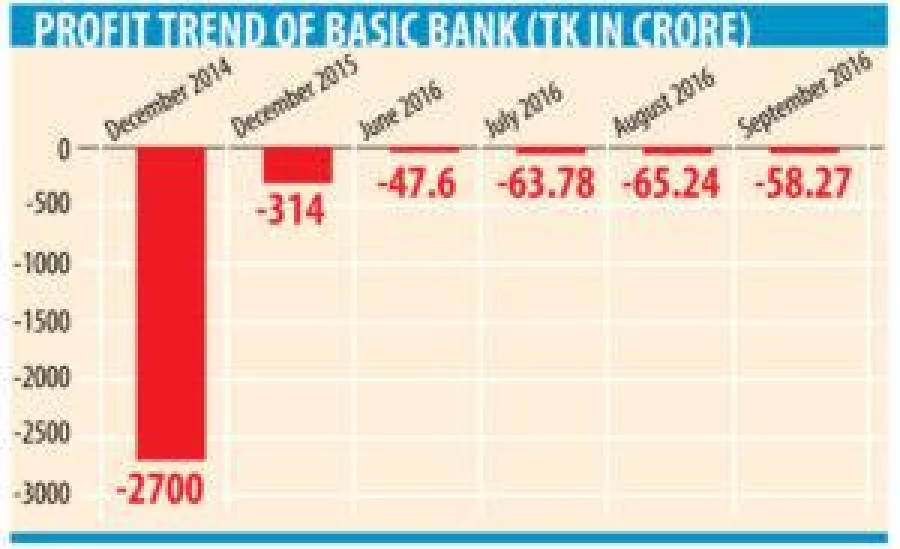
As the bank fell in severe financial crisis after the largest loan scam, the government dissolved the board of the bank in 2014. Later on, a new board took over the charge of bank and adopted a fresh strategy to revive the bank from a possible collapse.The net loss of the bank came down to over Tk58 crore in September this year from the total loss of Tk314 crore in December last year.
The bank had earlier incurred the highest amount of loss worth around Tk2,700 crore in the year 2014, according to Bangladesh Bank data.
While talking to the Dhaka Tribune, BASIC Bank Chairman Alauddin A Majid said: “As the bank has released some high cost large deposits in an attempt to reduce the expenses, it ultimately contributed to shrink the overall loss.”
“Loan rescheduling has also helped the bank to increase its interest income,” said Majid with a hope that the bank will see operating profits at the end of the year.
The bank plunged into a loss of Tk53 crore for the first time in the year 2013 since its inception, compared to the net profit of over Tk2 crore in 2012.
The loss increased by 153.52% during the year 2014 as the bank witnessed a negative growth with the piling of the default loans over the years.
BASIC Bank rescheduled total loans of Tk4,170 crore during two years from 2015 to September this year. Despite huge loan rescheduling, the classified loan rate remained high at 52.52% as of September. Meanwhile, the board of the bank has been requesting Bangladesh Bank for long time to allow the bank to maintain high Advance Deposit Ratio (ADR) because of releasing some big deposits, said a senior executive of the central bank.
It is noted here that if the deposit figure of a bank decrease and the loan goes up, the ADR will be higher.
In response to the bank’s request, the central bank has relaxed the ADR limit for the BASIC Bank recently, so the bank can come out from the loss.
The ADR of BASIC Bank went up to 91.90% as of September this year which is beyond the authorised limit of 80%, according to the central bank data.
The total deposit of the bank stood at Tk13,626 crore as of September which was Tk14,066 crore in December last year.
The top boss of BASIC bank has, however, identified higher administrative cost as a major cause behind the huge loss.
“We are trying to reduce our administrative costs by cutting extra benefits offered to the high officers. But the high number of employs is still major concern for the bank,’’ said Majid.
The capital shortfall of the bank stood at Tk2,423 crore as of December even after the capital support of Tk790 crore by the government in 2014.
A Bangladesh Bank inspection detected many irregularities in four branches of the state-owned BASIC Bank-Motijheel, Shantinagar, Dilkusha and Gulshan branches that involved loans of around Tk4,425 crore in between December 2009 and November 2012.
As the bank fell in severe financial crisis after the largest loan scam, the government dissolved the board of the bank in 2014. Later on, a new board took over the charge of bank and adopted a fresh strategy to revive the bank from a possible collapse.
Meanwhile, the board of the bank has been requesting Bangladesh Bank for long time to allow the bank to maintain high Advance Deposit Ratio (ADR) because of releasing some big deposits, said a senior executive of the central bank.
It is noted here that if the deposit figure of a bank decrease and the loan goes up, the ADR will be higher.
In response to the bank’s request, the central bank has relaxed the ADR limit for the BASIC Bank recently, so the bank can come out from the loss.
The ADR of BASIC Bank went up to 91.90% as of September this year which is beyond the authorised limit of 80%, according to the central bank data.
The total deposit of the bank stood at Tk13,626 crore as of September which was Tk14,066 crore in December last year.
The top boss of BASIC bank has, however, identified higher administrative cost as a major cause behind the huge loss.
“We are trying to reduce our administrative costs by cutting extra benefits offered to the high officers. But the high number of employs is still major concern for the bank,’’ said Majid.
The capital shortfall of the bank stood at Tk2,423 crore as of December even after the capital support of Tk790 crore by the government in 2014.
A Bangladesh Bank inspection detected many irregularities in four branches of the state-owned BASIC Bank-Motijheel, Shantinagar, Dilkusha and Gulshan branches that involved loans of around Tk4,425 crore in between December 2009 and November 2012.
As the bank fell in severe financial crisis after the largest loan scam, the government dissolved the board of the bank in 2014. Later on, a new board took over the charge of bank and adopted a fresh strategy to revive the bank from a possible collapse.
Meanwhile, the board of the bank has been requesting Bangladesh Bank for long time to allow the bank to maintain high Advance Deposit Ratio (ADR) because of releasing some big deposits, said a senior executive of the central bank.
It is noted here that if the deposit figure of a bank decrease and the loan goes up, the ADR will be higher.
In response to the bank’s request, the central bank has relaxed the ADR limit for the BASIC Bank recently, so the bank can come out from the loss.
The ADR of BASIC Bank went up to 91.90% as of September this year which is beyond the authorised limit of 80%, according to the central bank data.
The total deposit of the bank stood at Tk13,626 crore as of September which was Tk14,066 crore in December last year.
The top boss of BASIC bank has, however, identified higher administrative cost as a major cause behind the huge loss.
“We are trying to reduce our administrative costs by cutting extra benefits offered to the high officers. But the high number of employs is still major concern for the bank,’’ said Majid.
The capital shortfall of the bank stood at Tk2,423 crore as of December even after the capital support of Tk790 crore by the government in 2014.
A Bangladesh Bank inspection detected many irregularities in four branches of the state-owned BASIC Bank-Motijheel, Shantinagar, Dilkusha and Gulshan branches that involved loans of around Tk4,425 crore in between December 2009 and November 2012.
As the bank fell in severe financial crisis after the largest loan scam, the government dissolved the board of the bank in 2014. Later on, a new board took over the charge of bank and adopted a fresh strategy to revive the bank from a possible collapse.