




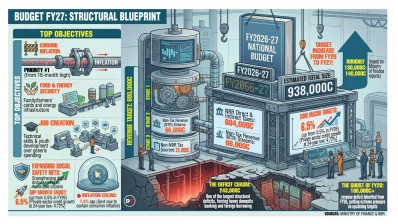
The government, led by Finance Minister Amir Khasru Mahmud Chowdhury, is scheduled to propose a national budget layout of approximately Tk938,000 crore for the upcoming fiscal year 2026-27 (FY27) in the national parliament Thursday.
Positioned as the Bangladesh Nationalist Party (BNP)-led administration's first full-scale financial blueprint since 2006, the proposed fiscal policy shifts away from traditional, spending-heavy frameworks.
The administration intends to recalibrate public spending as a targeted mechanism for domestic social welfare, macro-stabilization, and private sector revitalization amid persistent inflationary pressures.
Policy planners are gambling on a "production-oriented tax policy" that balances aggressive structural net-widening with extensive fiscal concessions.
The central economic narrative focuses on whether this strategy can successfully inject momentum into a stagnant labor market while providing immediate price stability for ordinary citizens.
To sustain this massive expenditure framework, the state has fixed its total revenue mobilization target at an unprecedented Tk695,000 crore, representing an aggressive 20% expansion over the outgoing year's revised baseline.
The government's core mobilization strategy explicitly splits this historic Tk695,000 crore revenue target across three distinct financial pipelines.
The National Board of Revenue (NBR) direct and indirect taxes are budgeted to generate the lion's share at Tk604,000 crore.
Non-NBR tax sources are slated to bring in Tk25,000 crore, while Non-Tax Revenue (NTR) streams are projected to contribute the remaining Tk66,000 crore.
Rather than lifting baseline corporate or individual income tax rates, the revenue board aims to achieve this aggressive 20% collection jump by optimizing compliance, expanding the direct tax net, and deploying advanced technology-driven tracking networks at production points.
Executing this strategy depends entirely on hitting these targets, which macroeconomists fear could prove difficult given that the revenue shortfall breached the Tk100,000 crore mark within the first nine months of the current fiscal year alone due to cooling commercial activity and high inflation.
Consumer relief vs. targeted tax hikes
In a direct move to lower the baseline cost of living, the withholding tax on roughly 60 core essential daily commodities is dropping from a multi-tiered 1%–5% framework to a uniform 0.5%.
This immediate waiver will systematically impact bulk items, including paddy, rice, wheat, pulses, potatoes, onions, garlic, fish, meat, sugar, and edible cooking oils.
Furthermore, life-saving medical supplies—including imported cardiac stents, intraocular lenses, and critical oncology medicines—will receive absolute VAT and tariff waivers.
The NBR will also completely dismantle supplementary duties on 68 raw chemical ingredients used in domestic pharmaceutical manufacturing.
Conversely, the state is imposing heavy fiscal penalties on luxury consumer goods, tobacco products, and foreign agricultural items to secure domestic revenue lines.
Retail cigarette prices are slated to escalate by Tk5 to Tk7 per pack, backed by a staggering 300% supplementary duty on cigarette filter paper and an unprecedented 350% levy on imported industrial nicotine.
Imported food items will experience sharp price hikes as customs duties on imported cashew nuts surge from 5% to 25% to protect local growers.
Imported Pangasius fillets will face a new 20% supplementary duty, while premium foreign frozen fish will attract a 15% VAT framework.
High-end packaged foodstuffs—such as foreign chocolates, wafers, potato chips, and processed juices—will see steep import-stage tax escalations.
Additionally, luxury cosmetics, imported makeup, high-end perfumes, and foreign spirits will face higher import-stage VAT and customs tariffs.
Digital and structural reforms
To automate the revenue pipeline, individual taxpayers will now have the statutory opportunity to submit income tax returns at any point during the fiscal year.
To eliminate the historical complexity of rolling deadline extensions, the NBR is dividing the fiscal year into four distinct quarters.
Under this new structure, filing an income tax return in the first quarter (July to September) guarantees a direct tax deduction of 5% of the total tax paid, or a maximum of Tk25,000.
Filings completed in the second quarter (October to December) incur no penalty but receive zero fiscal incentives, while late filers in subsequent quarters face strict interest penalties.
The state is simultaneously reducing investment-related tax concessions from 15% of the total approved investment to 10% of the approved investment, capped at a maximum of Tk7.50 lakh.
In tandem, the NBR is pushing through sweeping changes to expand the direct tax net by making Taxpayer Identification Numbers (TINs) mandatory for opening and operating both new and existing bank accounts.
Additionally, a 15% capital gains tax will be imposed on profits realized from the transfer and sale of registered capital assets, including gold ornaments, silver, precious stones, digital currencies, paintings, and exclusive club memberships.
For corporate compliance relief, a statutory system is being launched to guarantee the electronic refund of excess taxes paid through verified bank channels within 60 business days.
ADP focus, safety net overhaul
To directly insulate lower-income households from economic shocks, the government is shifting the upcoming Annual Development Program (ADP) away from un-targeted public expenditures toward structured social welfare allocations.
The layout redirects substantial state resources into verified, card-based cash transfers, expanding financial stipends with a specific Tk1,081 crore allocation to support 256,000 local religious personnel.
A dedicated monthly honorarium of up to Tk20,000 will be permanently instituted for families of martyrs and individuals who sustained severe injuries during the July uprising.
Furthermore, the NBR will extend the absolute value-added tax (VAT) exemption on Dhaka Metro Rail ticket fares for another full fiscal year to shield over 350,000 daily urban commuters from inflation.
To support sustainable livelihoods, the budget also grants complete VAT exemptions on eco-friendly consumer goods, including items made from betel nut husks, hogla leaves, and traditional clay pottery.
Widening the SME net
For small and medium enterprises (SMEs), the mandatory filing of VAT return forms will transition from a monthly framework to a consolidated quarterly schedule, cutting the annual compliance workload down from twelve submissions to four.
The budget also establishes total automation for online VAT registration and stipulates that businesses managing inventory through integrated Enterprise Resource Planning (ERP) software will be exempted from submitting physical paperwork during routine digital audits.
However, the state is aggressively expanding its active VAT registration base from 800,000 entities to an ambitious long-term target of 2 million enterprises.
The statutory baseline threshold for mandatory VAT registration is being slashed from an annual commercial turnover of Tk30 lakh down to Tk20 lakh.
This structural shift means small neighborhood retail shops averaging daily sales of just Tk5,500 will be pulled into the formal tax tracking net.
To enforce this expansion, a verified Business Identification Number (BIN) will be strictly mandatory to open commercial bank accounts, register land deeds, and maintain mobile financial service merchant accounts.
Macroeconomic risks
The financial framework projects a massive overall budget deficit of approximately Tk243,000 crore, representing roughly 3.6% of the country’s Gross Domestic Product (GDP).
To plug this gap, state planners intend to secure Tk116,000 crore in net foreign financing and Tk127,000 crore from domestic sources.
Specifically, the plan to borrow a net Tk112,000 crore directly from the domestic banking sector has triggered fresh anxieties among macroeconomists.
