




The amount of dollars spent on education abroad by Bangladeshi students is increasing rapidly.
The number of Bangladeshi students going abroad has more than doubled in a decade; in 15 years it has tripled.
But the dollar expenditure on education overseas has also increased so rapidly that it has more than doubled in just five years.
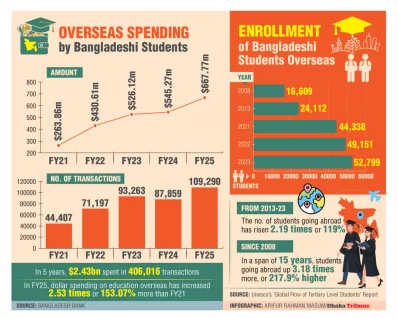
In the last five years, Bangladeshi students going abroad have spent a total of $2,433.63 million.
Out of this, students spent $667.77 million in FY25 alone, which is a record high for a single year. This expenditure is 2.53 times, or 153.07%, more than FY21.
According to data received from Bangladesh Bank, greenback expenditure is 22.46% more in FY25 than in FY24.
That is, in FY25, Bangladeshi students abroad have spent $122.5 million more from the country's reserves compared to the previous fiscal year.
Data analysis shows that Bangladeshi students have spent $263.86 million through 44,407 transactions in the banking channel in FY21.
In FY22, 71,197 transactions were completed in this sector, during which $430.61 million was spent.
In FY23, through 93,263 transactions, $526.12 million was spent by Bangladeshi students.
Although the number of transactions in this sector decreased to 87,859 in FY24, compared to the previous year, the total expenditure increased to $545.27 million.
And in FY25, $667.77 million was spent through 109,290 banking transactions by Bangladeshi students abroad.
Movement
The latest number of students who have migrated from Bangladesh abroad for educational purposes is not known.
However, this dollar expenditure proves that the number of people leaving the country is increasing rapidly every year.
A Unesco report titled “Global Flow of Tertiary Level Students,” published last year shows that in 2023, 52,799 students from Bangladesh went to 55 countries for tertiary education.
The report also shows that in 2013 only 24,112 students went abroad from Bangladesh.
In 2022, this number was 49,151, and in 2021, the number of Bangladeshi students going abroad for study was 44,338.
Analyzing the data from 2013 to 2023, it is seen that the number of students going abroad has more than doubled, exactly 2.19 times and 119%.
Data analysis also revealed that since 2008, within 15 years, students going abroad have become 3.18 times more, or 217.9% higher; that means in that year only 16,609 Bangladeshi students went abroad.
Breakdown
The UN report on the destination of higher education abroad shows that the United States is the top choice destination for Bangladeshi students for higher education abroad. In 2023 alone, a total of 8,524 students went to the United States from Bangladesh.
Earlier, in 2022, 8,665 Bangladeshi students were admitted to various universities in the United States for higher education.
Apart from the United States, students have also listed countries like the United Kingdom, Canada, Malaysia, and Germany as their preferred countries for higher education.
More than half of the total students (52,799) have migrated to these countries, respectively.
Of these, 6,586 students have left Bangladesh for higher education in the United Kingdom, 5,835 in Canada, 5,714 in Malaysia, and 5,046 in Germany.
Why it is rising
Is Bangladesh moving towards a talent crisis? It is becoming a million-dollar question now.
Labib Jahangir, CEO of Aspire Academy, told Dhaka Tribune, “As I have seen in recent years, more and more students are choosing to study abroad. This number is easily increasing year after year. I think most of the students are choosing this because of the chaotic situation of our country. Moreover, the job crisis and low salary in Bangladesh are playing a crucial part as well.”
Citing an example, he said: “Quoting one of my students: ‘No one wants to complete his graduation by spending Tk10-15 lakh and get a job with a starting salary of Tk20,000 a month.’”
To analyze the study destination, he noted that “Countries like Australia, the UK, Canada, and the US have always been popular and still remain in demand.
However, countries that have a lower tuition fee are gaining popularity too, such as South Korea, Cyprus, Malaysia, etc.
Previously, studying abroad was a thing that only rich families got to afford, but now it is something middle-class people can look forward to too.
In recent years, Japanese language schools have seen a huge growth in applicants because of the country's pay scale. This leads to most of the Bangladeshi students studying in Japan paying their tuition plus sending money back home to support their families.
Other side of coin
Jahangir remarked, “Overall, I think there are a couple of reasons for this situation, not just one. The tuition fees for most of the countries have dramatically increased throughout the years. I can speak from my personal experience, as I finished my bachelor's abroad. Back in 2017, when I enrolled in Algoma University, the yearly tuition fee was about CAD $15,000, whereas now it is approximately CAD $25,000. Moreover, even the job crisis is also a problem that most of the countries are facing. Countries like Canada, the US, and the UK, and even countries in Europe, are in the middle of a recession, which is why it is becoming harder for the students to pay for their own living costs, let alone tuition fees. Due to this, students need to take more money from Bangladesh to support themselves abroad, far more than before.”
Voicing frustration, Nilima Haque, a student at the University of Windsor, Canada, told Dhaka Tribune, “Beyond education and jobs, I also wanted a sense of freedom and security in daily life, which I could not always feel back home.”
“The fragile state of law enforcement, coupled with the recent outbreaks of mob violence against women, students, and ordinary citizens, has been deeply unsettling. For me, that is why staying in Canada feels like a safer and more promising future,” Haque explained.
“Many people come to study abroad with good scholarships, but initially, they need a large amount of money. I also had to bring money from the country in the same way. Moreover, the cost of education has also increased a lot in the last few years,” she added.
Nilima observed that students are compelled to carry not only tuition fees but also substantial living expenses when moving abroad for education. At a time when the country is grappling with economic challenges, this outward flow of funds represents a considerable financial drain. Instead of being invested to build opportunities at home, this money is leaving Bangladesh every year.
Prof. Mohammad Nure Alam Siddique of the Institute of Education and Research (IER), Dhaka University, also believes that economic, social, and political factors are significantly contributing to the increasing trend of students going abroad, alongside the lack of quality educational institutions in the country.
He told Dhaka Tribune, “The quality of educational institutions has not improved as much as the number of government and private institutions established in recent decades. I think this is the right time for the government and institutions to take proactive steps.”
“However, opportunities for employment and a better living environment abroad are strongly attracting students, especially since job options in our country, particularly economically, are very limited. Additionally, political instability is a major factor, which results in 99% of students settling abroad once they go.”
Regarding the money spent on education abroad, he stated, “I think that earlier, only children of upper-class families could study abroad, but now even middle-class families can send their children there (because the country's economy has grown in the last decades).”
“However, what I regret is that those who study in government universities in the country, for whom the state has spent money, go abroad and settle there,” he lamented.
