



The Bangladeshi Taka strengthened by Tk2.75 against the US dollar in the first two weeks of July. In just a day, the greenback's rate eased by Tk1.10 to stand at Tk120.10.
The last time the dollar rate was Tk120 was on January 1 this year.
Due to such volatile behavior of the dollar market, Bangladesh Bank (BB) has purchased dollars from the market as prescribed by the International Monetary Fund (IMF).
Although the commercial banks offered prices that were within Tk120 on the first day of the week, on Sunday (July 13) Bangladesh Bank bought $171 million from the market at Tk121.50.
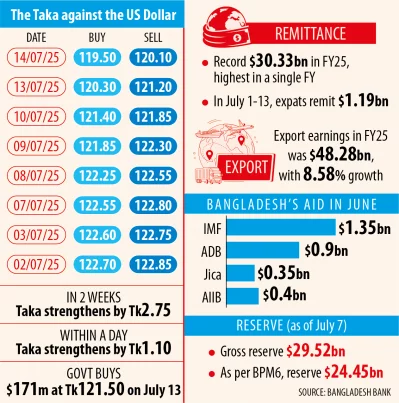
According to central bank official data, the interbank USD/BDT exchange rate on Monday was a buying/low rate of Tk119.50 and a selling/high rate of 120.10.
On July 13, the dollar buying/low and selling/high rate was Tk120.30 and Tk121.20. On July 10, it was Tk121.40 and Tk121.85; on July 10, it was Tk121.85 and Tk122.30; on July 8, it was Tk122.25 and Tk122.55; on July 7, it was Tk122.55 and Tk122.80; on July 3, it was Tk122.60 and Tk122.75; and on the first banking day of FY26, July 2, it was Tk122.70 and Tk122.85 respectively.
Why the dollar rate eased
Bankers and economists told Dhaka Tribune that record remittance inflow and export growth, along with loan disbursements from development partners, helped improve banks’ Net Open Position (NOP), and there is no big shortfall in the current account, which bolstered Bangladesh Bank’s forex reserves, subsequently bringing down the dollar rate.
The head of treasury at a private bank, seeking anonymity, told Dhaka Tribune that demand and supply have always been key factors in the dollar market.
“Mainly, there are fundamental and technical reasons behind this. Fundamentally, considering the last two years, the dollar supply has reached one of its strongest positions now. Both remittance and export earnings have risen. Besides, we don't have a big shortfall in our current account. Now it's probably around $1,300 million. The NOP of the banks is also in good shape. As a result, the reserves are increasing. This is reducing the pressure on the dollar market, so the taka is getting stronger.”
“On the other hand, on the technical ground, since the dollar market is floating, it’s become more market-oriented and competitive,” he added.
Since the May 14 announcement to let the dollar float to meet IMF loan conditions by Bangladesh Bank, the exchange rate did not rise. Instead, it declined, and the Taka became stronger.
According to latest data from Bangladesh Bank, expatriates sent $1.19 billion in remittance through banking channels within the first 13 days of FY26.
In FY25, expatriate Bangladeshis sent a record $30.33 billion in remittances, marking the highest amount ever received in a single fiscal year in the country's history.
Also in the last fiscal, the country's export earnings witnessed an 8.58% growth, raising the total volume to $48.28 billion, which also helped strengthen the Taka against the US dollar.
Zahid Hussain, former World Bank lead economist for Dhaka, said that good remittance inflow and more exports, along with loan disbursements from development partners, helped improve forex reserves, which contributed to the lower exchange rate.
According to media reports, in late June, Bangladesh received $1.35 billion from the IMF, $0.9 billion from the ADB, $0.35 billion from JICA, and $0.4 billion from AIIB.
As of July 7, Bangladesh's gross foreign exchange reserves were $29.52 billion; as per BPM6, they were $24.45 billion.
BB on dollar buying spree
On July 13, Bangladesh Bank bought dollars from commercial banks in an auction.
The central bank is buying $171 million at Tk121.50 from 18 commercial banks under the new system.
Arif Hossain Khan, executive director and spokesperson of Bangladesh Bank, told Dhaka Tribune that the dollar's depreciation is also not positive for the currency market.
“We intervened to keep the market stable, so we bought $171 million, the lowest price of which was Tk121.50”.
Regarding this auction price, a head of the treasury of a renowned private bank, seeking anonymity, told Dhaka Tribune: “We offered the central bank a price around Tk120 to sell dollars in the auction, but the central bank has bought dollars at Tk121.50.”
Asked why the central bank was offering a higher price than the commercial banks’ expectations, Arif Hossain Khan told this correspondent: “We cannot directly intervene in price determination now. That is why the market is being stabilized by buying dollars from the market.
“For this, we are following the prescription of the IMF, where it is said that if a mid-rate is found and the market exceeds it by more than 2%, we will be able to handle it. And the auction rate of Tk121.50 has been fixed considering the market, as the dollar rate should be.”
Explaining further, a banker said: “In a panicked market, when our dollar flow is good, a situation was created where this rate would fall further. This would benefit importers, but exporters and expatriates who send remittances would be adversely affected. It’s also a threat of transactions increasing via Hundi. Even our FDI may fall.”
“I think, due to this, the central bank bought dollars at a higher price and signaled the market to go up.”
He also informed them that on Monday (July 14), they bought dollars at Tk121.30.
That means after the central bank's intervention through dollar buying, the price went up, signaling a probable upward trend of Tk121-122.
Is Taka getting stronger a good thing?
Any type of drastic fall in the money market is not good, according to experts.
Zahid Hussain elaborated: “Taka is getting stronger, so our import cost will be lower. It’s good for the overall economy. But exporters and remittance senders may get slightly lower rates, which will be no good for them. It needs to be ensured that the change won’t be so drastic.”
The bank official also informed that a continued fall in the dollar rate is not entirely good for the economy. It could hurt remittance inflows and exporters, thereby reducing foreign earnings.
Since the Covid-19 pandemic, the Taka began weakening against the dollar in 2022 due to instability in the foreign exchange market, driven by turmoil in both global and local economies. In July that year, the Bangladeshi currency had depreciated by about 30%.
