




The sugar-based local consumer market-cakes, chocolates, juice, biscuits is growing in Bangladesh and so are noncommunicable diseases, some related to high consumption of sugar.
Consuming excess sugar leads to a condition called insulin resistance, which is a precursor to type 2 diabetes, a fatty liver, and cardiovascular disease. Insulin is responsible for the body's absorption of glucose — or sugar — for energy. Those with insulin resistance experience a buildup of glucose in the blood, says doctors.
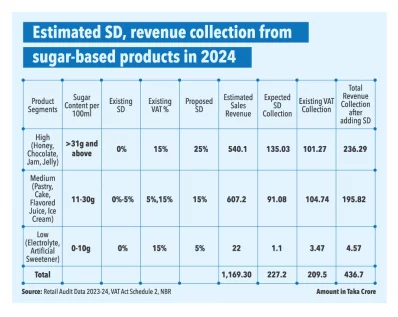
The local sugary foods industry pays only 5-15% VAT but no Supplementary Duty (SD) for any other sugar-based local product except for ice cream.
Industry insiders and economists think that the government has an opportunity for revenue from this untapped market, which is also unhealthy.
As per the retail audit data 2023-24 valuation, the government can collect an additional Tk227.2 crore from various sugar-based industries, like cake, biscuits, ice cream, candy, juices, etc.
Data shows that in 2024, sugar-based industries, minus the beverage industry, will have an estimated sales revenue of Tk1169.30 crore.
According to customs reports, the beverage industry, pharmaceuticals and beauty care industry altogether consume less than 4% sugar of the total imported sugar.
Most of it, more than 90% of sugar is used for confectionery, juice, condensed milk, candy, etc. and the rest is going to the open market for daily consumption.
As per the declaration of the customs authority, only a few industries use refined sugar in their production as raw materials and the rest are in open markets without any declaration.
It could be subject to discussion, whether there is any need for strict policy implementation at the sugar import level and impose taxes at source to avoid any leakages. This may also help restructure the tax formats.
Experts said, As the government is looking at taxing sugar-based products to ensure health parameters, they can introduce a segment-based Supplementary Duty (SD) taxation structure based on the level of sugar content in the products.
As per BSTI approvals, it is quite evident that there are so many high-sugar content products available in the market like jam, jelly, candy, and flavored juices.
These products are not essential products but rather treats and can be taxed more to reduce sugar consumption.
Seeking anonymity, a beverage industry insider told Dhaka tribune: “To meet the revenue target challenge, the National Board of Revenue (NBR) could think about examining the industries that aren't contributing much tax or have low-profit margins.”
“For instance--since there is no local production of sugar, Bangladesh has to maintain the balance of supply and demand by importing and refining raw sugar,” he also added.
Ahsan H Mansur, executive director of the Policy Research Institute (PRI) of Bangladesh feels that at least 15-20% SD can be imposed on this industry. “Tax hikes on sugar-based industries will not be unusual.”
As per section 55 imposition of supplementary duty under Value Added Tax and Supplementary Duty Act 2012, supplementary duty shall be imposable and payable on the import of goods, the supply of goods manufactured in Bangladesh and the supply of services rendered in Bangladesh.
Experts said, basically Supplementary Duty (SD) imposable on luxury goods, non-essential goods, to discourage the consumption of unhealthy goods etc.
They also highlighted that, as Bangladesh's revenue collection faces problems due to tax evasion and lower tax rates, the sugar industry, in particular, highlights this issue.
With high demand for imported sugar and allegations of duty evasion, the government can implement stricter policies on sugar imports, imposing taxes at the source, and restructuring tax formats. Furthermore, reviving sugar mills and promoting sugarcane as a profitable crop for farmers can boost the sector and attract foreign investments, leading to long-term economic benefits.
“By introducing a segment-based Supplementary Duty (SD) taxation structure based on sugar content, the government can collect additional revenue and promote healthier consumption habits. These measures can help Bangladesh meet its revenue targets and promote sustainable economic growth,” they also suggest.
Sugar import and sugar-based industry
Industry experts opine that the country’s demand for sugar is about 1.5 lakh tons per month. The demand increases by at least 50% during summer and the holy month of Ramadan.
The first 8 months of FY24 (till February) recorded a total of 9,82,000 tons of commercially imported sugar entering the market through the sea and land ports. The Customs Duty value of this import would be BDT 6,385 crores.
According to NBR, around 14,73,000 tons of total imported sugar will be imported by 5-7 companies over the FY2023-24.
The massive amount of imported sugar backs the production of various consumer items like juice, ice cream, chocolates, cakes and biscuits, jam and jelly, spreads, etc. These products have no supplementary duty to date.
There have also been allegations of duty evasion in the industry, with lower taxation of refined sugar being recorded than raw/unrefined sugar.
On the other hand, recent reports show that the Trading Corporation of Bangladesh (TCB) is set to further procure around 10 thousand tons of sugar (rated Tk160/kg) from the Bangladesh Sugar and Food Industries Corporation (BSFIC) under Direct Procurement Method (DPM). This has been approved in the sixth meeting of the Cabinet Committee on Government Purchase (CCGP) to satiate the added demand during the holy Ramadan.
The Bangladesh Trade and Tariff Commission reported that the annual consumption demand for sugar in Bangladesh is 2 to 2.2 million tons. Bangladesh annually imports about 2.2-2.4 million tons of raw sugar and nearly 50 thousand tons of refined sugar.
Opportunities and policies in tax collection
It has been speculated that the price of refined sugar at a certain point was about $100 more than that of raw sugar in the international market. Despite this, the taxation of refined sugar was held lower than that of unrefined sugar through various customs points, including Chittagong Custom House.
Given the massive consumption rate, the government can revive sugar mills in Bangladesh and make sugarcane a profitable crop for farmers, which is currently dying and losing the market.
With tax breaks and incentives, lucrative tax holidays and cash incentives on exports, industries like the agro-sector have experienced a positive impact. The government can consider facilitating other prospective industries with similar treatments for long-term economic benefits and stability. This may also attract FDIs, and eventually boost the overall economy.
Among the sugar-based products produced inside the country, A disparity is visible, as many sugar-based industries and products containing 0 to >31 grams of sugar per 100ml and have little to no SD, except for ice creams with 5% SD.
Regarding not implementing SD or low SD, the government and businesses were talking about the development of domestic industry.
Now the stakeholders think that it is logical to increase the duty on all types of sugar-based products produced in the country, and those are not good for health as well.
In that case, they think that it will be logical to determine SD by dividing it into three categories of sugar level: low (0-10 grams), medium (11-30 grams) and high (above 31 grams) as the amount of sugar per 100 ml of the product.
Analysis of VAT Act Schedule 2 and Retail Audit Data 2023–24 shows that, in the low category, products with low sugar content; 5% SD is imposed on those products, 15% on medium sugar-based products, and 25% SD on high-content sugar-based products, the annual revenue of the government will increase to Tk436.68 crore.
Which is Tk227.2 crore more than the revenue that may be earned from this sector.
However, The Center for Policy Dialogue (CPD) has already warned of an imminent shortfall of Tk82,000 crore by the end of FY 2023-24.
56.4% of the annual national budget for FY 2023-24 is expected to be covered by taxes administered by the National Board of Revenue (NBR).
The total revenue collection in the first 5 months (July-November) of the FY 2023-24 was Tk1,32,334 crores, while the target was Tk1,48,794 crores. There is already a critical deficit of Tk16,459 crores, and the rest of the months do not show much hope for alteration.
