




Bangladesh bagged $5.76 billion through exports in January – the first month of the calendar year 2024 – fetching an 11.45% year-on-year (YoY) growth, according to recent data published by the Export Promotion Bureau (EPB).
During the same period last year, the country earned $5.13 billion from export earnings. The export returned positive after a negative trend of several months.
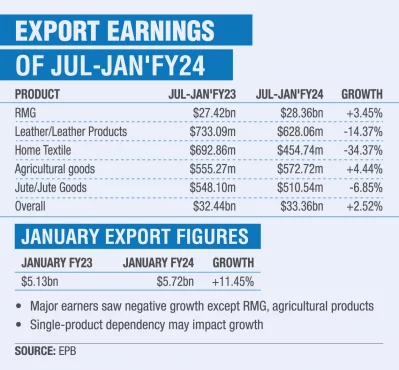
In January, the readymade garment (RMG) – the highest export earner – earned $4.97 billion, fetching a growth of 12.45% from $4.42 billion in the last FY.
According to the EPB data, the earnings from exports in the first seven months (July-January) of the current fiscal year (FY2023-24) experienced a narrow YoY growth of 2.52% to $33.26 billion, higher than $32.44 billion in the mentioned period of the last fiscal year (FY2022-23).
During the first seven months of FY24, the RMG sector bagged $28.36 billion, fetching a YoY growth of 3.45% from $27.41 billion in the mentioned period of FY23.
Among apparel products, knitwear export reached $16.17 billion, while export from woven items was $12.18 billion with 8.15% positive growth and 2.2% negative growth respectively, compared to FY23.
Export from other sectors
However, except for a thin positive growth of the RMG sector, export earnings from all the major sectors witnessed negative growth in the July-January period of FY24.
Among other notable sectors, home textile marked a negative growth of 34.37% to $454.74 million, down from $692.86 million in the mentioned period of last fiscal.
Leather and leather goods also experienced a negative growth of 14.33% to $628.06 million, which was $733.09 million in the first seven months of FY24.
In the July-January period of FY24, the export earnings from agricultural products stood at $572.72 million, fetching a positive growth, after a mentionable period, of 4.44% from $548.39 million in the same period of last fiscal.
Export receipts from jute and jute goods again experienced negative growth of 6.85% to $510.54 million, down from $548.10 million in July-January of FY23, EPB data stated.
Another potential export sector, engineering products, again fetched a negative growth of 6.41% to $289.19 million, down from $309.01 million in the same period of last FY.
Earlier, Faruque Hassan, president of the Bangladesh Garment Manufacturers and Exporters Association (BGMEA), said that most of the western buyers have been enjoying very good sales since last November due to festivals like Thanksgiving, Black Friday, Christmas, Boxing Day etc as their economy is likely to be stable after a slowdown.
“As a consequence of their sales growth in January our export was better. Moreover, brands are expected to boost their apparel sourcing from Bangladesh as they are expected to successfully clear their inventory over the past year thanks to decline in inflation in the US,” he added.
However, when exporters are expecting a surge in apparel orders from global buyers starting from the second quarter of this year, that time the withdrawal of cash incentive will impact the business, he expressed concern.
Fazlee Shamim Ehsan, the vice-president of the Bangladesh Knitwear Manufacturers and Exporters Association (BKMEA), said that the apparel export in January reached a new milestone, which is about $5 billion for the first time in a single month.
“There were additional goods shipments in January that were originally scheduled to be shipped in December. This delay was due to the Christmas holidays in western countries,” he added, mentioning that they are now exporting for the summer season.
The countries belonging to the Organization for Economic Co-operation and Development (OECD) are expected to witness a decline in inflation to 3.2%, along with projected GDP growth of 1.2% in 2024, which will also help Bangladesh exports to grow in the coming days.
Talking to Dhaka Tribune, BGMEA Director Mohiuddin Rubel said that they have done well despite the global economic downturn as the mechanisms adopted by the destination countries to restore their economic conditions may be working.
“However, as per the forecast, there is no reason to be too optimistic this year as the economic downturn is likely to continue. But we are doing well because we have diversified products and are finding new markets. If the economy recovers from this war and depression, we will be better off,” he added.
