




The issue of taxing Bangladesh's digital economy has emerged as an important area of policy interest for several reasons, and it's high time for the Bangladesh government to explore the frontiers of taxing the digital economy to boost the state coffers, according to a survey conducted by the Centre for Policy Dialogue (CPD).
The National Board of Revenue (NBR) must focus on how to tax non-resident tech giants such as Facebook, Google and Netflix. On the other hand, the government must be clear and precise about tax exemption of the 28 IT Enable Service (ITES) businesses because the think tank believes that there must be a “sunset clause”.
A sunset clause means a provision in a bill that gives it an expiry date once it is passed into law.
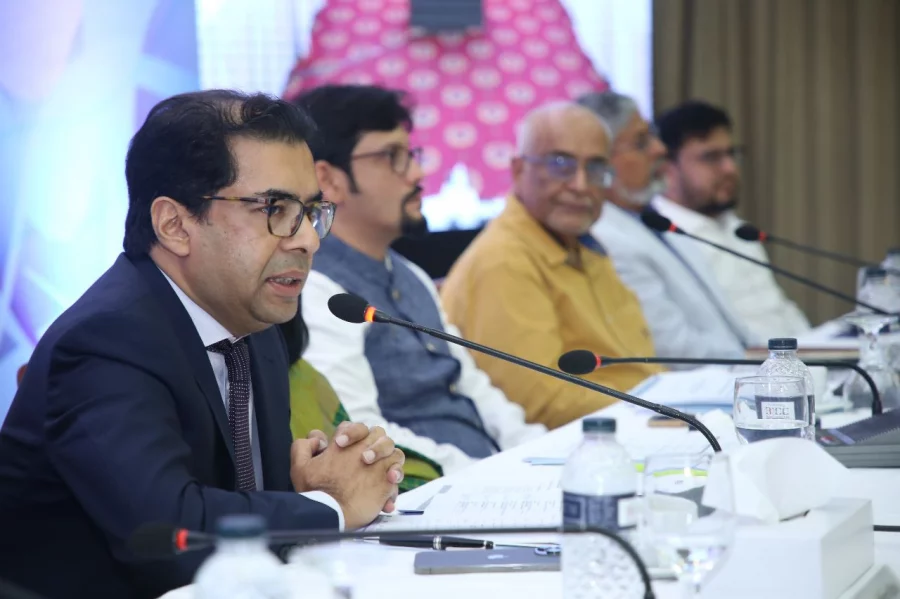
On Saturday, during a discussion titled "Taxing the Digital Economy: Trade-offs and Opportunities," which was co-organized with the European Union (EU), the discussants urged the government to address all of these issues by taking the necessary steps in the next finance act for FY24.
The keynote presentation was delivered by CPD Distinguished Fellow Professor Mustafizur Rahman.
In his presentation he said this paper argues that now is an appropriate time both to make the digital economy work towards fast-pacing the growth of the economy through targeted support, and, taking advantage of this, to explore the frontiers of taxing the digital economy from a forward-looking perspective.
In the current context, issues of taxing Bangladesh's digital economy have emerged as an important area of policy interest, for several reasons such as the IMF condition regarding enhancing Tax-GDP ratio.
There are definitional ambiguities concerning what constitutes a digital economy, which appropriate HS code to put in, and conflicting views persist as to what part of the digital economy should be brought under taxation, he also added.
At present, non-resident digital service providers are not under the tax net of the NBR and hence they are not liable to submit their tax returns in Bangladesh. They do not have any TIN. So they need to bring under the tax, he said.
According to a study, the e-commerce market in Bangladesh was estimated to be about $6.6 billion in 2022 and is expected to reach $10.5 billion in 2026 but a number of IT-enabled services (ITES) are at present allowed to operate under income tax exemption (28 in all, to be effective till June 2024).
Policymakers will need to soon take a decision in this regard and there must be a sunset clause.
According to Bangladesh B2C Ecommerce Market Report 2022 (Research and Markets, 2022), The B2C (Business to Consumer) e-commerce market in Bangladesh was estimated to be about $6.6 billion in 2022 and expected to reach $10.5 billion in 2026.
Local IT companies saw their export earnings of computer service shoot up 95% year-on-year to $592.1 million in FY22.
Bangladesh is the second largest supplier (approximately 36,800 freelance workers) at 14.3%, behind India's 18.4% (Gig Economy Data Hub, Sep. 2022).
Bangladesh ranks eighth among the top ten countries for freelancing income with a growth rate of 27%, while India ranks seventh with a growth rate of 29% (Payoneer, 2019).
In Bangladesh revenue from OTT video streaming platforms is projected to reach $152.7 million in 2023 and the number of users is projected to reach 11.3 million by 2027 (Statista, 2023).
As of now, 28 businesses are currently enjoying income tax exemption for several years, ranging between 2 to 15 years.
Along with the 100% income tax exemption, the ITES sector also enjoys several other tax exemption benefits.
The study stated that, if a 12% tax is imposed on the revenue of the BPO sector, which is a major sub-sector belonging to the tax-exempted ITES sectors, the government could have collected approximately Tk186 crore between 2018 and 2022, even if the low figures are considered.
But the sector insider thinks that this exemption must continue.
Mohammad Sahab Uddin, vice-president of e-CAB said: “Here I think this sector needs to continue this opportunity for tax exemptions for a few more years. Because there are still more small entrepreneurs than big ones. They may lose interest if they are brought under tax right now.”
Habibullah Neyamul Karim, director of Basis said that the digital economy is also part of the main economy as e-commerce is part of commerce.
As the Chief Guest Kazi Nabil Ahmed, member of the Parliamentary Standing Committee on the Ministry of Finance and member of the Parliamentary Standing Committee on Ministry of Foreign Affairs in his speech said: “In terms of accelerated revenue growth, what CPD presented today or the issues that have come up in today's discussion, I will definitely present the main summary of that to the parliament,” he added.
Ahsan Adelur Rahman, MP, member of the Parliamentary Committee on Estimates, CPD Distinguished Fellow Debapriya Bhattacharya and Executive Director Fahmida Khatun also spoke at the event.
