



In the last six months, more than 90.2% of lower-income households have changed their eating habits owing to financial constraints with 96% reducing meat consumption, 88% reducing fish consumption, 77% reducing egg consumption and 81% reducing edible oil consumption, according to a report.
Before, households ate chicken at least four times a month, eggs eight times, fish six times a month, and beef once, but now they consume chicken two times a month, eggs six times, Rui-Katla fish four times, and beef almost never in a month.
Moreover, a number of households have reduced the quality of food consumption.
According to a poll conducted by the South Asian Network on Economic Modeling (Sanem), their income has not increased, but their consumption has climbed by an average of 13%.
The survey results were disclosed at a news conference in the capital on Wednesday by Selim Raihan, executive director of the Sanem.
The survey found that 40% of poll respondents are covered by the social security net, whereas 60% are not.
About 74% of the country's low-income households have borrowed money to cover the higher expenditure caused by global and domestic issues such as rising commodity prices, dollar pricing, and market volatility.
Over a six-month period, the survey was conducted on 1600 low-income households in rural and urban areas of eight divisions of the country (September 2022-February 2023).
The survey also stated that the families have reduced their expenses outside of food.
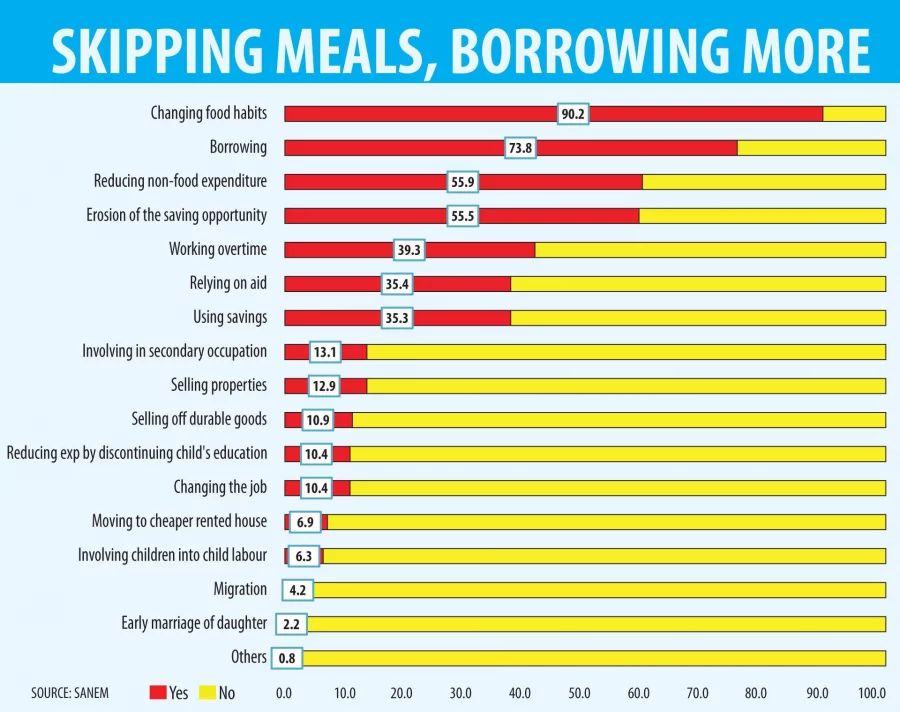
Among the respondents, 92% of the families have reduced their expenses on clothes, 61% on health, 58% have been forced to reduce utility costs and 45% of households have to reduce children's educational expenses.
Besides borrowing, 35% of households are using their savings whereas 55% erosion the opportunity of savings.
Sanem said, in addition to global reasons such as inflationary pressures, war and price increases in the global market, the devaluation of the country's currency and poor mismanagement in the domestic market is also to be blamed for this scenario.
The survey also found that the number of households suffering from severe food insecurity has doubled to 25% in the last six months from 12% earlier.

In their future coping strategies, respondents said that if the prices of goods continue to rise like this, 85% of them will have to borrow and 41% think they may have to rely on begging or unconditional aid in the future.
24% think they may discontinue their children's education where 19% said their children might have to engage in child labour to survive and 17% of the families think that they may have to sell their lands.
Responding to a question on how they measure lower-income or poorer groups, Selim Raihan said that they followed the definition and method given by the World Bank to determine the type of low-income people.
He also said that the control of the market of daily commodities is in the hands of a few business groups and they are doing monopoly business.
The government should take immediate steps to resolve this mismanagement of the market, he suggested.
In the recommendations, Sanem said that inflation is the cruellest form of taxation for the marginalized and so, inflation and food insecurity should be given top priority.
They also recommended increasing internal production and finding alternative sources of imports.
At the same time, the price of food products should be brought down to an affordable level and the scope of social security programs should be expanded.
Professor Sayema Haque Bidisha, research director of Sanem, was also present at the event.
