




According to the World Bank's most recent report on the "South Asia Economic Update," which was published on October 6, Bangladesh must navigate a difficult period in the near future due to the global slowdown and the effects of the Russia-Ukraine war.
According to the World Bank's biannual assessment, growth in South Asia is slowing down, underlining the necessity for countries to develop resilience.
In addition to the ongoing effects of the Covid-19 pandemic, it was further stated that South Asia is currently experiencing an unprecedented combination of shocks due to the economic crisis in Sri Lanka, the devastating floods in Pakistan, the global slowdown, and the effects of the conflict in Ukraine.
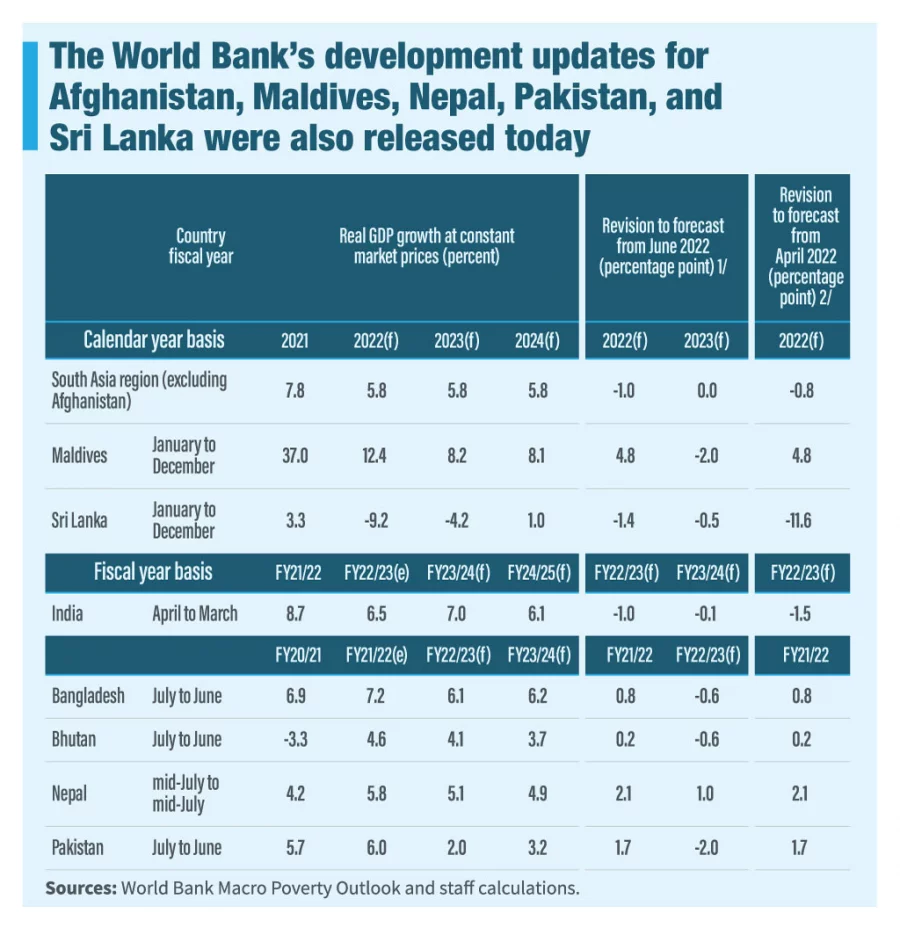
According to the most recent South Asia Economic Focus report, which is titled "Coping with Shocks: Migration and the Road to Resilience", regional growth will average 5.8% this year, which is 1% less than the prediction issued in June.
This follows a growth of 7.8% in 2021 when most countries were rebounding from the pandemic slump.
While economic distress is weighing down all the South Asian countries, some are coping better than others.
They lowered Bangladesh GDP growth forecast to 6.1% for FY23 which is 0.6 percentage points lower than the 6.7% forecast the World Bank made in April.
But they raised the projection for FY24 to 6.2%. The World Bank had first projected a growth of 5.4% for the next fiscal year but has since raised it by 0.8 percentage points.
Exports and the services sector in India, the region’s largest economy, have recovered more strongly than the world average while its ample foreign reserves served as a buffer to external shocks.
The return of tourism is helping to drive growth in Maldives, and to a lesser extent in Nepal—both of which have dynamic services sectors.
The combined effects of Covid-19 and the record-high commodity prices due to the war in Ukraine took a heavier toll on Sri Lanka, exacerbating its debt woes and depleting foreign reserves.
Plunged into its worst-ever economic crisis, Sri Lanka’s real GDP is expected to fall by 9.2% this year and a further 4.2% in 2023.
High commodity prices also worsened Pakistan’s external imbalances, bringing down its reserves.
After devastating climate-change-fueled floods submerged one-third of the country this year, its outlook remains subject to significant uncertainty.
In an online press briefing Martin Raiser, World Bank’s vice-president for South Asia said that the sudden swings in global liquidity and commodity prices, and extreme weather disasters were once tail-end risks but all three have arrived in rapid succession over the past two years and are testing South Asia’s economies.
“In the face of these shocks, countries need to build stronger fiscal and monetary buffers, and reorient scarce resources towards strengthening resilience to protect their people,” he said.
Inflation in South Asia, caused by elevated global food and energy prices and trade restrictions that worsened food insecurity in the region, is expected to rise to 9.2% this year before gradually subsiding.
The resulting squeeze on real income is severe, particularly for the region’s poor, who spend a large share of their income on food.
Regarding Bangladesh’s recent export, remittance and reserve fall, Hans Timmer, World Bank’s chief economist for South Asia said that the report may not have been able to present the current picture in a thorough manner.
However, it can be said that the effect of the declining tendency in exports and the rise in commodity prices will continue in the coming days and one of the main reasons for the decline in Bangladesh's exports will be the European countries' austerity policy as it is one of the biggest export markets for Bangladesh.
Moreover, the recent blackout or shortfall in electricity supply will have a significant impact on readymade garment (RMG) exports.
“Currency devaluation and forex reserves may also be major concerns. That is, like many other countries in Asia, a big challenge is waiting for Bangladesh in the coming days,” he explained.
South Asia’s migrant workers, many of whom are employed in the informal sector, were disproportionately affected when restrictions on movement were imposed during Covid-19.
However, the later phase of the pandemic has highlighted the crucial role migration can play in facilitating recovery.
Survey data from the report suggests that in late 2021 and early 2022, migration flows are associated with movement from areas hit hard by the pandemic to those that were not, thus helping equilibrate the demand and supply of labour in the aftermath of the Covid-19 shock.
Hans Timmer also said that labour mobility across and within countries enables economic development by allowing people to move to locations where they are more productive.
It also helps adjust to shocks such as climate events to which South Asia’s rural poor are particularly vulnerable.
Removing restrictions to labour mobility is vital to the region’s resilience and its long-term development, he added.
Their recommendations are firstly, cutting the costs that migrants face should be high on the policy agenda.
Secondly, policymakers can de-risk migration through several means including more flexible visa policies, mechanisms to support migrant workers during shocks, and social protection programs.
