




As the amount of foreign debt or loans availed by the private sector rises, people who already had foreign debt are now finding themselves in a difficult position due to currency depreciation.
At the end of December 2017, foreign debt in the private sector of the country was $12.28 billion.
In five and half years, this foreign debt in the private sector stood at $25.95 billion.
Bangladesh Bank data analysis shows that during this period it's up by 52.68% and 39% year-on-year (YoY).
Besides, short-term external debt accounted for 68.4% of all foreign loans taken by the private sector till June.
The repayment tenure for a majority of these short-term loans is a maximum of three years.
On the other hand, in less than seven months, the value of taka has fallen by about 25% against the US dollar.
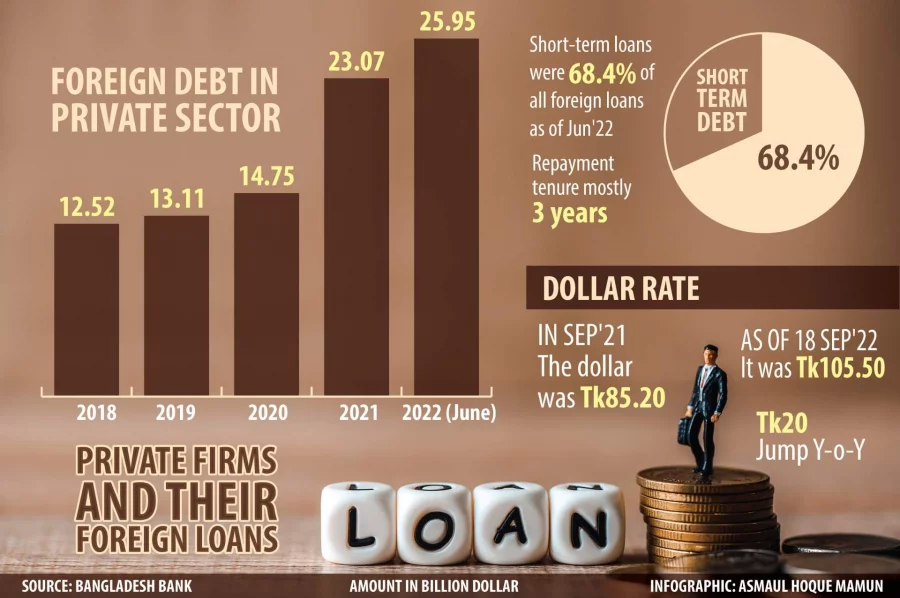
A year ago in September 2021, the dollar exchange rate was Tk85.2 and according to Bangladesh Bank's official website on September 18, 2022, the dollar exchange rate was Tk105.5, meaning a YoY increase by more than Tk20.
As a result, now they are having to repay interest-principal of those loans beyond their expectation.
Businessmen and economists say that during the pandemic businesses took hefty amounts of foreign loans at a lower cost when the LIBOR and other benchmark rates nosedived to below 1% in the global market.
Local businesses were allowed to take foreign loans at the benchmark rate plus 3.5% as set by Bangladesh Bank.
But things are completely different now as the benchmark rates have ballooned to more than 3% in the foreign market.
Ahsan H Mansur, executive director of the Policy Research Institute of Bangladesh, said: “It will be difficult to handle the pressure of foreign debt as the dollar market is on the rise. And if we fail to handle this pressure, the situation in Bangladesh can be awful.”
“The private sector is at risk the most as the foreign debt burden has increased due to depreciation of the taka. Because those who have taken a loan at the rate of Tk84-85 per dollar, now they have to pay the interest-principal of that loan by buying dollars at Tk106-107,” the Brac Bank chairman explained.
Offshore Banking Unit
A separate department of the bank called the Offshore Banking Unit was formed in 1985 to provide opportunities for domestic entrepreneurs to collect loans from abroad.
At present 36 banks are disbursing loans by forming this department.
Initially, the traders in the ready-made garment sector took this advantage, but later the entrepreneurs of other sectors also started taking this advantage.
On January 19, 2021, Bangladesh Bank widened the way to take foreign loans. From now on, foreign-owned service sector organizations can also take loans from parent companies.
However, this facility will not be applicable for trading business. Production and service activities can be taken up to six years from inception. Earlier this facility could be availed for up to three years.
Branches of foreign banks operating in the country are acting as major providers or mediums to take loans from foreign sources.
HSBC and Standard Chartered are leading in this regard. On the other hand, Eastern, City, Brac, AB and Islami Banks are at the top among the local banks.
Agrani, Al-Arafah, Bank Asia, Dhaka, Dutch-Bangla, Exim, IFIC, Jamuna Bank, Mercantile, Midland, Madhumati, Mutual Trust, National, NCC, ONE, Premier, Prime, Pubali, Shahjalal, Social Islami, Southeast, Standard, Trust, UCB, Uttara, CT NA, Commercial Bank of Ceylon, State Bank of India and Woori Bank are also providing this loan.
