




It has become an inherent habit to increase the Public Infrastructure Projects (PIPs) cost by a number of revisions.
So far, a total of 31 projects have been revised by the Executive Committee of the National Economic Council (ECNEC) in FY2022, which amounts to Tk29,471 crore.
Meanwhile, as per the budget presented for FY23, a total of 1356 projects are to be implemented in this fiscal year's Annual Development Project (ADP). Of these, 106 are technical assistance and the remaining 1250 are various infrastructural projects.
Being able to finish them on time at the lowest cost can be a big challenge for the government.
Experts were speaking at the Centre for Policy Dialogue (CPD) and The Asia Foundation’s (TAF) program, “Implementation of Public Infrastructure Projects (PIPs) in Bangladesh-ensuring good value for money.”
In his keynote presentation Mustafizur Rahman, distinguished fellow at CPD said: “A total of 1,243 projects of the ADP are being implemented for 4.6 years on average while 258 projects for more than six years. 39 projects of the ADP are going on for 10-15 years.”
Project revision is becoming ingrained in Bangladesh's development practice, he said and admitted that some are justified, but many are not.
According to CPD, the ADP of the next fiscal year contains 291 projects which were revised once, while 64 projects were revised twice, 12 thrice, and two projects have been revised four times.
A total of 31 projects have been revised by the Executive Committee of the National Economic Council (ECNEC) in FY22, which amounts to Tk29,471 crore - equivalent to building another Padma Bridge (estimated budget of Tk30,192 crore).
Mustafizur Rahman said: “Ensuring good governance in PIP implementation has become an emergent concern for us. Addressing infrastructure deficits is the next big challenge for these countries.”
“A framework can be made ready by utilizing good experiences from the Padma Bridge project so that we can come up with a proper plan. And later we can work on the implementation of all the projects accordingly,” he added.
Fahmida Khatun, executive director of CPD and chair of the session said: “It is very important to consider the qualifications and experience of the contractors in project implementation.
“Properly check whether they are of international standard before handing over the project work order. Another important person involved in the project is the Project Director (PD).
“So, regarding them, we have to focus differently and since we continue to work on one after another project throughout the year, we have to consider whether a separate cadre can be created here (government jobs). In addition to this, after appointing a PD, the government needs to keep him/her on the project work site till the end.”
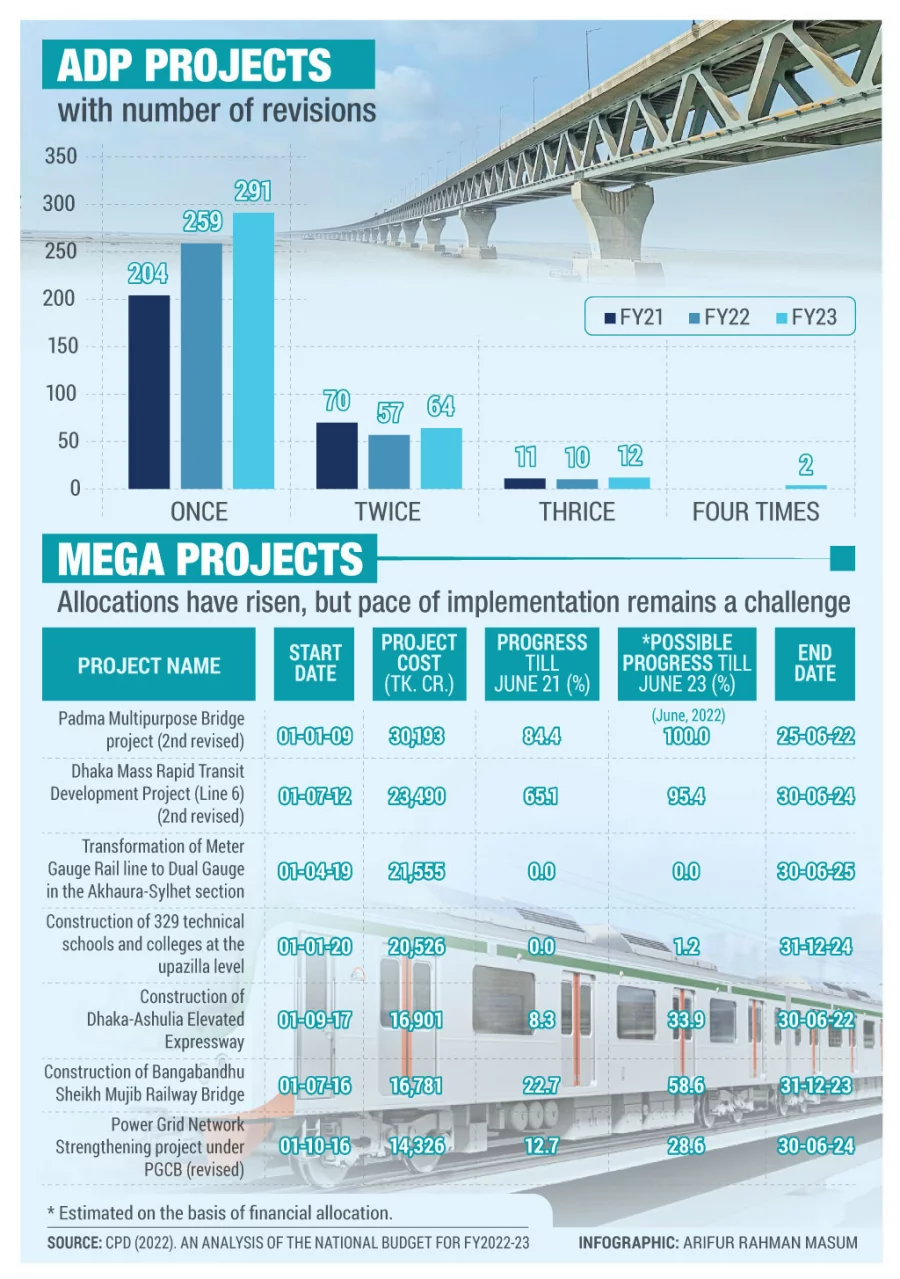
In the presentation, it was mentioned that the share of projects with symbolic allocation (token allocation to keep these projects in the ADP list) is on the rise again and a majority of these are carryover projects.”
“Inclusion of projects under Tk1 lakh has been a continuous practice (barring FY22). 59 projects (4.4% of the total number of projects) under ADP FY23 have received only Tk1 lakh or below; 31 projects (2.2%) received such allocation in FY22). 52 (88.1%) of those are carried over from ADP FY22.”
“Investment in infrastructure projects leads to enhanced productivity, higher competitiveness, reduced transportation costs, access to greater social services, and closer integration with regional and global markets,” Mustafizur Rahman added
He also said that Bangladesh requires an additional $928.48 billion to meet the SDGs, while more than 73% of the additional resources are required for developing infrastructure.
Quoting the Global Competitiveness Index 2019, Mustafizur Rahman said that Bangladesh ranked 114 out of 141 countries in the world and at the bottom position out of five South Asian countries.
"Bangladesh lags behind in the global context in terms of infrastructure due to lower implementation of infrastructure projects," Mustafiz said adding that the country achieved 2.39 points out of five regards the infrastructure pillar of the Logistics Performance Index (LPI), while India scored 2.91 and Vietnam 3.01; Bangladesh's score ranged 2.11 points to 2.24 points over the last two decades.
Mustafiz urged the government to engage stakeholders and the tentative beneficiaries of any project in the stage of preparation and implementation to ensure the best return from the project.
He also recommended strengthening citizens' engagement in monitoring and evaluation.
As a chief guest at the dialogue MA Mannan, minister of planning said those who are involved in various government projects, including infrastructural development, were not found in the workplace, including the project director. At the upazila, district or divisional level, “key persons” are often not available.
“The prime minister has given strict orders in this regard, but still we are not able to achieve them,” he added.
In the research paper presentation, one of the main recommendations by Mustafizur Rahman was to decentralize the Implementation Monitoring and Evaluation Division (IMED), under the Ministry of Planning at the divisional level.
He highlighted strengthening IMED's institutional capacity to enable it to deliver mandated support; about 123 posts out of 338 remain vacant in the IMED and recommended enhancing human resources.
He also recommended introducing monitoring and evaluation cells in all of the ministries and divisions.
Abdus Shahid, chairman, Parliamentary Standing Committee on Estimates; Enamul Haque, member, Parliamentary Standing Committee on Ministry of Road Transport and Bridge; Rizwan Rahman, president, Dhaka Chamber of Commerce and Industry (DCCI) also commented as distinguished discussants.
