



 Former Governor of BB Dr Salehuddin Ahmed said: “Small scale entrepreneurs always remain alert to clear their dues in time, but still they are ignored and the powerful ones are just the opposite but still they are favoured more.”
He said: “Banks enjoy collecting loan instalments from small businesses but it’s big businesses that do not pay in time. Small enterprises contribute more to the country’s economy. This is why the number of big loan defaulters is increasing.”
Top-level executives of banks say farmers and small business owners pay the instalments in time but the big businessmen do not. As a result default loans and risks in the banking industry are rapidly increasing.
BB’s information shows, 55 banks provided Tk3.5 lakhs crore to big businesses, which is 36% of the total loans given.
If a loan amount is more than 10% of a bank’s paid-up capital, then it is considered as a big loan.
Commercial Banks cannot give more than 15% loan of the paid-up capital to a single client without the permission of BB.
According to the banking law, a single client cannot get more than 25% loan of the bank’s paid-up capital.
But Banks gave more than 25% loan to powerful individual clients, dodging the banking rules.
In some cases, a single client’s business organizations have more loan than the paid-up capital.
As a result big amount of loan defaults have been written off as bad debts. Banks have put themselves at high level of risk because of it.
Good clients are affected as well due to loan defaults and bad debts.
Over the years powerful clients benefitted through loan re-scheduling and re-construction but the small businessmen have been deprived of it.
Former Governor of BB Dr Salehuddin Ahmed said: “Small scale entrepreneurs always remain alert to clear their dues in time, but still they are ignored and the powerful ones are just the opposite but still they are favoured more.”
He said: “Banks enjoy collecting loan instalments from small businesses but it’s big businesses that do not pay in time. Small enterprises contribute more to the country’s economy. This is why the number of big loan defaulters is increasing.”
Top-level executives of banks say farmers and small business owners pay the instalments in time but the big businessmen do not. As a result default loans and risks in the banking industry are rapidly increasing.
BB’s information shows, 55 banks provided Tk3.5 lakhs crore to big businesses, which is 36% of the total loans given.
If a loan amount is more than 10% of a bank’s paid-up capital, then it is considered as a big loan.
Commercial Banks cannot give more than 15% loan of the paid-up capital to a single client without the permission of BB.
According to the banking law, a single client cannot get more than 25% loan of the bank’s paid-up capital.
But Banks gave more than 25% loan to powerful individual clients, dodging the banking rules.
In some cases, a single client’s business organizations have more loan than the paid-up capital.
As a result big amount of loan defaults have been written off as bad debts. Banks have put themselves at high level of risk because of it.
Good clients are affected as well due to loan defaults and bad debts.
Over the years powerful clients benefitted through loan re-scheduling and re-construction but the small businessmen have been deprived of it.The banking sector is at grave risk due to disbursement of massive loans to a handful of large businesses, experts have said.
There have been complaints that banks are lending to large-scale businesses while the small and medium enterprises are ignored.
When powerful businessmen are unable to pay their dues on time, the banks are powerless to act against them, which in turn causes a liquidity crisis in the banking sector.
According to a Bangladesh Bank (BB) report, a total of 233% of the entire paid up capital of banks were given as large loans to big organizations.
Last year, Janata Bank’s paid-up capital was Tk2,979 crore and against it the bank loaned Tk13,377 crore. The bank has given of 365% more than the paid-up capital.
At the same time, Sonali Bank disbursed loans up to a total of 546% more than its paid-up capital and Rupali Bank gave 555% more than the paid-up capital.
Agrani Bank had paid-up capital worth Tk3,053 core, against which it gave loan of Tk7,957 crore, that is 199% more than the paid-up capital.
In this way 55 banks against their total paid-up capital of Tk90,131 crore, gave loan of Tk3.5 lakhs crore, which is 233% more than the total paid-up capital.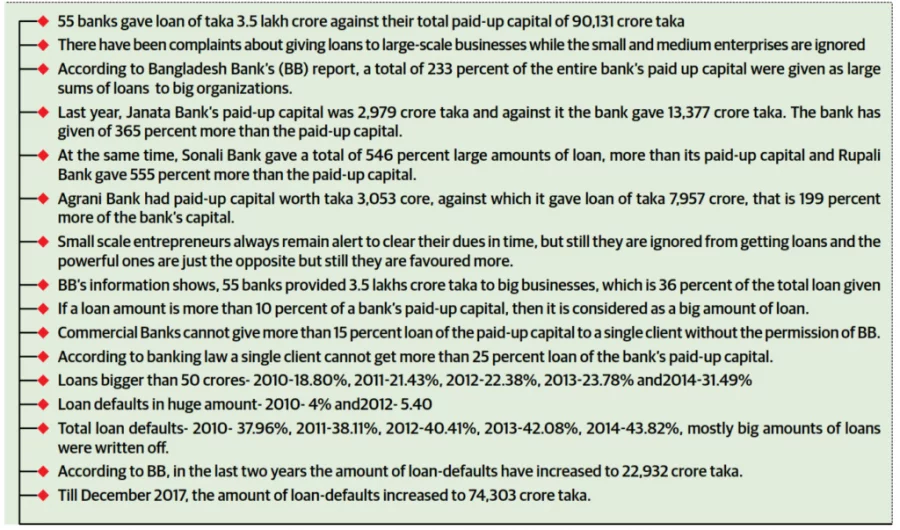 Former Governor of BB Dr Salehuddin Ahmed said: “Small scale entrepreneurs always remain alert to clear their dues in time, but still they are ignored and the powerful ones are just the opposite but still they are favoured more.”
He said: “Banks enjoy collecting loan instalments from small businesses but it’s big businesses that do not pay in time. Small enterprises contribute more to the country’s economy. This is why the number of big loan defaulters is increasing.”
Top-level executives of banks say farmers and small business owners pay the instalments in time but the big businessmen do not. As a result default loans and risks in the banking industry are rapidly increasing.
BB’s information shows, 55 banks provided Tk3.5 lakhs crore to big businesses, which is 36% of the total loans given.
If a loan amount is more than 10% of a bank’s paid-up capital, then it is considered as a big loan.
Commercial Banks cannot give more than 15% loan of the paid-up capital to a single client without the permission of BB.
According to the banking law, a single client cannot get more than 25% loan of the bank’s paid-up capital.
But Banks gave more than 25% loan to powerful individual clients, dodging the banking rules.
In some cases, a single client’s business organizations have more loan than the paid-up capital.
As a result big amount of loan defaults have been written off as bad debts. Banks have put themselves at high level of risk because of it.
Good clients are affected as well due to loan defaults and bad debts.
Over the years powerful clients benefitted through loan re-scheduling and re-construction but the small businessmen have been deprived of it.
Former Governor of BB Dr Salehuddin Ahmed said: “Small scale entrepreneurs always remain alert to clear their dues in time, but still they are ignored and the powerful ones are just the opposite but still they are favoured more.”
He said: “Banks enjoy collecting loan instalments from small businesses but it’s big businesses that do not pay in time. Small enterprises contribute more to the country’s economy. This is why the number of big loan defaulters is increasing.”
Top-level executives of banks say farmers and small business owners pay the instalments in time but the big businessmen do not. As a result default loans and risks in the banking industry are rapidly increasing.
BB’s information shows, 55 banks provided Tk3.5 lakhs crore to big businesses, which is 36% of the total loans given.
If a loan amount is more than 10% of a bank’s paid-up capital, then it is considered as a big loan.
Commercial Banks cannot give more than 15% loan of the paid-up capital to a single client without the permission of BB.
According to the banking law, a single client cannot get more than 25% loan of the bank’s paid-up capital.
But Banks gave more than 25% loan to powerful individual clients, dodging the banking rules.
In some cases, a single client’s business organizations have more loan than the paid-up capital.
As a result big amount of loan defaults have been written off as bad debts. Banks have put themselves at high level of risk because of it.
Good clients are affected as well due to loan defaults and bad debts.
Over the years powerful clients benefitted through loan re-scheduling and re-construction but the small businessmen have been deprived of it.
Former Governor of BB Dr Salehuddin Ahmed said: “Small scale entrepreneurs always remain alert to clear their dues in time, but still they are ignored and the powerful ones are just the opposite but still they are favoured more.”
He said: “Banks enjoy collecting loan instalments from small businesses but it’s big businesses that do not pay in time. Small enterprises contribute more to the country’s economy. This is why the number of big loan defaulters is increasing.”
Top-level executives of banks say farmers and small business owners pay the instalments in time but the big businessmen do not. As a result default loans and risks in the banking industry are rapidly increasing.
BB’s information shows, 55 banks provided Tk3.5 lakhs crore to big businesses, which is 36% of the total loans given.
If a loan amount is more than 10% of a bank’s paid-up capital, then it is considered as a big loan.
Commercial Banks cannot give more than 15% loan of the paid-up capital to a single client without the permission of BB.
According to the banking law, a single client cannot get more than 25% loan of the bank’s paid-up capital.
But Banks gave more than 25% loan to powerful individual clients, dodging the banking rules.
In some cases, a single client’s business organizations have more loan than the paid-up capital.
As a result big amount of loan defaults have been written off as bad debts. Banks have put themselves at high level of risk because of it.
Good clients are affected as well due to loan defaults and bad debts.
Over the years powerful clients benefitted through loan re-scheduling and re-construction but the small businessmen have been deprived of it.