The coyote was a spiritual figure for Native Americans, and only with the arrival of European settlers did it become hunted. This sacred animal’s action against a newspaper that was the voice of the military industrial complex was the apropos completion of Beuys’ circle of critique. The “like” in the title, while ironic, also hinted at the possibility of redemption, through acknowledgement and dismantling of American hegemony from within. Back in Germany, Beuys went on to become a co-founder of the Green Party, which brought environmental politics to the centre when it entered a coalition German government in the 1990s.
Would Beuys be able to stage his action today, or would he be turned away at the airport as a “subversive?” More to my point, what would JFK airport officers say to Abir Shome, if he arrived from Dhaka with his latest work? Would he be labelled a brown subversive (presumed “Muslim”) and turned away? Would immigration make a distinction based on surname Shome, or would “Muslim” as an all-purpose container for “other” prevail? As poet Sham e-ali-Nayeem said to me recently, “Islamophobes don’t care how pious you are. They don’t even care if you are Muslim.”
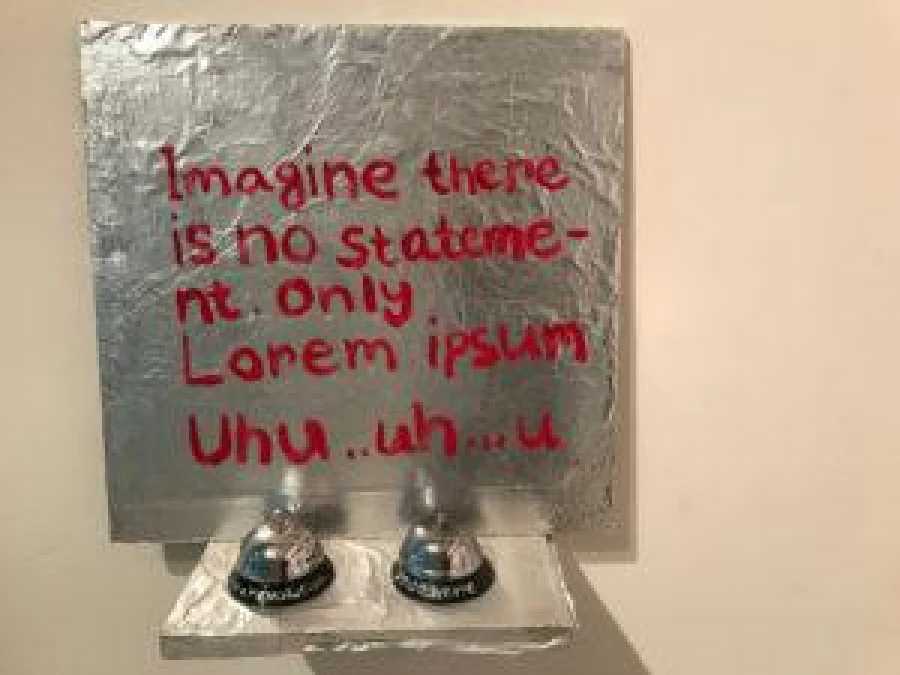
At Chobi Mela IX (Bangladesh Shilpakala Academy), Abir Shome has brought together a melange of text based works that may be opaque to the impatient visitor. Audiences have taken selfies in front of his row of empty frames with price tags; the colour splashes of the tags were the symmetrical “pretty” they wanted. Others have loudly rung his two bells, but not paused to read the text above. On silver foil, “Imagine there is no statement. Only Lorem ipsum...” takes a dig at the tendency for over-explanatory artist statements to take away multiplicity of readings.
In the midst of this busy grid of works are black and white photographs of a toilet, and then closeups of the posters on its walls. Each carries a slogan, referring back to Marcel Duchamp’s temple-breaking moment of 1917, when he brought a porcelain urinal into the gallery, and labelled it Fountain. Back then, the avant garde was elated at this intervention that proposed everyone was an artist, and everything was art. But another section was initially infuriated and dismissed the work as a “stunt.” I presume a similar reaction (translated into Bengali as “stuntbaji”) sometimes greets Abir’s work. Anticipating that possibility, the text here is defiant: “This is art too! And guess what it’s 100 years old” (this is the centenary of the original Duchamp), and “I met R Mutt. He is from Bangladesh” (R Mutt was Duchamp’s faux signature on the urinal).
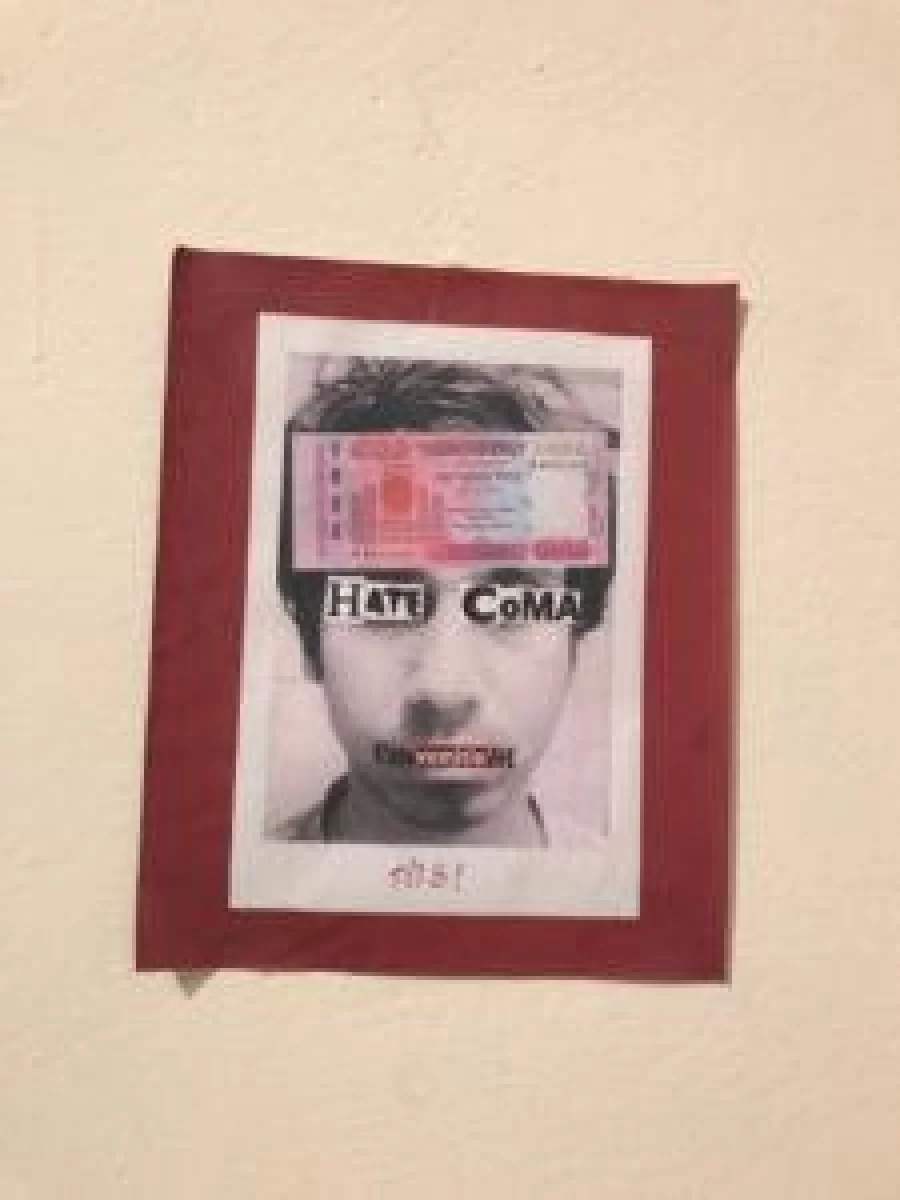
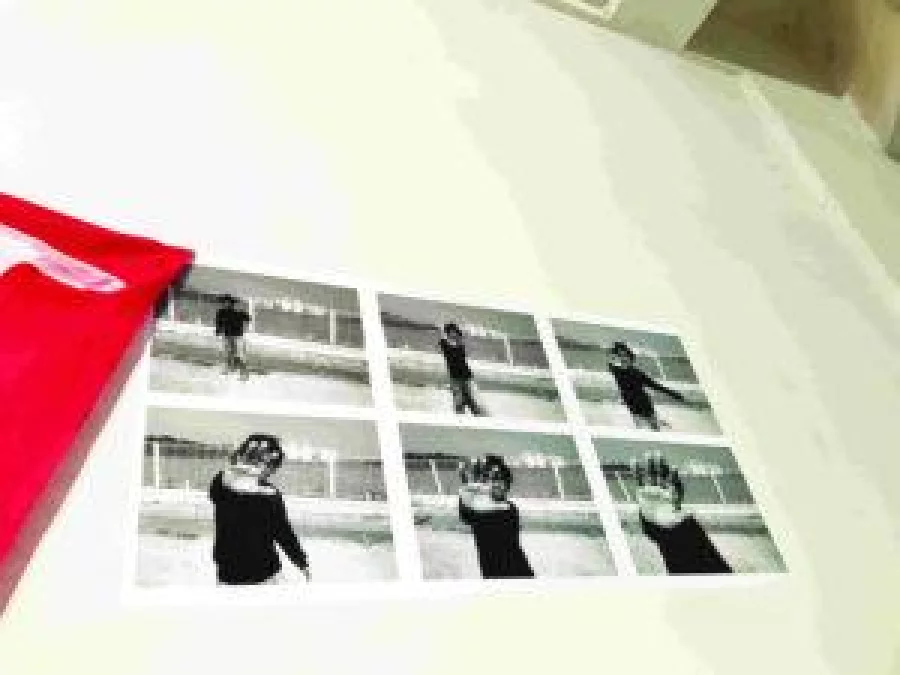
In an upper corner is the poster that grabbed my attention and brought me to Beuys of 1974. Abir has written “I love America but America hates me,” bringing us back to the reality that today, if he tried to carry out Beuys’ intervention, he would not be allowed to land in New York. His Bangladeshi passport, brown skin, and presumed “danger” would render him permanently outside. At the top of the wall are a grid of photographs of Abir, his hands covering his face, running away from the surveillance drones.
Courtesy
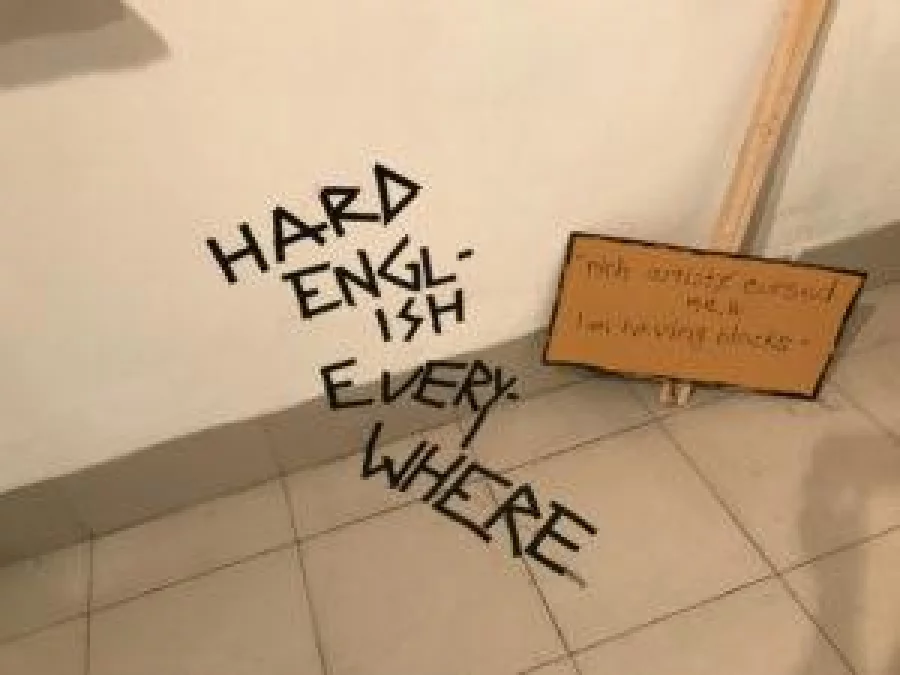
In my earlier review of Razib Datta (“Ramiz was not seen before 1757,” Depart), I noted the “frenzied energy and density of reference” in Razib’s Bangla prose, and mourned the “concrete shoes of converted language” when we use English. But an exception has to be made for Abir Shome, who has said to critics that using English (including words out of sequence, in satirical mimicry) is part of his politics (one text in this new piece says “Hard English is everywhere”). However, I am still waiting, and excited, to see what happens when Abir starts using Bangla more intensely. In a time of evisceration of our language (during my 2015 project Baksho Rohoshyo, Chobi Tumi Kar? at LL6, I was surprised to see how many younger Banani-bashis cannot read Bangla), a choice to not use Bangla carries long-term consequences.
Abir comes out of a group of surrealist artists who graduated from Dhaka University’s Charu Kala department. They studied traditional forms there (painting for Abir, sculpture for Rafiqul Shuvo, graphic design for Marzia Farzana, crafts for Ronni Ahmmed, and printmaking for Mustafa Zaman), but were also influenced by Surrealism, Dada, and the Situationist International. The decade-long demand to add photography, video, performance, and mixed media to the Charu Kala syllabus is still in limbo, and without these additions the institute was not able to fulfil their needs. Yet that same Charu Kala, which also has Shomoy artist collective alumni as professors, did give them a base from which to reach out for other influences. Mustafa Zaman cites a late 1980s to early 1990s period of intense experimentation by this core group of Charu Kala students.
Bangladesh had a jagged art trajectory in the five decades since independence, and many movements and experiments remain undocumented, and linkages have not been made. Depart magazine, under Mustafa Zaman (an innovative artist who is also an art critic, filling a gap in local infrastructure), has catalogued these trends, and some of these artists have been highlighted in local group shows over the last decade curated by Rafiqul Shuvo (OGCJM), Ebadur Rahman (Country of Rising Sadness), Shehzad Chowdhury (Latitude Longitude), Britto Arts Trust, and others. Shahman Moishan is currently doing a long-form research on new media trends within Bangladeshi visual arts for Depart. These are overdue efforts. To properly place and parse these new forms and artists. Abir’s father, Biren Shome produced a specific form of abstract painting in response to the tumult of the 1960s and 1970s, just as Abir produces intuitive interventions and irreverent videos responding to this age of unending wars. The work deserves to be understood through iterative conversations, a systematic art history, and a new arts curriculum that builds viewers as well as artists.
Naeem Mohaiemen uses films, essays, and mixed media installations to trace Bangladesh history since 1971.




 In the midst of this busy grid of works are black and white photographs of a toilet, and then closeups of the posters on its walls. Each carries a slogan, referring back to Marcel Duchamp’s temple-breaking moment of 1917, when he brought a porcelain urinal into the gallery, and labelled it Fountain. Back then, the avant garde was elated at this intervention that proposed everyone was an artist, and everything was art. But another section was initially infuriated and dismissed the work as a “stunt.” I presume a similar reaction (translated into Bengali as “stuntbaji”) sometimes greets Abir’s work. Anticipating that possibility, the text here is defiant: “This is art too! And guess what it’s 100 years old” (this is the centenary of the original Duchamp), and “I met R Mutt. He is from Bangladesh” (R Mutt was Duchamp’s faux signature on the urinal).
 In an upper corner is the poster that grabbed my attention and brought me to Beuys of 1974. Abir has written “I love America but America hates me,” bringing us back to the reality that today, if he tried to carry out Beuys’ intervention, he would not be allowed to land in New York. His Bangladeshi passport, brown skin, and presumed “danger” would render him permanently outside. At the top of the wall are a grid of photographs of Abir, his hands covering his face, running away from the surveillance drones.
 Courtesy
In my earlier review of Razib Datta (“Ramiz was not seen before 1757,” Depart), I noted the “frenzied energy and density of reference” in Razib’s Bangla prose, and mourned the “concrete shoes of converted language” when we use English. But an exception has to be made for Abir Shome, who has said to critics that using English (including words out of sequence, in satirical mimicry) is part of his politics (one text in this new piece says “Hard English is everywhere”). However, I am still waiting, and excited, to see what happens when Abir starts using Bangla more intensely. In a time of evisceration of our language (during my 2015 project Baksho Rohoshyo, Chobi Tumi Kar? at LL6, I was surprised to see how many younger Banani-bashis cannot read Bangla), a choice to not use Bangla carries long-term consequences.
Abir comes out of a group of surrealist artists who graduated from Dhaka University’s Charu Kala department. They studied traditional forms there (painting for Abir, sculpture for Rafiqul Shuvo, graphic design for Marzia Farzana, crafts for Ronni Ahmmed, and printmaking for Mustafa Zaman), but were also influenced by Surrealism, Dada, and the Situationist International. The decade-long demand to add photography, video, performance, and mixed media to the Charu Kala syllabus is still in limbo, and without these additions the institute was not able to fulfil their needs. Yet that same Charu Kala, which also has Shomoy artist collective alumni as professors, did give them a base from which to reach out for other influences. Mustafa Zaman cites a late 1980s to early 1990s period of intense experimentation by this core group of Charu Kala students.
Courtesy
In my earlier review of Razib Datta (“Ramiz was not seen before 1757,” Depart), I noted the “frenzied energy and density of reference” in Razib’s Bangla prose, and mourned the “concrete shoes of converted language” when we use English. But an exception has to be made for Abir Shome, who has said to critics that using English (including words out of sequence, in satirical mimicry) is part of his politics (one text in this new piece says “Hard English is everywhere”). However, I am still waiting, and excited, to see what happens when Abir starts using Bangla more intensely. In a time of evisceration of our language (during my 2015 project Baksho Rohoshyo, Chobi Tumi Kar? at LL6, I was surprised to see how many younger Banani-bashis cannot read Bangla), a choice to not use Bangla carries long-term consequences.
Abir comes out of a group of surrealist artists who graduated from Dhaka University’s Charu Kala department. They studied traditional forms there (painting for Abir, sculpture for Rafiqul Shuvo, graphic design for Marzia Farzana, crafts for Ronni Ahmmed, and printmaking for Mustafa Zaman), but were also influenced by Surrealism, Dada, and the Situationist International. The decade-long demand to add photography, video, performance, and mixed media to the Charu Kala syllabus is still in limbo, and without these additions the institute was not able to fulfil their needs. Yet that same Charu Kala, which also has Shomoy artist collective alumni as professors, did give them a base from which to reach out for other influences. Mustafa Zaman cites a late 1980s to early 1990s period of intense experimentation by this core group of Charu Kala students. Bangladesh had a jagged art trajectory in the five decades since independence, and many movements and experiments remain undocumented, and linkages have not been made. Depart magazine, under Mustafa Zaman (an innovative artist who is also an art critic, filling a gap in local infrastructure), has catalogued these trends, and some of these artists have been highlighted in local group shows over the last decade curated by Rafiqul Shuvo (OGCJM), Ebadur Rahman (Country of Rising Sadness), Shehzad Chowdhury (Latitude Longitude), Britto Arts Trust, and others. Shahman Moishan is currently doing a long-form research on new media trends within Bangladeshi visual arts for Depart. These are overdue efforts. To properly place and parse these new forms and artists. Abir’s father, Biren Shome produced a specific form of abstract painting in response to the tumult of the 1960s and 1970s, just as Abir produces intuitive interventions and irreverent videos responding to this age of unending wars. The work deserves to be understood through iterative conversations, a systematic art history, and a new arts curriculum that builds viewers as well as artists.Naeem Mohaiemen uses films, essays, and mixed media installations to trace Bangladesh history since 1971.