




Students from seven government colleges staged road blockades at multiple points across Dhaka on Wednesday, demanding the immediate issuance of the final ordinance for the proposed Dhaka Central University (DCU).
The demonstrations were held as part of a pre-announced program under the banner of the Seven College University Transformation Movement, pressing for the promulgation of the DCU ordinance for the seven colleges.
From around noon, students blocked key intersections including Technical Mor, Science Lab, Tantibazar, and Amtoli Mor in Mohakhali, disrupting traffic across major routes in the capital. In several areas, vehicular movement came to a complete halt, causing severe traffic congestion and widespread public suffering.
At Technical Mor, students began their blockade around 12pm, shutting down roads leading to Gabtoli, Mirpur, and Kallyanpur. Simultaneously, Dhaka College students blocked the busy Science Lab intersection, paralysing traffic at the four-way junction. At the same time, students of Government Titumir College blocked the Amtoli area in Mohakhali, while protesters also occupied several roads in Old Dhaka.
Around 1pm, a group of Titumir College students temporarily blocked the road in Mohakhali for about 10 minutes before withdrawing. Protesters later began clearing some locations, leaving the Technical Mor area around 3:30pm and Tantibazar shortly after 3:15pm.
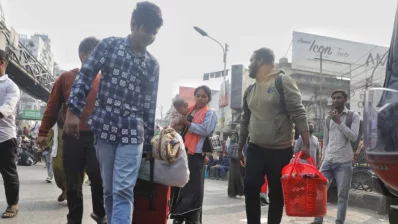
Due to the prolonged blockades, commuters and drivers were forced to endure long delays, with many passengers seen walking to their destinations amid the traffic gridlock.
The students’ sole demand is that the updated draft of the Dhaka Central University ordinance be approved at Thursday’s Advisory Council meeting and that the president issue the final ordinance without delay. They warned that failure to meet this demand would result in continued agitation.
On Tuesday, the Ministry of Education said in a press release that the revised draft of the proposed DCU ordinance had been sent to the Ministry of Public Administration. The draft incorporates decisions taken at an inter-ministerial meeting.
According to the ministry, the ordinance will be placed before the Advisory Council for final approval after receiving policy clearance from the Cabinet Division and legal vetting by the Legislative and Parliamentary Affairs Division of the Law Ministry.
Despite these assurances, student leaders said they would not suspend their movement unless the ordinance is formally approved and issued.
The proposed Dhaka Central University is set to include seven government colleges: Dhaka College, Eden Mohila College, Begum Badrunnesa Government Girls’ College, Government Shaheed Suhrawardy College, Kabi Nazrul Government College, Government Bangla College, and Government Titumir College.
Classes for the 2024–25 academic session under the DCU framework began on January 1.
The seven colleges have faced prolonged instability since 2017, when they were affiliated with Dhaka University without sufficient preparation. Persistent administrative and academic challenges followed, leading the government to announce in January last year that the colleges would be separated from DU.
However, the affiliation was revoked before a new university structure was finalised, further complicating the situation. In response, the government decided to establish a separate university by integrating the seven colleges.
Disputes soon emerged over the structure proposed in the initial draft of the ordinance, prompting protests from both teachers and students. Following consultations with stakeholders, the Ministry of Education recently revised the draft ordinance.
Under the revised proposal, Dhaka Central University will be established as a separate institution, while the colleges will retain their existing identities and operate as affiliated but not fully merged entities under the new university, resembling, though not identical to, the current National University model.
