




 Dr Khondaker Golam Moazzem, the research director at Centre for Policy Dialogue, said that getting out of the LDC list meant that nobody would be able to consider Bangladesh a weak nation.
“It is a matter of pride for any country. Once this feat is achieved, a sense of relief will be created in the country,” he added.
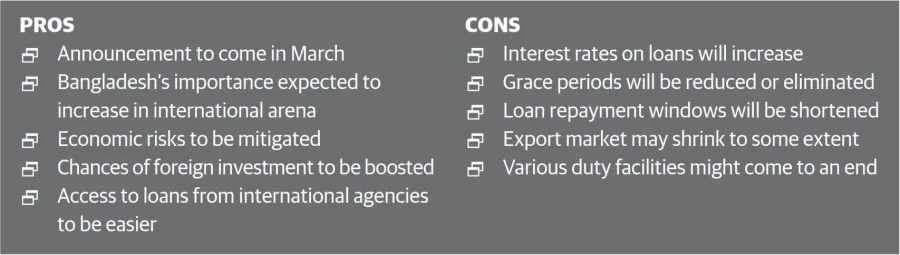
Moazzem noted that as a developing country, Bangladesh’s importance will increase in the international arena. The world considers the economic basis of developing nations as strong. This will help mitigate Bangladesh’s economic risks, meaning the risks taken into account while investing in private and public sectors will go down to some extent.
“This will help boost the chance of foreign investment while international agencies will be interested to give loans,” he noted.
Dr Khondaker Golam Moazzem, the research director at Centre for Policy Dialogue, said that getting out of the LDC list meant that nobody would be able to consider Bangladesh a weak nation.
“It is a matter of pride for any country. Once this feat is achieved, a sense of relief will be created in the country,” he added.
Moazzem noted that as a developing country, Bangladesh’s importance will increase in the international arena. The world considers the economic basis of developing nations as strong. This will help mitigate Bangladesh’s economic risks, meaning the risks taken into account while investing in private and public sectors will go down to some extent.
“This will help boost the chance of foreign investment while international agencies will be interested to give loans,” he noted.Over the last few years, anticipation that Bangladesh would become a developing country by 2021 has grown. On February 22, Home Minister Asaduzzaman Khan Kamal told reporters that a formal announcement would be made on March 20 about Bangladesh’s graduation into the developing country category.
Amid all this discussion on poor and middle-income countries, many are wondering what will happen when Bangladesh sheds its LDC status and becomes a developing nation.
There are three criteria a country must fulfil before graduating from low-income country status to developing country status. The first one is having a Gross National Income (GNI) per capita of $1,242. Bangladesh’s current per capita income is $1,610.
The second one is Human Assets Index (HAI), which has to be 66 or above. Bangladesh’s HAI is 72.9.
And the last one is having an Economic Vulnerability Index below 32. Bangladesh’s EVI is 25.
Having fulfilled all three criteria, the country now awaits a formal approval for inclusion in the list of developing countries. Bangladesh will formally become a developing country with the approval of United Nations Economic and Social Council.
The government considers the country’s promotion as a major achievement. A reception will be given to Prime Minister Sheikh Hasina on March 22. On that day, processions will be brought out throughout the country. This celebration will continue until March 26, Bangladesh’s Independence Day.
UN Resident Coordinator and UNDP Resident Representative in Bangladesh Mia Seppo has already congratulated the country for the achievement.
Atiur Rahman, the former central bank chairman, said the country’s inclusion in the list of developing nations is a matter of great pride.
“Our stature will rise once we make it into the developing country list. Bangladesh’s image will be brightened,” he said. “Nobody will be able to call Bangladesh poor anymore.” Dr Khondaker Golam Moazzem, the research director at Centre for Policy Dialogue, said that getting out of the LDC list meant that nobody would be able to consider Bangladesh a weak nation.
“It is a matter of pride for any country. Once this feat is achieved, a sense of relief will be created in the country,” he added.
Moazzem noted that as a developing country, Bangladesh’s importance will increase in the international arena. The world considers the economic basis of developing nations as strong. This will help mitigate Bangladesh’s economic risks, meaning the risks taken into account while investing in private and public sectors will go down to some extent.
“This will help boost the chance of foreign investment while international agencies will be interested to give loans,” he noted.
Dr Khondaker Golam Moazzem, the research director at Centre for Policy Dialogue, said that getting out of the LDC list meant that nobody would be able to consider Bangladesh a weak nation.
“It is a matter of pride for any country. Once this feat is achieved, a sense of relief will be created in the country,” he added.
Moazzem noted that as a developing country, Bangladesh’s importance will increase in the international arena. The world considers the economic basis of developing nations as strong. This will help mitigate Bangladesh’s economic risks, meaning the risks taken into account while investing in private and public sectors will go down to some extent.
“This will help boost the chance of foreign investment while international agencies will be interested to give loans,” he noted.
Dr Khondaker Golam Moazzem, the research director at Centre for Policy Dialogue, said that getting out of the LDC list meant that nobody would be able to consider Bangladesh a weak nation.
“It is a matter of pride for any country. Once this feat is achieved, a sense of relief will be created in the country,” he added.
Moazzem noted that as a developing country, Bangladesh’s importance will increase in the international arena. The world considers the economic basis of developing nations as strong. This will help mitigate Bangladesh’s economic risks, meaning the risks taken into account while investing in private and public sectors will go down to some extent.
“This will help boost the chance of foreign investment while international agencies will be interested to give loans,” he noted.