




Water is nature's most important and life-saving element. But the people of the coastal region of Satkhira are constantly facing death in that water. As a result of excess salinity in drinking water and water used for daily purposes, they suffer from various common as well as unknown diseases. There is no proper solution to this problem for various government and private projects. The concerned authority could not give a proper answer as to whether it is possible to solve this problem at all.
According to Satkhira district-level data from Public Health Engineering, 13% of Satkhira, 22% of Khulna, and 15% of Bagerhat have food and water shortages. Due to geographical reasons, Shyamnagar and Asashuni upazilas of Satkhira district are near the sea level, so the water shortage is greater than in other upazilas.
According to United Nations Development Program (UNDP) survey results in 2021, 73% of people living in Asashuni and Shyamnagar upazilas of Satkhira are drinking unsafe saline water. A salinity of more than 1,000 milligrams per litre is considered undrinkable. But the water in those upazilas has a salinity of 1,427mg to 2,406mg per litre. Moreover, 52% of the ponds and 77% of the tube wells in these areas were found to have high levels of salinity.
Talking to the residents of Gabura, Burigoalini, and other areas of Shyamnagar in Satkhira, it is known that the problem of salinity has become more pronounced in the last three decades. Once there was usable water in houses and nearby ponds and canals, but as a result of Cyclones Aila and Amphan, the dam broke and salt water entered the area due to the increase in salinity. The locals are in dire need of drinking water.
Farida Begum, a 26-year-old resident of the Madhyam Khalisha area of Gabura Union, said: "We don't lack water. But we don't have drinking water. Before two decades, our situation was not like this. But for the last two decades, we have had to suffer for drinking water. As long as there is rainwater, there is no shortage of water. Somehow. Then we must fetch water from a distance of two to three kilometres. Which is very difficult for us."
Her neighbour, Saleha Banu, said the same thing. She said: "Due to salt water, there is a shortage of drinking water as well as diseases. Among them, stomach problems, itching, and bone loss, are consuming the body compared to age. In addition, due to salinity, women's uterus problems are common in this area."
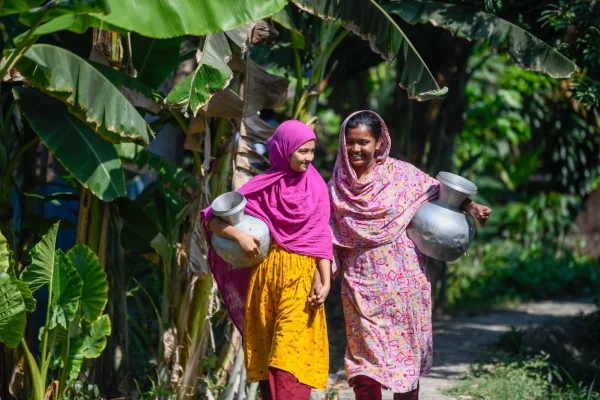
According to World Bank research, 20% of women in coastal areas suffer premature abortions, and 3% of babies die due to salinity.
Jahanara Begum, a quinquagenarian of Ward No. 8 of the Kazipara area of Birgoalini Union, pointed to the pond in front of her and said: "Once I could drink this water, I used to take a bath. But, Aila, after the last Amphan, the amount of salt water in the pond has increased. You can't take a bath; stay away from eating." If you take a bath, it becomes itchy and sore. Even if you wash your clothes in this water, your whole body itches. But there is nothing to do. You have to save your life."
It is reported that there is an acute shortage of drinking water in about 95% of the Shyamnagar area alone. Since 1990, a food and water crisis has started in Shyamnagar. These organizations blamed unplanned shrimp farming, river erosion, cyclones, and floods for this.
Seventy-year-old Abdur Rahim Sardar, who was in charge of cooking for the boys and girls of the Jannat Orphanage in Burigoalini, said: "Earlier, I used to keep rainwater." Now it doesn't even rain. Still, try to retain some water. Now the “Probaho” has a pure water pump and does not buy water from there."
Not only Rahim Sardar, but now the private organization ‘Probaho’ has shown the light of hope to the residents of Ward No. 8 and the surrounding areas of Shyamnagar.

Hafiza Akhtar, a resident of the Kazipara area of the upazila, said: "As long as this machine is sitting, I have been taking water from here. Before there was no machine, there was a government tap here. After it got damaged, I used to take water from the front pond and drink salt water with alum. At first, I felt bad enough to eat. Couldn't. Stomach upset. Ever since we came here (flow), we haven't had any problems. Now we buy water from here at Tk5 per pitcher, Tk7 per jar, and Tk10 per drum. Even if we spend Tk4,000 per month, the body is sick. It is better than being born. Four of my family members can drink this water for two days. We have benefited a lot by installing this water machine."
Madrasa student Habibur, a local resident who is a beneficiary of the flow, said that earlier they had to drink salt water, which was very difficult. “Even after bathing in salt water, my father and I started getting itchy and rashy. The doctor said to take a bath with good water. But where can I get good water? Two years ago, when I used to bathe in water from here because of the (flow plant), now I am very healthy. I can buy one drum for Tk10, which lasts for a few days. "
Meanwhile, the villages are visited; there are several plants of Pond Sand Filter (PSF) in the village, but they are not functioning. Some are forced to drink pond water.
Abu Bakar, who is involved in water supply work in various areas, including Kazipara, Paddapukur, and Kaikhali, said: "There are many water problems here. We supply water through vans to those who can't get water from faraway places. Many people cannot buy water and consume it, so they drink water from the pond. That's it. This is life here. From birth to death, this is how you fight for life."
It is known that, in addition to the government, various private organizations have already come forward to resolve this crisis. In continuation of this, ‘Probaho’ is setting up safe water plants to solve the water problems of the locals. In its 15-year journey since 2009, Probaho has set up 121 water purification plants in 22 districts across the country to ensure the supply of clean water. About 300,000 people collect 585,000 litres of water every day from the Probaho safe drinking water project.
The tap water is tested twice a year to ensure proper hygiene. Beneficiaries can also report any problem to the flow team by calling them free of charge. For more than a century, “Probaho” has been supplying clean water to various arsenic-prone areas of the country, including the only coral island in Cox's Bazar, Saint Martin, Sabuj Nagar Rajshahi, and the hilly region of Bandarban.
Recently, two separate modern-technology fresh water plants have been set up in Munshiganj Akashleena Eco Park and Nildumur Zila Parishad Pond in Shyamnagar Upazila of the district. Each plant is producing about five thousand litres of fresh water per day.
Stakeholders of ‘Probaho’ say that, despite many problems, Probaho is operating such plants in remote areas. Many times, there is no electricity here. Without electricity, the production of clean water is not possible. The stream has a separate collection centre on the roadside for those who bring boats from Burigoalini, Nildumur, island regions, and from within the Sundarbans. They are supplied with water through pipes.
When asked how the water is purified in these plants, Abu Salman Muhammad Abdullah, the representative of the "Probaho" plant, said: "We use the latest technology ever. This is called reverse-osmosis (RO) technology. Through this, we make any water, including surface water and underground water, pure and suitable for drinking. The difference between this technology and other technologies is that the minerals required by the body are automatically imposed here after passing through various steps. No matter where the water is from, it is possible to make it useful as food water, even if it is from a canal, a river, or the Bay of Bengal.”
He said: "Water quality is mainly determined by two factors. One is total dissolved solids (TDS), and the other is pH. According to the standard in Bangladesh, the value of TDS should be within 1,000. And as per WHO standards, the TDS value should be within 50 ppm. Also, the pH level should be between 6.5 and 7.5. Monitors have been set up to control the water quality in the “Probaho” water purification plant. TDS and the pH of water can be seen on that monitor. Our plant water has TDS between 20 and 30."
Another representative, Arpi Howladar, said: “We are being supported by the government for these plants. But the plant system is very limited compared to the beneficiaries. But we are trying to support everyone under the flow.”
In this regard, Shyamnagar Upazila Executive Officer (UNO) Najibul Islam Ratul said salt water is predominant in several unions of Shyamnagar Upazila. The availability of clean drinking water is comparatively low. The government has made arrangements to distribute water tanks and store water in them. Also, canals that are filled up are being excavated. Apart from the government, various volunteers, NGOs, and organizations are working to provide clean water to the people.

The public ponds are fitted with PSF (Pond Sand Filter). Also, large canals are dug to facilitate agriculture so that rainwater can be stored in them. Tube wells are being distributed where there is fresh water.
But according to the Shyamnagar Upazila Executive Officer's office, there are 5,795 ponds and 136 water bodies in the 12 unions of the upazila. Of these, 453 have Pond and Sand Filters (PSFs), but most of them are unusable due to a lack of management. Besides, most of the 1,412 deep tube wells are useless. There are 422 shallow tube wells. Three of them are closed. Although salt water rises in most tube wells, There are 304 rainwater storage tanks, and more are needed.
In this regard, Satkhira District Commissioner Mohammad Humayun Kabir said: "Once the construction of rainwater harvesting is completed, the shortage of clean drinking water will be eliminated in Satkhira. Tk48 crore has been allocated in the next financial year."
