




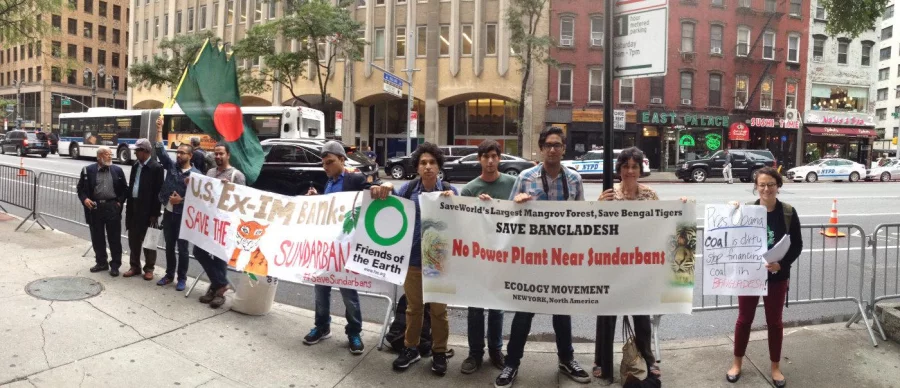
 Bangladeshi-American individuals, and environmental and other groups rallied outside the UN Headquarters in New York on Monday, September 19, 2016; to protest against the development of coal-fired power plants at Rampal near the Sundarbans Courtesy-Friends of the Earth USBangladesh is the guarantor of the loan and is liable for any environmental hazards. It aims at generating 30% of its electricity from coal in the near future.
From an agitation programme at the Central Shaheed Minar on August 20, activists announced to observe Dhaka March on November 24 if the government does not cancel the project by this time, and a grand rally in Dhaka on November 26.
After BNP chief Khaleda Zia demanded relocating the project, Hasina at a press conference last month blasted groups and individuals opposing the Rampal coal power plant for spreading “negative, baseless, fictitious and misleading information” and questioned the motive of the BNP chief for supporting the protests.
The premier claimed that the plant would not cause any harm to the Sundarbans mangrove forest and the Pashur River water. She assured that they would import best quality coal from Indonesia, Australia and South Africa, and that all sorts of modern technology would be used to curb any kind of pollution.
The mangrove forest spans the border of India and Bangladesh and is home to endangered species like the Bengal tiger and Irrawaddy dolphin, and upwards of six million people. It protects the coastal people like a shield during cyclones.
Apart from the Ramsar Convention, the Unesco in a recent report submitted to the Bangladesh authorities last month opposed the 1,320MW project saying the biodiversity of the mangrove forest will be dangerously affected, and hence suggested shifting it to somewhere else.
The Unesco also termed the environmental impact assessment (EIA) done by a state agency incomplete. It has also sought the reply of the government on its report by October 11.
Bangladeshi-American individuals, and environmental and other groups rallied outside the UN Headquarters in New York on Monday, September 19, 2016; to protest against the development of coal-fired power plants at Rampal near the Sundarbans Courtesy-Friends of the Earth USBangladesh is the guarantor of the loan and is liable for any environmental hazards. It aims at generating 30% of its electricity from coal in the near future.
From an agitation programme at the Central Shaheed Minar on August 20, activists announced to observe Dhaka March on November 24 if the government does not cancel the project by this time, and a grand rally in Dhaka on November 26.
After BNP chief Khaleda Zia demanded relocating the project, Hasina at a press conference last month blasted groups and individuals opposing the Rampal coal power plant for spreading “negative, baseless, fictitious and misleading information” and questioned the motive of the BNP chief for supporting the protests.
The premier claimed that the plant would not cause any harm to the Sundarbans mangrove forest and the Pashur River water. She assured that they would import best quality coal from Indonesia, Australia and South Africa, and that all sorts of modern technology would be used to curb any kind of pollution.
The mangrove forest spans the border of India and Bangladesh and is home to endangered species like the Bengal tiger and Irrawaddy dolphin, and upwards of six million people. It protects the coastal people like a shield during cyclones.
Apart from the Ramsar Convention, the Unesco in a recent report submitted to the Bangladesh authorities last month opposed the 1,320MW project saying the biodiversity of the mangrove forest will be dangerously affected, and hence suggested shifting it to somewhere else.
The Unesco also termed the environmental impact assessment (EIA) done by a state agency incomplete. It has also sought the reply of the government on its report by October 11.Bangladeshi-American individuals, and environmental and other groups rallied outside the UN Headquarters in New York on Monday to protest against the development of coal-fired power plants at Rampal near the Sundarbans, a Unesco World Heritage site and the world’s largest continuous mangrove forest.
The demonstrations took place when Bangladesh’s Prime Minister Sheikh Hasina, who is firm on implementing the 1,320MW India-Bangladesh joint venture project, was attending the UN General Assembly meeting, a joint statement says.
Apart from the government one being set up on the bank of Pashur River, local private firm Orion Group is constructing another 566MW coal-run plant at Rampal.
Among the groups who supported the protest in New York Monday were Ecology Movement North America (Protibesh Andolon), Friends of Earth US, the Sierra Club, Rainforest Action Network, and Centre for Biological Diversity.
The activists in New York demanded that the US Export-Import Bank, the taxpayer-funded export credit agency of the United States, publicly reject financing for the Orion plant, which would be built just over 14km from the Sundarbans.
Local environmental groups and individuals have been opposing the construction of the coal-power plants and several dozen other industrial projects – already approved by the Department of Environment – expressing concern over the long-term adverse impact on the Sundarbans and the people who depend on the mangrove forest. Similar protests have also been held in London, Paris, Washington DC, Atlanta and New York.
The government, however, claims that they would use ultra super-critical technology and high-quality imported coal and monitor its operations strictly to curb pollution. India's Export-Import Bank has agreed to finance 70% of the project cost while the governments of India and Bangladesh will pay the rest equally. Bangladeshi-American individuals, and environmental and other groups rallied outside the UN Headquarters in New York on Monday, September 19, 2016; to protest against the development of coal-fired power plants at Rampal near the Sundarbans Courtesy-Friends of the Earth USBangladesh is the guarantor of the loan and is liable for any environmental hazards. It aims at generating 30% of its electricity from coal in the near future.
From an agitation programme at the Central Shaheed Minar on August 20, activists announced to observe Dhaka March on November 24 if the government does not cancel the project by this time, and a grand rally in Dhaka on November 26.
After BNP chief Khaleda Zia demanded relocating the project, Hasina at a press conference last month blasted groups and individuals opposing the Rampal coal power plant for spreading “negative, baseless, fictitious and misleading information” and questioned the motive of the BNP chief for supporting the protests.
The premier claimed that the plant would not cause any harm to the Sundarbans mangrove forest and the Pashur River water. She assured that they would import best quality coal from Indonesia, Australia and South Africa, and that all sorts of modern technology would be used to curb any kind of pollution.
The mangrove forest spans the border of India and Bangladesh and is home to endangered species like the Bengal tiger and Irrawaddy dolphin, and upwards of six million people. It protects the coastal people like a shield during cyclones.
Apart from the Ramsar Convention, the Unesco in a recent report submitted to the Bangladesh authorities last month opposed the 1,320MW project saying the biodiversity of the mangrove forest will be dangerously affected, and hence suggested shifting it to somewhere else.
The Unesco also termed the environmental impact assessment (EIA) done by a state agency incomplete. It has also sought the reply of the government on its report by October 11.
Bangladeshi-American individuals, and environmental and other groups rallied outside the UN Headquarters in New York on Monday, September 19, 2016; to protest against the development of coal-fired power plants at Rampal near the Sundarbans Courtesy-Friends of the Earth USBangladesh is the guarantor of the loan and is liable for any environmental hazards. It aims at generating 30% of its electricity from coal in the near future.
From an agitation programme at the Central Shaheed Minar on August 20, activists announced to observe Dhaka March on November 24 if the government does not cancel the project by this time, and a grand rally in Dhaka on November 26.
After BNP chief Khaleda Zia demanded relocating the project, Hasina at a press conference last month blasted groups and individuals opposing the Rampal coal power plant for spreading “negative, baseless, fictitious and misleading information” and questioned the motive of the BNP chief for supporting the protests.
The premier claimed that the plant would not cause any harm to the Sundarbans mangrove forest and the Pashur River water. She assured that they would import best quality coal from Indonesia, Australia and South Africa, and that all sorts of modern technology would be used to curb any kind of pollution.
The mangrove forest spans the border of India and Bangladesh and is home to endangered species like the Bengal tiger and Irrawaddy dolphin, and upwards of six million people. It protects the coastal people like a shield during cyclones.
Apart from the Ramsar Convention, the Unesco in a recent report submitted to the Bangladesh authorities last month opposed the 1,320MW project saying the biodiversity of the mangrove forest will be dangerously affected, and hence suggested shifting it to somewhere else.
The Unesco also termed the environmental impact assessment (EIA) done by a state agency incomplete. It has also sought the reply of the government on its report by October 11.
Bangladeshi-American individuals, and environmental and other groups rallied outside the UN Headquarters in New York on Monday, September 19, 2016; to protest against the development of coal-fired power plants at Rampal near the Sundarbans Courtesy-Friends of the Earth USBangladesh is the guarantor of the loan and is liable for any environmental hazards. It aims at generating 30% of its electricity from coal in the near future.
From an agitation programme at the Central Shaheed Minar on August 20, activists announced to observe Dhaka March on November 24 if the government does not cancel the project by this time, and a grand rally in Dhaka on November 26.
After BNP chief Khaleda Zia demanded relocating the project, Hasina at a press conference last month blasted groups and individuals opposing the Rampal coal power plant for spreading “negative, baseless, fictitious and misleading information” and questioned the motive of the BNP chief for supporting the protests.
The premier claimed that the plant would not cause any harm to the Sundarbans mangrove forest and the Pashur River water. She assured that they would import best quality coal from Indonesia, Australia and South Africa, and that all sorts of modern technology would be used to curb any kind of pollution.
The mangrove forest spans the border of India and Bangladesh and is home to endangered species like the Bengal tiger and Irrawaddy dolphin, and upwards of six million people. It protects the coastal people like a shield during cyclones.
Apart from the Ramsar Convention, the Unesco in a recent report submitted to the Bangladesh authorities last month opposed the 1,320MW project saying the biodiversity of the mangrove forest will be dangerously affected, and hence suggested shifting it to somewhere else.
The Unesco also termed the environmental impact assessment (EIA) done by a state agency incomplete. It has also sought the reply of the government on its report by October 11.