




Three consecutive days of relentless monsoon rain have turned Bangladesh’s flood emergency into a nationwide crisis, crippling Dhaka, leaving more than a million people affected across seven districts, claiming at least 51 lives and prompting fresh warnings that the worst may not yet be over as heavy rainfall is forecast to continue for several more days.
While Sunday’s downpour brought the capital to a near standstill, inundating roads, disrupting transport and forcing schools to postpone examinations, floodwaters and landslides continued to devastate the southeast, even as forecasters warned that the focus of the disaster is gradually shifting towards Sylhet, the northeast and parts of northern Bangladesh.
The Bangladesh Meteorological Department (BMD) recorded 175 millimetres of rainfall in Dhaka during the latest spell, while warning that moderate to very heavy rain is likely to continue over the next 24 hours and persist across much of the country during the coming week because of an active monsoon over the Bay of Bengal.
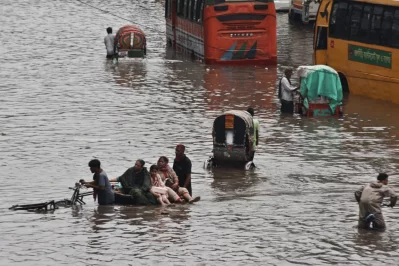
In Dhaka, familiar scenes of urban paralysis unfolded once again.
Major roads in New Market, Azimpur, Nilkhet, Shantinagar, Malibagh, Moghbazar, Mirpur, Panthapath, Kakrail, Banani and Manik Mia Avenue went under knee- to waist-deep water, leaving vehicles stranded, engines stalled and commuters struggling for hours to reach workplaces.
In several neighbourhoods, residents relied on manually operated vans or paid double transport fares simply to cross flooded streets.
The disruption extended beyond commuters.
Private vehicles broke down after water entered engines, businesses remained closed as floodwater entered shops, and several educational institutions -- including Viqarunnisa Noon School and College, Manipur School and College and YWCA School -- postponed examinations because students and teachers were unable to reach campuses safely.
Urban planners said the latest flooding again exposed Dhaka’s chronic drainage failures, arguing that rapid urbanisation, encroached canals, shrinking wetlands and fragmented drainage management have left the capital increasingly vulnerable to climate-driven extreme rainfall.
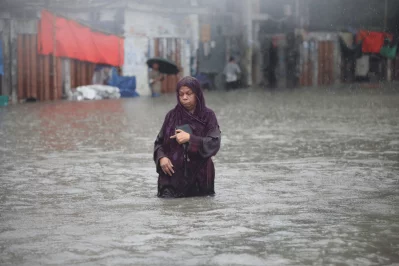
Md Abul Basar, team leader of Swisscontact Bangladesh, said climate-resilient urban management can no longer be treated as a future agenda.
“Urban resilience is not just about improving drainage infrastructure; it is about ensuring cities can continue functioning while protecting livelihoods, public health and economic productivity during climate-related disruptions,” he said.
Beyond the capital, the humanitarian situation remained severe.
According to the Ministry of Disaster Management and Relief, seven districts -- Khagrachhari, Rangamati, Bandarban, Chittagong, Cox’s Bazar, Moulvibazar and Habiganj -- have been affected by flooding and landslides.
The ministry said more than one million people have been affected, with over 267,000 families still marooned and 44,457 people taking shelter in 1,131 emergency shelters.
Relief assistance in cash and food has already been distributed to affected communities.
The official death toll has climbed to 51, including 28 deaths in Cox’s Bazar, where 15 Bangladeshi residents and 13 Rohingyas lost their lives.

Chittagong recorded 13 deaths, while Bandarban reported six fatalities, underscoring the devastating impact of landslides and flash floods across the southeastern hill districts.
Authorities also reported 39 people injured in the disaster.
Although floodwaters have started receding in parts of Khagrachhari and some stranded tourists have been rescued from Sajek, landslides continue to disrupt transport in Rangamati, while the Chittagong-Cox’s Bazar railway remained suspended for a sixth consecutive day after floodwaters submerged sections of the track at Shamsherpara.
The disaster has also disrupted the country’s education system.
The Chittagong Education Board postponed HSC and equivalent examinations scheduled for July 13, 15 and 16 across all districts under the board, while Dhaka schools cancelled or deferred examinations because of severe waterlogging.
The next phase of the emergency, however, may lie outside the southeast.

According to the Flood Forecasting and Warning Centre (FFWC), floodwaters are gradually receding in parts of Chittagong, Bandarban and Cox’s Bazar, but the threat is shifting towards the northeast and northern regions as continued rainfall and upstream flows from India push river levels higher.
The FFWC warned that flood conditions could deteriorate in Sylhet, Sunamganj and parts of Rangpur, while fresh inundation remains possible in Feni, Khagrachhari, Lakshmipur, Noakhali, Moulvibazar, Netrokona, Sherpur and Mymensingh over the next 24 to 72 hours.
The Sangu, Manu, Khowai and Kushiyara rivers are flowing above danger level at several monitoring stations, while water levels in the Teesta basin continue to rise.
Meteorologists say the situation is being driven by an active monsoon combined with heavy rainfall over the adjoining Indian states of Meghalaya, Assam and Tripura, where runoff quickly enters Bangladesh’s transboundary rivers.
The Bangladesh Meteorological Department has forecast moderate to very heavy rainfall across all eight divisions during the next few days, with the heaviest downpours expected in Dhaka, Mymensingh, Rangpur, Sylhet and Chittagong divisions.
Although rainfall may gradually weaken towards the end of the week, forecasters say localized flooding and waterlogging are likely to continue.
Officials also warned of renewed landslide risks across the Chittagong Hill Tracts as saturated hillsides remain unstable despite a reduction in rainfall.
Responding to the evolving situation, Prime Minister Tarique Rahman on Sunday placed the entire civil administration on maximum alert, directing divisional commissioners, deputy commissioners, police, civil surgeons and disaster management authorities to work in close coordination to protect lives and property.
Meanwhile, the latest flooding has once again exposed the vulnerability of Bangladesh’s urban infrastructure.

Dhaka’s drainage system failed after a single day of exceptionally heavy rainfall, while transport links across the southeast were severed by floods and landslides.
Experts said the recurring disasters underline the growing impact of climate change, unchecked urbanisation and the loss of natural drainage channels.
Environmental experts noted that although extreme rainfall has become more frequent, much of the resulting damage is driven by inadequate drainage, encroached canals, shrinking wetlands and unplanned development.
For millions of Bangladeshis, however, the debate over causes remains secondary to immediate survival.
Families in flood-hit districts continue to wait in shelters or marooned homes for clean water, food and medical assistance.
Farmers are counting crop losses, businesses are struggling with interrupted transport and damaged goods, and thousands of students face uncertainty as examinations are postponed.
With rivers still rising in several basins and more rain forecast throughout the week, authorities say the immediate challenge is no longer confined to rescuing flood victims in the southeast.
It is preparing for a disaster that is steadily shifting across the country, testing Bangladesh’s disaster response, urban resilience and flood management systems all at once.
Our correspondents Sushmita Munshi and Shaikh Shahrukh, along with district correspondents, contributed to this report
