




For Anima (pseudonym), a student at Jagannath University, commuting on a Dhaka bus has become a nightmare.
On her way to Sadarghat from Badda aboard a bus, she was sexually harassed by a middle-aged man.
“At first I thought it was unintentional,” she recalled.
“But when I moved forward, he came behind me again and touched me inappropriately.”
When she protested, passengers dismissed her.
“They told me to ignore it — that he was my father’s age, that such things happen on buses,” she said.
This was not her first encounter. “It happened again on my way to Nilkhet,” she said.
“Women can sense when a touch is intentional.”
Anima’s story reflects the experience of countless women in Dhaka’s chaotic public transport system.
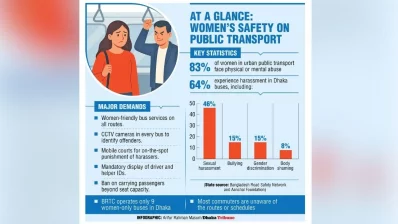
According to the Bangladesh Road Safety Network, 83% of women using urban buses face physical or psychological harassment.
The Aanchal Foundation found that nearly two-thirds of female commuters in Dhaka have experienced some form of abuse — 46% sexual harassment, 15% bullying, and 15% gender discrimination.
Accountability
Pahari Bhattacharya, coordinator of the Bangladesh Road Safety Network, said most public transport “is structurally unfriendly to women.”
He added that many bus helpers refuse to let women board, while others enable harassment.
“We demand women- and disability-friendly public transport immediately,” he said.
Rights activists argue that lack of evidence allows perpetrators to escape punishment.
“Even when victims speak up, they’re often blamed,” said Zakiah K Hasan, executive director of the Dipto Foundation.
She noted that a previous initiative to install CCTV cameras in 100 city buses reduced incidents,
but the project was never expanded.
Samira Akter, general secretary of Aanchal Foundation, said her organization has long urged the government to install CCTV cameras in all buses.
“If buses were monitored, offenders couldn’t get away so easily,” she said.
Women-only bus service
The Bangladesh Road Transport Corporation (BRTC) launched a women-only bus service in 1998, later expanding it to Dhaka and nearby districts.
But today, only nine buses operate across the capital, covering limited routes such as Mirpur–Motijheel and Demra–Motijheel.
Many commuters don’t even know these routes exist.
“I travel to college four days a week and face harassment regularly,” said Tahmina Akter, a student of Nazrul College.
“If there were dedicated women’s buses, many of us would be safer.”
Nurse Sushama Akter, who travels from Kolabagan daily, echoed that sentiment: “I’ve faced harassment countless times. I can’t afford private transport. Separate buses for women would make a real difference.”
BRTC Deputy General Manager (Operations) Shukdev Dhali said: “We can’t expand the service without a government directive. Once approved, women’s buses will run on all routes.”
Legal gaps, weak enforcement
Activists stress that Bangladesh lacks strong enforcement mechanisms to address sexual crimes on public transport.
Aanchal Foundation has proposed mobile courts to punish offenders on the spot.
“People rarely report harassment because it’s time-consuming and humiliating,” said Samira Akter.
“If mobile courts acted immediately, it would send a powerful message.”
She added that driver and helper ID cards should be displayed clearly, and buses should never carry more passengers than seats.
“These simple steps can make travel safer for women,” she said.
Anima, however, has little faith in change.
“Every woman I know has faced this,” she said quietly.
“We keep enduring, but for how long?”
