



The interim government promulgated the Public Service (Amendment) Ordinance, 2025 on the evening of May 25, introducing sweeping changes to the Public Service Act, 2018 and significantly reshaping the disciplinary framework for nearly 1.4 million civil servants.
Presented as a measure to restore “order and efficiency” within the civil service, the ordinance revives aspects of a 1979 statute, tightening disciplinary protocols, limiting appeal rights, and enforcing swift penalties for misconduct.
Thousands of government employees have since protested, decrying the changes as arbitrary and unconstitutional.
This has led to an unsettled situation across the entire government workforce, particularly within the Secretariat.
Now, pressing questions arise: Why did civil servants take to the streets? What did the old law stipulate? What changes does the new law introduce? And what is the core debate surrounding these amendments?
What’s in the 2018 Public Service Act
Enacted as the Government Service Act, 2018 (later renamed the Public Service Act), the existing law established a multi-step framework for disciplining civil servants. Its core components included:
Codes of conduct: A detailed list of prohibited behaviours—from corruption to insubordination—aligned with established public-sector norms.
Formal inquiries: Allegations of misconduct triggered departmental proceedings, evidence-gathering and hearings before an independent inquiry committee.
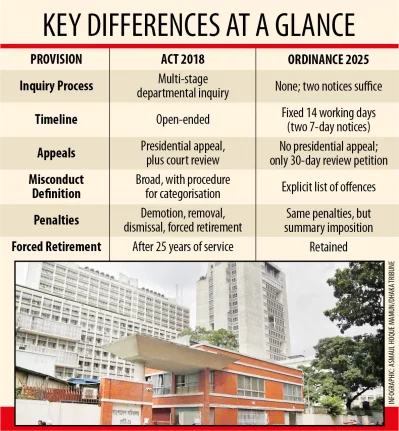
Range of penalties: Four major sanctions—demotion, removal, dismissal and forced retirement—could be imposed, often only after exhaustive review.
Right to appeal: Aggrieved employees could appeal severe punishments to the President, and subsequently to the courts under judicial review.
Forced retirement clause: A separate provision enabled compulsory retirement after 25 years of service, though it was never actively enforced.
Under this system, disciplinary actions could span months—even years—allowing extensive defence rights and multiple layers of scrutiny.
What the 2025 ordinance changes
Fixed, two-step timeline: The 2025 ordinance accelerates disciplinary procedures by imposing a fixed, two-step timeline that significantly tightens the punishment process for civil servants.
Once an allegation is made, the accused employee is given seven working days to respond to a show-cause notice, explaining the alleged misconduct.
If the authorities find them “guilty,” a second notice is issued, also with a seven-day window, which outlines the proposed penalty—ranging from demotion or reassignment to complete removal or dismissal from service.
Unlike the previous system, which allowed for lengthy departmental proceedings, the new law enables summary discipline, meaning that penalties can be imposed immediately after the second notice without additional reviews or investigations.
However, employees facing dismissal are granted one final opportunity—a seven-day period to contest the decision before the punishment is officially enforced.
No formal inquiry: The ordinance omits the 2018 Act’s multi-stage departmental inquiry process, allowing summary enforcement upon issuance of notices alone.
Narrow appeal routes: Under the new ordinance, punishments ordered by the President cannot be appealed directly to the President, effectively removing a crucial avenue for administrative reconsideration.
Instead, affected employees are given the option to file a review petition with the President or a competent authority within 30 days of the decision.
While employees still retain the right to challenge disciplinary actions in court, this process is expected to be lengthy and financially burdensome, potentially discouraging many from pursuing legal recourse.
Critics argue that these restrictions limit civil servants’ ability to defend themselves, making the new framework more rigid and unforgiving than its predecessor.
Explicit misconduct list: Offences warranting swift discipline include disrupting workplace discipline, obstructing duties, unauthorized absence and inciting collective leave.
Retained forced retirement: Despite earlier recommendations, the ordinance leaves intact the 25-year compulsory retirement rule from the 2018 law.
Why civil servants are protesting
The ordinance has sparked intense controversy, with critics calling it unconstitutional and draconian.
Civil service unions warn that the law grants excessive power to punish dissent, effectively banning strikes and petitions.
Protesters fear employees will be forced to accept any order without protest, leaving them vulnerable to arbitrary punishments.
Several analysts compare the ordinance to martial law regulations, arguing that it reintroduces outdated authoritarian clauses.
Former secretary Abu Alam Mohd Shahid Khan calls it a “barbaric law” that undermines basic rights.
Critics argue that Bangladesh already has sufficient legal frameworks to address corruption, making these harsh new penalties unnecessary.
Legal experts also raise concerns over due process, highlighting the limited appeal options for disciplined employees.
If the president imposes a penalty, there is no direct appeal, and judicial recourse is complex and expensive.
Bangladesh Secretariat Officers and Employees United Council (BSOEUC) President Badiul Kabir warn that staff can now be “dismissed without the opportunity for self-defence” on vaguely defined misconduct charges.
BSOEUC Secretary General, Nizam Uddin Ahmed asserts the law enables officials to “punish any staff member arbitrarily,” eroding civil service independence.
The Inter-Ministerial Employees’ Association calls the ordinance a “black law” that curtails free thought, promotes “fear-driven service” and undermines fundamental rights.
Secretariat officials and employees have announced a daily one-hour strike starting on Wednesday in protest, demanding the repeal of the ordinance. The strike will continue indefinitely until their demands are met.
Restoring pre-2018 rules
Senior advisers argue that the ordinance reverses politically motivated changes made in 2018.
Home Adviser Lt Gen (Retd) Jahangir Alam Chowdhury said that the previous amendments were introduced to manipulate elections, and the new ordinance simply reinstates the original law.
He emphasized that concerns should be addressed through dialogue, not confrontation.
Authorities believe the previous disciplinary process was too slow and vulnerable to lobbying.
The ordinance imposes strict timelines, including a one-week reply period, and allows summary penalties.
Supporters claim this will enhance efficiency and deter strikes, ensuring swift accountability.
The Public Service (Amendment) Ordinance, 2025 stands at the crossroads of governance, embodying the tug-of-war between discipline and democratic safeguards.
With over 1.4 million public servants directly impacted, its implementation will define the future of bureaucratic accountability and civil service autonomy in Bangladesh.
Proponents champion it as a step toward efficiency and swift enforcement, while critics decry it as an instrument of excessive control.
The coming days will determine whether dialogue leads to refinements or protests and resistance shape the ordinance’s fate.
The demands for the repeal of the ordinance are expected to be addressed once Chief Adviser Dr Muhammad Yunus returns from Japan.
