




Rokeya Akhter, 23, lives in Azizpur village in Debhata Upazila, Satkhira. She is currently seven months pregnant and has visited the health complex four times for checkups. To ensure the well-being of both herself and her child, she has consistently included fruits, eggs, and milk in her daily diet. She is also preparing for the birth of her second child, which she will not deliver at home. Her first child was born at home three years ago with the assistance of a midwife.
When a correspondent visited her house, Rokeya was washing her hands with soap. She remarked: “Who doesn’t know that washing hands with soap makes them germ-free? This is nothing new, but how many people actually do it properly? I didn’t follow this habit before, but now I do.”
She added: “I had an ultrasound to determine whether my first child was a boy or a girl—that was the only time I visited a doctor. After that, I delivered at home with a midwife. However, it took me a long time to physically recover. My cervix was slightly torn during childbirth, and I suffered for three days at home before I went to the hospital to have it stitched up. I went through a lot.”
Rokeya is now much more aware of her own health and that of her child. Her husband and mother-in-law regularly join her at village courtyard meetings, where they receive various health messages.
Who can forget the Meena cartoon? This popular cartoon conveyed important messages to both villages and remote areas of Bangladesh—emphasizing that open defecation and urination should be avoided, hands should be washed thoroughly with soap, boys and girls should be treated equally, and mothers and children should receive proper care. However, even though people remember Meena’s words, they do not always put them into practice.
Nevertheless, the focus is now shifting back to the healthy villages. A “Healthy Village” is one that has implemented improved sanitation systems, regular handwashing with soap, breastfeeding for newborns, exclusive breastfeeding for children up to six months, and proper record-keeping (including birth registrations and growth charts) for all children under five. In addition, it ensures that pregnant and lactating mothers receive at least four check-ups at health centers and provides the public with information on available services.
Nasima Akhtar, another resident of the village, said: “I have three children. Our family toilet was unhygienic, so we fixed it—and as a result, my children no longer suffer from frequent diarrhea. I now pay careful attention to nutrition in our diet, and I have instilled the habit of cleanliness in my children.” She added, “Everyone knows the importance of cleanliness, but we never really practiced it. However, by simply changing a few habits and increasing our awareness, we have become residents of a ‘Healthy Village.’”
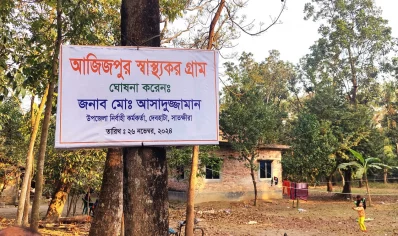
Seven villages in Debhata Upazila, Satkhira, have been declared Healthy Villages. These villages are now more environmentally friendly, and their residents enjoy a better quality of life by practicing healthy habits. The designation of “Healthy Village” is awarded to villages that meet nine specific indicators of healthy living.
The project has strengthened existing Civil Society Organizations (CSOs) in each village, enabling them to play an active role in the community. With the support of the CSOs and the local government in promoting social change in Debhata Upazila—and under the technical guidance of the Right to Grow Project, World Vision Bangladesh—seven villages have been declared Healthy Villages.
Jaganmay Prajesh Biswas, project manager for the Right2Grow project at World Vision Bangladesh, said: “Local people have become more aware of health, nutrition, and WASH issues, and they now express their needs through various activities including yard meetings, GMP sessions, school-based campaigns, and home visits.”
He added: “The identified families were linked with the union council, healthcare centers, local entrepreneurs, and other service providers. CSO members regularly inspected homes and advised residents on practicing healthy habits and creating a healthy environment. As a result, every family in the village adopted these practices, and the village met all the required indicators. With the approval of the Upazila Executive Officer through the local government, the village was declared a Healthy Village.”
Right2Grow is a consortium advocacy project funded by the Dutch Government and implemented by six development organizations: World Vision Bangladesh, Action Against Hunger, the Centre for Economic Governance and Accountability Africa (CEGAA), Max Foundation, Save the Children, and The Hunger Project. World Vision Bangladesh is implementing the project in five unions within Debhata Upazila of Satkhira District.
One of the seven villages is Azizpur, which is part of Debhata Union. In this village, all 324 families have access to safe water, use improved sanitation, and practice proper handwashing. Additionally, four newborns are fed formula, 10 children are exclusively breastfed for six months, 46 children under the age of five have both birth registrations and growth charts, and five pregnant women and three mothers have received at least four health check-ups.
Similarly, other villages—such as Sushil Ganti and Town Sripur in Debhata Union, Bejor Aeet in Nawapara Union, Khariadanga and Charkuni in Parulia Union, and Nunekhola in Kulia Union—have been declared Healthy Villages through the active efforts of civil society organizations, in cooperation with the local government and under local leadership.
MD Asaduzzaman, upazila nirbahi officer of Debhata, Satkhira, said: “We are essentially supervising the work carried out by NGOs to develop Healthy Villages. The local chairman and other members also oversee these efforts. Our work has focused on increasing public awareness so that people can adopt and adhere to the nine targeted indicators of a Healthy Village.”
