




Unplanned dam construction, encroachment, and pollution have led to a crisis in river navigability, resulting in the disappearance of approximately 500 rivers in Bangladesh.
Among these, notable rivers like the Konai and Pinar in Dhaka, along with five others, and ten additional rivers from districts such as Narayanganj and Munshiganj, now exist only on paper.
Experts suggest that a decrease in upstream water flow is causing coastal rivers to fill with sediment.
Some rivers have dried up entirely, while others have experienced a significant reduction in water flow.
The construction of the Farakka dam upstream on the Padma River and the Gojaldoba dam on the Teesta, along with various other unplanned projects, is obstructing water flow.
As a result, many small and large rivers have disappeared, and those that remain are also under threat.
According to the "Bangladesh Rivers: Definition and Number" report, published by the National River Conservation Commission under the Ministry of Shipping in 2023, there are currently 1,008 rivers in Bangladesh.
However, additional data from district administrations and the Bangladesh Water Development Board suggest that 931 rivers are currently flowing.
Of these, 308 rivers have lost their navigability.
This breakdown includes 85 rivers in Dhaka division, 71 in Rangpur, 18 in Rajshahi, none in Barisal, 11 in Chittagong, 10 in Sylhet, 26 in Mymensingh, and 87 in Khulna.
While there is some confusion regarding the number of rivers according to the River Conservation Commission, environmental organizations estimate that there are approximately 1,500 rivers in the country.
The Bangladesh Environment Movement claims that due to a lack of water flow, one and a half rivers disappear each year. Over the past two decades, more than 300 rivers have dried up, and nearly 400 are now on the verge of extinction.
Among these are rivers like Betna, Shalikha, Shalita, Hamkura, Chuna, and Hatitan, which once had strong currents but have now dried up, allowing habitation in those areas.
In this regard, Kamruzzaman Majumdar, General Secretary of the Bangladesh Environment Movement, stated that while the River Conservation Commission has reported 1,008 rivers, the actual number is closer to 1,500. Since independence, around 500 rivers have been lost over the past six decades, based on various research papers, books, and local data.
He further noted that approximately one and a half rivers are vanishing each year for three main reasons.
Firstly, upstream water flow has decreased due to the construction of various dams and projects, leading to a navigability crisis in the rivers. Secondly, silted riverbeds, which are already struggling with reduced navigability, are being filled and encroached upon for industrial development, causing pollution and further obstructing water flow. This ultimately leads to the disappearance of these rivers. Although the highest court of the country has declared rivers as living entities and has directed efforts to revive them, implementation has remained ineffective.
“To save the rivers, we must move beyond political and commercial interests.”
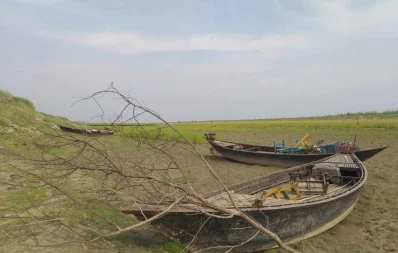
Reports indicate that in recent years, water flow has ceased in 40 of the 54 rivers shared between Bangladesh and India before the onset of the dry season.
Throughout the year, these rivers experience minimal flow, causing sediment accumulation of three to six feet annually. This ongoing siltation is leading to the closure of one navigational route after another.
To maintain ferry services like those at Aricha, Daulatdia, Paturia, and Nagarbari at the confluence of the Padma and Jamuna rivers, large sums of money are spent daily.
5 rivers lost in Dhaka
Research conducted by the River and Delta Research Centre (RDRC) reveals that at the time of Bangladesh's independence, there were 15 rivers in Dhaka District.
Among these, five rivers—Aati, Konai, Dolai, Pando, and Narai—no longer exist.
According to Mohammad Ejaz, chairman of RDRC, unplanned urbanization and housing developments initiated by RAJUK are responsible for the extinction of these rivers.
He noted that these rivers were still present in the 1980s and 1990s but have since disappeared due to excessive filling, encroachment, and pollution. Currently, around 500 rivers are facing a similar fate.
The researcher points out that one of the main reasons for the crisis of these rivers is the lack of year-round water flow. This results in sedimentation in the riverbeds, leading to navigability issues. The presence of many dams in cross-border river sections exacerbates the problem, as they operate without Bangladesh's consent. Despite the existing water flow, regulatory violations prevent effective management.
According to the Water Development Board, Tk 40,000 crore has been spent solely on dredging, yet no significant improvements are evident.
“Meanwhile, the former Minister of Shipping, Khaled Mahmud Chowdhury, claimed that 10,000 kilometers of navigable waterways are being restored, but in reality, even 4,000 kilometers have not been recovered,” he added.
He emphasized that to resolve these issues, local community involvement must be prioritized in future projects, ensuring transparency in their implementation. There is optimism regarding those who have taken charge after the mass uprising, with hopes that they will fulfill their promises.
Existence crisis of 200 rivers
Various sources indicate that since the construction of the Gajoldoba dam by India on the Teesta River in 1998, desertification has been occurring in Bangladesh's Teesta basin.
Due to the absence of a finalized water-sharing agreement for the Teesta, rivers in northern Bangladesh are now facing severe water shortages.
Not only the Teesta but also rivers like the Dharla, Dudhkumar, Koratoa, Ghatak, Barak, and Brahmaputra are suffering from critical water shortages. At the Kaunia Bridge point of the Teesta in Rangpur, the water is now only knee-deep. This river flows through approximately 12 districts in Bangladesh before merging with the Brahmaputra, making the economy of northern Bangladesh and these 12 districts heavily reliant on the Teesta River.
The Teesta irrigation project supports about 14% of the country’s arable land, requiring 3,500 cubic feet per second of water for around 600,500 hectares of land.
However, the current flow of the Teesta is only 600 to 700 cubic feet per second, down from approximately 5,000 cubic feet per second before dam construction began in West Bengal in 1985.
Dr Tuhin Wadud, a river and environment activist, researcher, and professor and dean of the Bangla Department at Begum Rokeya University, stated that there are over 250 rivers in the northern region, with 200 of them, including the Teesta, being critically endangered.
He added that many other rivers exist, including the recently discovered Jatsira River, though public awareness of them is lacking. While there are no definitive counts of how many rivers have disappeared from Bangladesh, it is believed the number exceeds 300, he said.
He emphasized, “Although we are a river-centric nation, our rivers lack guardianship, and the actual number of rivers remains unknown.”
Nevertheless, he believes the government has the capacity to implement river protection measures. If the interim government avoids bureaucratic delays, resolving these issues is possible.
He suggested that the River Conservation Commission should be reformed and strengthened to take swift action in protecting rivers. Without this, effective river conservation through district administration or local officials will not be feasible.
 Rivers turn into canals and farmlands
 Additionally, the encroachment and filling of rivers by powerful individuals, politicians, institutions, and notable industrial groups have further endangered these waterways.
The National River Protection Commission has released a list of 39,558 river encroachers, but only a few limited operations have been carried out by previous governments.
The acting Chairman of the River Protection Commission, Abul Islam, could not be reached for comment.
However, in an interview, Syeda Rizwana Hasan, adviser to the Ministry of Environment and Water in the interim government, stated that initiatives have begun to combat river pollution.
Initially, they plan to compile a "red zone" list of the most polluted river areas, followed by regular operations in those zones. Additionally, divisional commissions have been directed to compile lists of polluters, she said.
Following the mass uprising, many positions in the river commission and administration remain vacant, causing delays in initiatives. However, there is hope that activities will resume soon. She added that she has already directed the creation of a roadmap for the rivers of Dhaka, along with a list of polluters to be addressed promptly.
