




Coir rope and paposh (door mat) making has always been an indigenous cottage industry at Sutiakathi Union of Swarupkathi (Nesarabad upazila ) of Pirojpur District for long. Abundance of coconut trees in the region, particularly along the picturesque Shandhya River, has provided the necessary ingredient. In fact, Sutiakathi is possibly the only union where the coir industry thrives.
I was told by Nantu Mia, an owner of a “factory” that his father, Tabarek Mia, a member of the local union, started this industry at a small scale back in 1948. It soon spread to different villages and now about 200 – 250 families are involved in the traditional, age-old industry.
These are not factories in the true sense. The work is done in the courtyard of the house or cottage, hence the name cottage industries. These tiny businesses run by members of the family support entire families.
It was late afternoon. We were on our way to Atghor – Kuriana , the largest guava and aamra gardens in the country. Trekking through different villages, we stopped at one of the households, and were amazed to see young women and girls engaged in the process of rope and door mat making in their own courtyard.
The men collect coconut fibres, cotton wastes, plastic materials and nylon from different villages and also help in cleaning and sorting. The women does the rest of the work like cleaning, sorting and weaving manually through a knitting machine locally called “ Charka” to produce wonderful door mats. The weaving is done in a meticulous manner. Such industries have created employment opportunities particularly for women at the household level. Many of the girls work on a part time basis in addition to their school/college education. Amazing !
Coir (Chobra) is a natural fibre extracted from husk of the coconut and are used directly for making paposh. Often, the coconut fibres are soaked in water for three days and after grinding the husk are spun into fine yarn called Kata. These kata are then mixed with chobra to make the paposh (door mat).
The tougher longer fibres (katchi) are used for making ropes for launch, boats and trawlers.
The fibres are also used for making cricket mat, brush for kitchen and toilet.
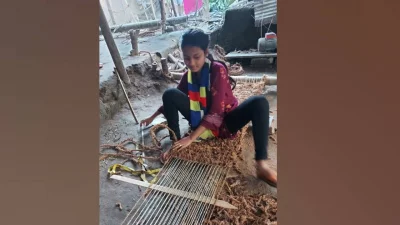
We found Laizu and Juthee, two school going girls at work. They informed us that a woman can make about three door mats daily. They are paid about 50 taka only for each mat .The paintings and labeling are also done by the women.
Normally, about 1000-1200 pieces of paposh are produced monthly at each “factory”. Depending on the quality, door mat is sold at Tk200 to Tk400. The quality ones are sold at Tk1,000-1,500.
Door Mats of coir are sold across the country.
In conversation with Nantu Mia over a cup of tea and muri (puffed rice) and molasses, I was further informed that there are more than dozen factories in the BSCIC industrial estate at Miarhat in Sutiakathi Union making different kinds of items from coir ropes.
Men are mostly engaged in rope making. Raw materials like garment wastes, cotton, jute, plastic nylon and other elements collected from different factories are mixed with coir to make ropes. Around 10 kg. of coir is produced in a ‘factory” daily. These ropes are mostly used in launches, ships, trucks and households. Men are paid Tk50 to Tk100 as daily wages.
Depending on different categories, each kg of rope is sold for Tk80 to Tk120 .
These ropes are sent to different markets in Barishal, Khulna, Chattogram, Dhaka and across the country. We were further informed that plastics and nylon pose a formidable challenge to the age-old traditional industry.
Despite stiff completion from artificial fibres, the natural fibres continue to thrive and given government support could find its place beyond our borders.
Dr Shamim Ahmed is a senior public health and nutrition specialist, a passionate traveler and a photographer.
