




In the annals of history, certain speeches mark a turning point, transcending their immediate context to spark movements that shape the destiny of nations.
Among these transformative orations is Dhirendranath Dutta’s impassioned plea in the Constituent Assembly of Pakistan in 1948. His words became the catalyst for the momentous language movement that would eventually secure Bangla as the national language of Bangladesh.
The backdrop was a defining moment for the newly formed state of Pakistan. On February 25, 1948, the Constituent Assembly of Pakistan considered Urdu and English as the official languages, neglecting Bangla, spoken by the people of East Pakistan, Pakistan’s most populous province.
It was during this pivotal session that Dhirendranath Dutta, an unsung hero and advocate for human rights, stood up to champion the cause of Bangla.
"The national language should be the language spoken by the majority of the people of the country, and I think that Bangla should be the lingua franca of our country," Dhirendranath Dutta proclaimed.
His words were a plea for linguistic inclusivity, rooted in the belief that a country’s language should reflect the voice of its people. However, his proposition was met with resistance, and the assembly rejected the plea to recognize Bangla as an official language. This decision by the assembly proved to be the tinder that ignited a fervent movement.
The then prime minister Nawabzada Liaquat Ali Khan, recognizing the significance of Dhirendranath 's words, foresaw the potential implications. He cautioned Dhirendranath, saying that his words could cause potential secession of the eastern wing and which could stem from such divisive language policies.
Liaquat Ali Khan’s words proved to be prescient. Dhirendranath Dutta's words not only articulated a plea for linguistic parity but also sowed the seeds of discontent that burgeoned into the language movement of 1952. The rejection of Bangla as an official language stirred deep sentiments among the Bangla-speaking populace, fostering among them a determination to assert their linguistic rights.
After returning to Dhaka following his bold, indeed seminal speech, students of Dhaka University went to greet Dhirendranath Dutta at the airport. One of the students was a young, yet to be Bangabandhu Sheikh Mujibur Rahman.
While the constitutional amendment recognizing Bangla as the national language did not materialize immediately after Dhirendranath Dutta’s speech, the fervor he ignited in his fellow Bengalis and in fact across the entirety of Pakistan paved the way for a groundbreaking shift. The
sacrifice and struggle of those who fought for the cause of Bangla language rights remain etched in the history of Bangladesh, securing a pivotal place in the nation’s narrative.
The documentary “Titas Parer Manushti: Shaheed Dhirendranath Dutta,” a testament to the life and legacy of Dhirendranath Dutta, offers a comprehensive insight into his journey, his advocacy, and the profound impact of his words.
The premiere of the documentary, held at Shilpakala Academy's Chitrashala Auditorium, was a testament to the enduring legacy of a man whose speech served as the initial spark for a monumental movement.
Aroma Dutta, Member of Parliament and granddaughter of Dhirendranath Dutta, RM Obaidul Muktadir Chowdhury, Member of Parliament, writers and intellectuals Mofidul Haque and Shahriar Kabir, and the director of the documentary, Tanvir Mokammel, spoke at the opening ceremony of the documentary.
Dhirendranath Dutta's legacy extends beyond mere words spoken in a legislative assembly. His vision, resilience, and unwavering belief in the significance of language and cultural identity resonated deeply with the people, setting ablaze the torch of a movement that would eventually change the course of history.
The clarion call for the Non-Cooperation Movement by Mahatma Gandhi resonated deeply with Dhirendranath Dutta. His involvement intensified, leading peaceful protests, organizing strikes, and disseminating Gandhi's philosophy of non-violence throughout Bengal.
According to Dhirendranath Dutta's family, he was once asked by a British lawyer on a train where he was going. In reply he said: “To a meeting to get rid of your kind from my land.”
At the premiere of the documentary, writer and intellectual Mofidul Haque said: “We are proud that such a wonderful person was born in Bangladesh. Dhirendranath Dutta laid the foundations of Bangladesh by demanding Bangla as the national language. His life needs comprehensive research."
The story of his speech and the subsequent movement for the Bangla language is a testament to the indomitable spirit of a people united in their quest for linguistic equality and for the preservation of cultural heritage.
Lawmaker RM Obaidul Muktadir Chowdhury said: "The demand to make Bangla the national language was a very bold demand. These words of his served as the seeds of the national language movement.”
In Brahmanbaria, the contributions of Dhirendranath Dutta have been immortalized through the establishment of a language square.
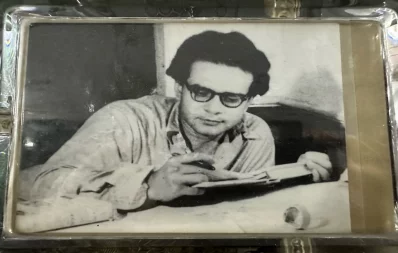
Although he was primarily known as a lawyer by profession, Dhirendranath Dutta exhibited remarkable engagement in both politics and social work, although this facet of his life is often overlooked.
Historian Muntasir Mamun says in the documentary: “He was part of the Congress. He played an effective role in the implementation of various laws such as those passed by the Bengal Legislative Council, Central Legislative Council. However, I do not discuss Dhirendranath's contribution as a public representative."
Dhirendranath Dutta was also appointed minister of health and social welfare in Chief Minister Ataur Rahman Khan's cabinet in 1956, an administration in which a young Sheikh Mujibur Rahman too served in a ministerial position.
It may be recalled that in his time, Dhirendranath Dutta established Rajshahi Medical College and Chittagong Medical College.
Director Tanvir Mokammel said: "In 1948, his demand for Bangla being the state language along with English and Urdu was simple but the implications were huge. As a documentary filmmaker I wish to speak for the unspoken. Therefore, I think it is my duty to try to understand the language of those people. I am very grateful to Aroma Dutta and her family for helping me make this film.”
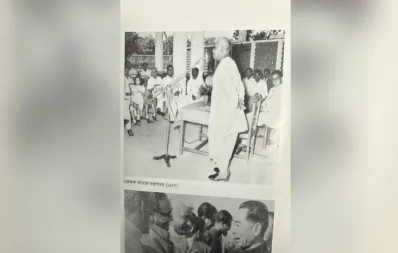
On March 29, 1971, in the aftermath of the genocide launched by the Pakistan army four days earlier, the eighty-five-year-old Dhirendranath was arrested from his house along with his son by the soldiers and taken to Comilla Cantonment, never to be seen again.
Recalling the distressing events of March 29, 1971, Aroma Dutta became emotional as she recounted the inhumane treatment inflicted upon her grandfather and uncle.
She revealed: "Both were subjected to brutal torture. Ramani Sheel, a Hindu barber, was spared because he used to trim the beards of the Pakistanis. He knew my grandfather. From him, we learned about the severe torture my grandfather endured. His knee was broken, but he remained resolute and did not yield to any pressure, even after
immense suffering. Ultimately, they were both killed. My uncle passed away before my grandfather. They were killed together and buried in a slaughterhouse."
A man of honour, Dhirendranth Dutta was revered by everyone. Following his demise, the then prime minister of India Indira Gandhi held a minute of silence in the Indian Parliament in his respect.
Dhirendranath Dutta remains, all these decades after his tragic passing, a lighthouse for succeeding generations of Bengalis as they understand Bangladesh’s history and engage in research on the phases which led to the country’s freedom.
Dhirendranath Dutta was a patriot par excellence, a Bengali beyond measure and a citizen of the world through his erudition and his comprehension of the forces which constitute history.
Profile
Dhirendranath Dutta
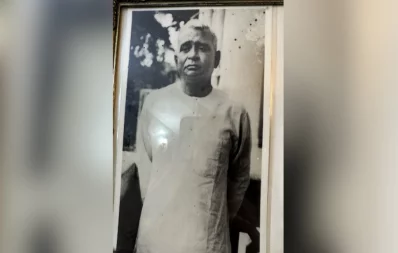
Dhirendranath Dutta, born on November 2, 1886, was a Bangali language advocate, politician, social worker, and linguist deeply devoted to his country and the well-being of its people. His unwavering commitment to truth and justice defined his life.
He ardently fought for the recognition of Bengali as a state language alongside English and Urdu at the 25th February, 1948 session of the Constituent Assembly of Pakistan in Karachi. His unyielding dedication to truth was evident even in the face of adversity, and he strongly believed that those sacrificing their lives for their country were immortal.
Dhirendranath Dutta's educational journey included studying at Nabinagar High School, Victoria College in Comilla, and Ripon College (currently known as Surendranath Law College) in Calcutta, India.
Dhirendranath Dutta's foray into activism commenced during his college years. He was actively involved in the Swadeshi movement, advocating the boycott of British goods and emphasizing the promotion of indigenous products. His oratory skills and fervent conviction made him a compelling orator and an influential figure among the youth.
His active involvement in political movements against the partition of Bengal and his significant role in various political assemblies and the East Pakistan cabinet underline his lifelong political engagement, He was referred to as Edmund Burke of the East.
In his historic speech in the Pakistan Constituent Assembly, Dhirendranath Dutta fervently advocated for Bangla as the lingua franca of the State, reflecting the voice of the majority population of the country.
But Dutta's unwavering dedication to independence was not restricted to political activism. He ardently believed in social equality and the eradication of caste discrimination.
Dutta's indomitable spirit, coupled with his organizational prowess, led to his being one of the prominent figures of the Indian National Congress. His influence and charisma were pivotal in mobilizing the masses and garnering support for the Congress in the region.
Despite his fervor for the cause, Dutta faced numerous challenges. He was imprisoned multiple times, enduring hardship and persecution for his unwavering commitment to India's freedom. His resilience in the face of adversity and his unyielding spirit made him a symbol of fortitude for his contemporaries.
The tragic event of his arrest on March 29, 1971, along with his son Dilipkumar Dutta, and subsequent killing at Mainamati Cantonment was highlighted by an eyewitness, Lieutenant Imamuzzaman, Bir Bikrom, and Pranab Kumar De in the documentary, describing the unjust accusations and the poignant moment when Dutta smiled despite the circumstances.
Pranab Kumar De said: “My father was a police inspector. Our house was inside the police lines. In the middle of the night there was a lot of shooting. Captain Bukhari's car arrived on March 27. Later I saw Dhirendranath Dutta and his son Dilipkumar Dutta sitting in the car. Dhirendranath was being abused as a spy of India. Then he gave a wry smile that I can still remember vividly.”
Even though his mortal remains have never been discovered, Dhirendranath Dutta endures as a symbol of unwavering dedication and an unyielding commitment to serving his motherland.
Aroma Dutta
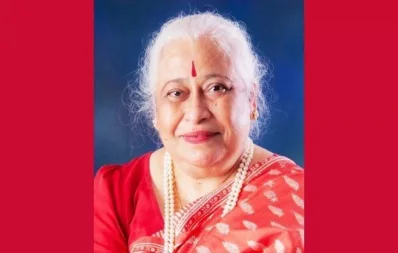
Aroma Dutta, is a Rokeya Padak winning human and women’s rights activist. She is currently a member of the 11th National Parliament and carries out her responsibilities as the founder of PRIP Trust, presently the Vice Chair of PRIP Trust, holds a significant identity as the granddaughter of the revered Language Martyr, Dhirendranath Dutta.
She was born on July 20, 1950, in the family's ancestral home in Comilla. Her father, Sanjib Dutta, served as a journalist with the erstwhile Pakistan Observer newspaper and her mother is famed director Ritwik Ghatak’s twin Pratiti Devi.
Her educational journey began in an American Convent School in Comilla, but when her grandfather became a Minister of the United Front, she briefly attended Viqarunnessa Noon School in Dhaka, and in Nawab Faizunnessa Government Girls High School, Comilla, studying in Bangla medium.
Aroma Dutta completed her Matriculation from Faizunnessa School and Higher Secondary from Comilla Mahila College in 1968. Subsequently, she pursued her higher studies in the Department of Social Sciences at Dhaka University in 1968, earning her master's degree in 1974. Initially, she embarked on a teaching career at Dhaka University, dedicating a year and a half to the institution.
Aroma Dutta has always had profound admiration for her grandfather, Dhirendranath Dutta, a sentiment rooted in her childhood.
Speaking about her grandfather's premonition of the liberation war in 1971, Aroma Dutta emotionally revealed: "My grandfather predicted a significant war in the country, that there would be a severe bloodbath, that many would perish, but that the nation would gain independence."
She reflects on her grandfather's patriotism and courage in the face of adversity, recalling the moment when he was taken away.
She narrated: "As they took my grandfather away, he recited a verse from his Pocket Gita, saying that one who willingly sacrifices life for his country in war is indestructible. Today, the Pakistani military will take me. They will torture me and attempt to extract a statement, and I will tell them, to stop killing these innocent unarmed people of the State.”
Despite their efforts, Aroma Dutta asserted that the enemy failed to break her grandfather's resolve. She recalled: "A father saw his son tortured in front of him. Despite his immense patriotism, torture couldn't shake him. They couldn't extract any statement."
Tanvir Mokammel

Tanvir Mokammel, the esteemed film director, was born on March 8, 1955, and spent his formative years in Khulna. His educational journey included studying at St. Joseph's High School, and later, he delved into journalism during his university years. Mokammel completed his Masters in English Literature from Dhaka University, shaping the foundations of his diverse expertise.
In his career, he has created remarkable films such as "Chitra Nadir Pare" (1999), "Lal Shalu" (2001), and "Lalon" (2004), earning him accolades, including the Ekushey Padak and the National Film Award.
Tanvir Mokammel produced the documentary on Dhirendranath Dutta. He meticulously crafted this autobiographical account of Dhirendranath Dutta through extensive interactions with Dutta’s family members and personal visits to Dutta's roots in Brahmanbaria.
Tanvir Mokammel believes that individuals who are not widely discussed deserve recognition, particularly for their contributions to their country and society.
Referring to Dhirendranath as an unsung hero, he said: "As a documentary filmmaker, it's crucial to shed light on those who are often overlooked. In 1971, a foreign journalist in Pakistan after his murder wrote: “Somewhere in Comilla cantonment lies an unsung hero, whose contributions will go unnoticed by history.”
