


As Bangladesh slowly climbs the stairs out of LDC (Least Developed Countries) status, sometimes it’s easy to forget the forces slowing its steps. Corruption is rife here, of course—but it’s rife in other developing countries too, and despite corruption, rather than because of it, Bangladesh is winning its economic battles. But a story emerged the other day from a village in Bhola, Char Fasson Upazilla, that really illustrates the victims of the "victimless crime" of corruption and the real cost to Bangladesh’s economy.
At midnight last Thursday, a group of thugs attacked a primary school, which three teachers and a couple of hundred children called “home”. They destroyed the school, broke up the furniture, scattered the school books, hacked open the school safe, and stole the school records. Records that go back 16 years.

This was no ordinary school. This is a school built with money donated by Australian schoolchildren to a charity that has been working in Bangladesh for over 30 years. Co-operation in Development (or Fred Hyde Schools, as it is perhaps better known) is the 99th NGO on the Bureau’s register and is one of those quiet achievers in our development. They have educated tens of thousands of children from landless families at a cost of exactly zero taka to the Bangladeshi economy—in fact, they are pumping in many crores of money, employing hundreds of locals who would otherwise be destitute.
And their reward is this: a pile of rubble and school books torn up and half buried in mud.
It’s the why of this story that is the worry. The land was kindly donated to the charity 18 years ago by a local lady for the purpose of a school, and she passed away seeing the fruit of her generosity.
Two years ago, the charity agreed to allow the World Bank to build a cyclone shelter on the site, a magnificent structure that caught the envious eye of the donor’s son, who decided he wanted his mother’s donation back. So, he seized the cyclone shelter, planted some stooges in as teachers, and then went about changing the records at an Upazilla level to rewrite history. Now "his" school, not the school that the Australians built, sits in government records. A school that was being run by professionals is now replaced by a school that is run by thugs. Are they motivated by wanting to improve educational standards in rural Bangladesh? Hardly. Typically, what happens is that the "teachers" jobs are sold to the highest bidder, and then a central organiser starts submitting documents and applying pressure to have the school nationalised. I’m not saying that this is happening in this case—I’m just saying this is what typically happens.
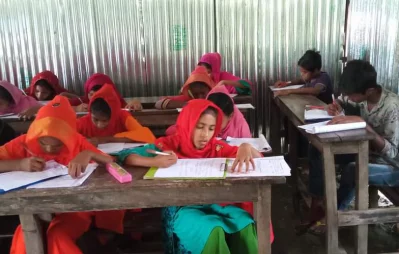
How do I know so much about the inside story? Well, I have worked as a volunteer for this charity since 2016. The school I am writing about was established by the Charity NGO Co-operation in Development (CO-ID) by legendary 80-year-old Australian volunteer Fred Hyde in 2006. The key thing is that we ran a school without trouble for seventeen years on the site. But a local group got greedy. They destroyed the school at midnight, pretended it was a storm, and then planted trees among the school books. They have destroyed 19 years of hard work overnight. And we did not get any help from the local authority to save the school.
In this secluded char, the indomitable essence of education finds itself at a critical juncture. It is my earnest conviction that both our education ministry and the local administration will delve into this issue. The multitude of students from Middle Char Aicha CO-ID School yearns for justice and the continuation of their educational journey. We must stand to support them, ensuring they are not left to navigate this challenge alone.
The writer is a teacher and independent journalist.
