



As sanctions on Russia have delayed payments for the under-construction Rooppur Nuclear Power Plant (RNPP), Bangladesh is now searching for solutions to clear payments.
The problem arose as some of the largest banks in Russia are barred from much of the international banking system.
Along with this, Dhaka's forex reserves have declined somewhat, adding to the problem, reports Nikkei Asia.
Rosatom, Russia's state-owned nuclear energy organization, is currently building the Rooppur power plant, Bangladesh's first nuclear power plant, which is due to start operating in 2024.
The RNPP, about 140km west of Dhaka, is Bangladesh's biggest infrastructure project to date and a vital part of plans to move away from coal and other fossil fuels.
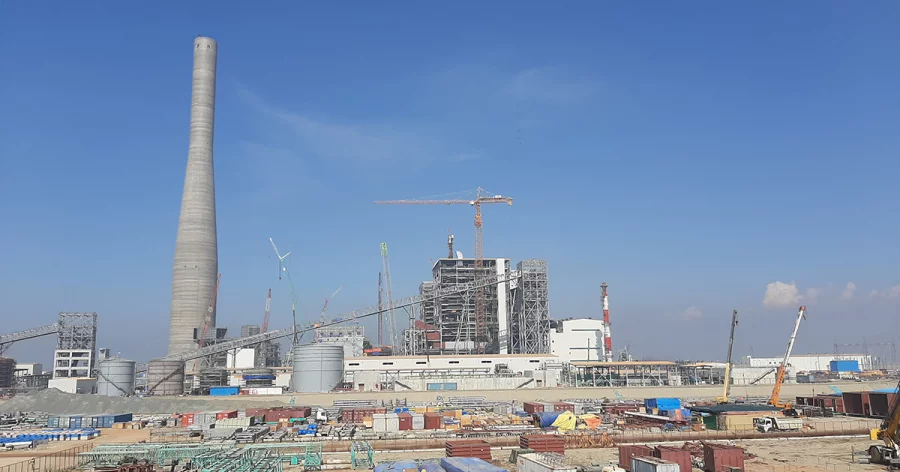 Dhaka Tribune
The facility would be capable of generating 2,400MW of electricity when it is fully operational, which is enough for 15 million households.
Russian loans are funding 90% of the $12.65 billion project.
But the country could not pay three debt instalments totalling $110 million since Russia invaded Ukraine in February last year.
It is also becoming difficult for Russia to disburse the multibillion-dollar lending it has promised due to the sanctions, said Alok Chakraborty, chief administrative officer of the Rooppur project.
Rosatom has written to the Bangladesh government to find a solution for repaying the debt, reports Nikkei Asia.
The main problem arose in March last year when some of the largest banks in Russia were barred from the SWIFT financial system, which handles the vast majority of cross-border payments.
A Russian state-owned institution, the Bank for Development and Foreign Economic Affairs (VEB), which handles transactions for the RNPP, was among those hit by the sanctions.
 Rooppur nuclear power plant Bigstock
Moreover, a plunge in the taka's value against the US dollar is not making the situation any easier to resolve either.
However, officials claim that there is no connection.
Bangladesh recently secured a $4.7 billion loan from the International Monetary Fund (IMF).
In the meantime, many banks have been unable to settle import payments and have stopped opening letters of credit for essential products.
Mezbaul Haq, a spokesperson for Bangladesh Bank, said the delay in payment has nothing to do with the current dollar crisis as the amount currently due is not much.
The $110 million is owed on a $500 million loan agreed in 2013, which Russia disbursed through VEB for preliminary work on the power plant.
A deal for a far bigger main loan -- worth $11.38 billion -- was signed in 2016.
Russia has so far provided $4.97 billion, and repayments are not due to start until 2027.
The payment problem appears to have slowed construction, according to Nikkei Asia.
Officials concerned fear that the project could be delayed by a year.
The plant was supposed to start generating electricity by the end of 2024.
International pressure on Russia over the Ukraine war has created other logistical problems.
In December, Bangladesh was obliged by US and UN sanctions to turn away a large Russian cargo vessel that was carrying equipment for the nuclear plant.
The government also recently blocked the entry of 69 Russian ships that had violated Western sanctions.
The ship which was blocked in December later unloaded at an Indian port.
The plan was drawn up to transport the equipment by road to Bangladesh, increasing the time and cost of supplying the construction.
Bangladesh also finds itself in the middle of US-Russian sparring over human rights and the role of foreign missions in domestic affairs.
With Moscow applying pressure to fix the payment issue, Bangladesh's Science and Technology Ministry, which oversees the project, held an emergency meeting on February 2 with officials from the central bank and commercial banks involved in the project.
However, nothing came of the meeting.
Yeafesh Osman, the science and technology minister, told the media that a high-level delegation would soon visit Russia for talks with the government.
Rosatom, meanwhile, said in a statement to Nikkei Asia: "Our governments are working closely to ensure the smooth implementation of the project in all aspects.
“Rosatom is committed to and continues to fulfil all of its contractual obligations in regard to the Rooppur power plant."
Russia had been asking Bangladesh Bank to encourage the country's commercial banks to join SPFS, a Russian alternative to SWIFT.
However, Bangladeshi institutions showed no interest for fear of incurring US penalties.
A Bangladesh Bank official who requested anonymity said most commercial banks they approached were also reluctant because dispute settlements under SPSF are handled according to Russian law.
SWIFT, on the other hand, operates based on international law due to the network's joint ownership by more than 2,000 banks and financial institutions in the US and European Union.
A proposal for paying back the loan in rubles was also shunned by Dhaka because of the complex procedures involved and conversion risks.
The two countries had earlier pursued a separate currency swap arrangement, which would have entailed creating a credit line of 10 billion rubles for Bangladesh and Tk1,000 crore for Russia. One ruble is worth about 1.49 taka.
But the Bangladesh Bank official said the plan never materialized because of multiple issues.
Mirza Amin, a veteran Bangladeshi banker who has headed the foreign exchange departments of several multinational banks, said currency swap agreements usually work between countries that have large, relatively balanced bilateral trade.
He also pointed out that annual trade between Bangladesh and Russia is only around $1 billion.
Amin said a currency swap would not be that attractive -- especially to Bangladesh, as imports from Russia are about 15% more than its exports to the country.
The best possible solution for Bangladesh now would be to find Russian banks that are not barred from the SWIFT system, said the bank, adding that not all Russian banks are under the sanctions.
He said seeking help from India or China, both of which still do significant business with Russia, could be an option. They could act as a third party, Amin added.
However, he cautioned that Western countries are Bangladesh's main export destination, and “we should keep in mind that they sanctioned Russia."
