




Flash floods and standing water, triggered by water running down the hillsides after heavy rains have damaged makeshift shelters, infrastructure, stored food and other establishments in the Cox’s Bazar Rohingya camps since the beginning of the monsoon.
An Oxfam survey of Rohingya refugees in Bangladesh found that more than half of them were unprepared to face the calamities that come with the monsoon.
“The monsoon rains are causing flooding, landslides, and disease outbreaks in the Rohingya refugee camps,” said Oxfam’s Humanitarian Program Coordinator in Bangladesh, Gabriela Luz-Meillet.
“Hundreds of thousands of people are living in temporary shelters, on hills of compacted mud which are completely shorn of protective trees and plants. Those hills could melt into the earth. There are refugees alive today who will not make it through to the end of the rainy season.”
Kutupalang D5 camp dweller Mohammad Reaz told the Dhaka Tribune that they become anxious whenever it rains. “Every day, a number of shelters are damaged by rain, flash floods, and landslides,” he said.
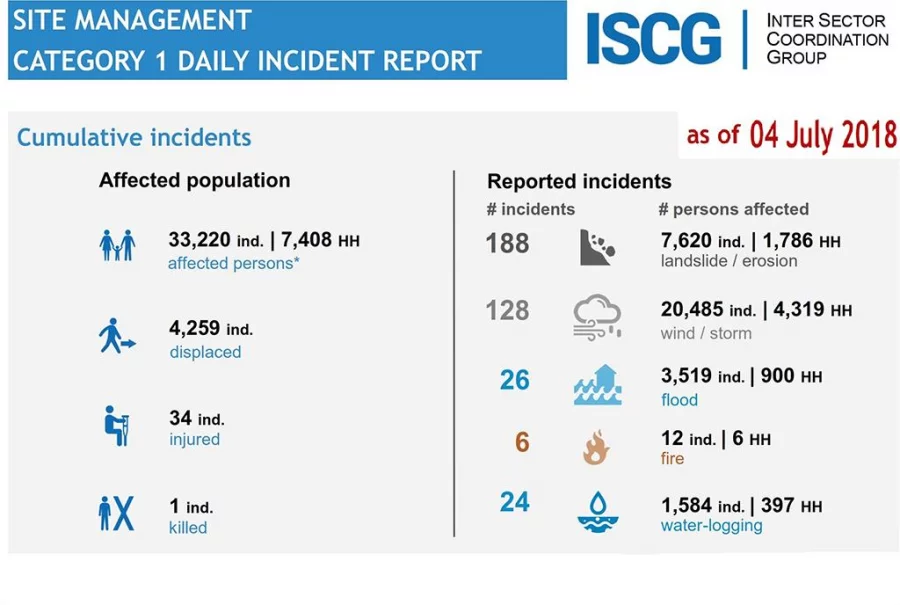
“But water logging causes more suffering in the camps,” added Mohammad Arafat, another refugee at the Balukhali camp.
The Bangladesh Water Development Board’s Flood Forecasting and Warning Centre recorded 116mm rainfall in Cox’s Bazar during the last 24 hours. It has forecast 945.60mm rainfall in the district this month.
The worst affected by the monsoon are the 4,000 or so Rohingya stranded at no man’s land of Tambru and Konarpara under Naikhongchhari’s Ghumdum union.
Rohingya leader Dil Mohammad said flash floods over the last two days had damaged their food. “We are facing scarcity of drinking water, medicines, food and other necessities,” he told the Dhaka Tribune.
‘Untenable, inhuman situation’
 The latest spate of torrential rain that started on Tuesday morning damaged more than a hundred shelters in Kutupalang camp, the refugees said.
Lalu Majhi, the designated Rohingya leader of a particular camp area of Balukhali, said many shelters had been set up on the hill slopes. The local administration evacuated more than 200 families from the risky hillsides but many families are still residing in areas at risk for landslides and floods.
He said they had received reports over the last two days, of minor landslides in the camp area.
Similar reports have come in over the last two days from Tanjimarghona, Balukhali-2, Moynarghona, Shafiullahkata, and Lombashia in the camp area. Many of the affected families are now living under the open sky.
Cox’s Bazar district administration said the Rohingya population affected by landslides and flash floods is getting support and aid.
International Federation of Red Cross and Red Crescent Societies expert, Steve McAndrew, after finishing a four-month assignment as head of emergency operations for IFRC in Bangladesh, said the monsoon rains are already causing chaos in the makeshift camps.
“Each year [with IFRC] I see more need, but this last operation in Cox’s Bazar was to me some of the worst conditions I’ve ever seen in my career. One of the things that’s lacking here is hope – there’s no end in sight, there’s no light at the end of the tunnel for the people we’re serving,” he said.
“We’re letting them know that we’re listening, and we are spreading the word so that the world knows this situation is difficult, untenable and inhuman,” McAndrew added.
