




 “In addition to faulty building construction practices, the rapid use of the city’s floodplain will play a role in possible building collapse and subsequent human causalities if an earthquake of 7.5 magnitude hits Dhaka,” he said.
The Ministry of Disaster Management and Relief commissioned a research named “Seismic Risk Assessment in Bangladesh” a few years ago, initiated by the Comprehensive Disaster Management Programme (CDMP).
The study, popularly known as “Dhaka Profile and Earthquake Risk Atlas 2014”, was conducted in two phases: CDMP I (2007-2009) and CDMP II (2012-2014). It assessed that if an earthquake of 7.5 magnitude strikes the capital, it will kill at least 50,000 people, injure 200,000 more, and cause damages worth as much as $5.7 billion.
The study was based on a probable model of a 7.5-magnitude tremor along the Madhupur fault line and was conducted by the Bangladesh Urban Earthquake Resilience Project with assistance from the World Bank and Earthquakes and Megacities Initiatives (EMI).
The research data estimated that around 88,000 buildings – over one quarter of the total in Dhaka – would be extensively damaged; Dhaka North could suffer the collapse of up to 54,000 buildings, while Dhaka South could face the collapse of 34,000 buildings.
The study further showed that the Dhaka North City Corporation (DNCC) could face an estimated bill of around $3.4billion, while the Dhaka South City Corporation (DSCC) might suffer damages of around $2.2 billion.
The study identified several aspects of construction which could compromise the structural integrity of buildings during a quake, which include soft storeys, flat slab, heavy overhang, torsional irregularity, slender and short column, non-parallel system, poor concrete, insufficient gap, non-structural vulnerability, soil liquefaction, narrow access and absence of fire protection.
Dr Md Humayun Kabir, a professor at the department of geography and environment in Dhaka University, said in the Dhaka city, more than 80% building are non-engineered.
“We have to focus on enforcing the Building Code so that buildings are made following the safety rules. We need to consult with the engineers, planners masons, building owners and developers to come up with coordinated solution,” he added.
When the earthquake in Nepal happened in 2015, many of its 94% non-engineered buildings miraculously survived, he further said.
“But you cannot surrender your life to the fate,” he added. “In Dhaka, a major earthquake will be fatal. As we have seen in the case of Rana Plaza collapse in Savar. We spent nearly a month just removing debris. If there is a strong earthquake in this city, or Chittagong, we can safely assume that it will be similarly disastrous as the population density is very high in these cities.”
When contacted, Bangladesh Fire Service and Civil Defence Director General Brig Gen Ali Ahmed Khan said the Fire Service had more post-earthquake rescue equipments, and disaster management plans were better than before.
However, intensive coordinated plans among organisations, public representatives and every member of society is also necessary, he added.
“In addition to faulty building construction practices, the rapid use of the city’s floodplain will play a role in possible building collapse and subsequent human causalities if an earthquake of 7.5 magnitude hits Dhaka,” he said.
The Ministry of Disaster Management and Relief commissioned a research named “Seismic Risk Assessment in Bangladesh” a few years ago, initiated by the Comprehensive Disaster Management Programme (CDMP).
The study, popularly known as “Dhaka Profile and Earthquake Risk Atlas 2014”, was conducted in two phases: CDMP I (2007-2009) and CDMP II (2012-2014). It assessed that if an earthquake of 7.5 magnitude strikes the capital, it will kill at least 50,000 people, injure 200,000 more, and cause damages worth as much as $5.7 billion.
The study was based on a probable model of a 7.5-magnitude tremor along the Madhupur fault line and was conducted by the Bangladesh Urban Earthquake Resilience Project with assistance from the World Bank and Earthquakes and Megacities Initiatives (EMI).
The research data estimated that around 88,000 buildings – over one quarter of the total in Dhaka – would be extensively damaged; Dhaka North could suffer the collapse of up to 54,000 buildings, while Dhaka South could face the collapse of 34,000 buildings.
The study further showed that the Dhaka North City Corporation (DNCC) could face an estimated bill of around $3.4billion, while the Dhaka South City Corporation (DSCC) might suffer damages of around $2.2 billion.
The study identified several aspects of construction which could compromise the structural integrity of buildings during a quake, which include soft storeys, flat slab, heavy overhang, torsional irregularity, slender and short column, non-parallel system, poor concrete, insufficient gap, non-structural vulnerability, soil liquefaction, narrow access and absence of fire protection.
Dr Md Humayun Kabir, a professor at the department of geography and environment in Dhaka University, said in the Dhaka city, more than 80% building are non-engineered.
“We have to focus on enforcing the Building Code so that buildings are made following the safety rules. We need to consult with the engineers, planners masons, building owners and developers to come up with coordinated solution,” he added.
When the earthquake in Nepal happened in 2015, many of its 94% non-engineered buildings miraculously survived, he further said.
“But you cannot surrender your life to the fate,” he added. “In Dhaka, a major earthquake will be fatal. As we have seen in the case of Rana Plaza collapse in Savar. We spent nearly a month just removing debris. If there is a strong earthquake in this city, or Chittagong, we can safely assume that it will be similarly disastrous as the population density is very high in these cities.”
When contacted, Bangladesh Fire Service and Civil Defence Director General Brig Gen Ali Ahmed Khan said the Fire Service had more post-earthquake rescue equipments, and disaster management plans were better than before.
However, intensive coordinated plans among organisations, public representatives and every member of society is also necessary, he added.Bangladesh is located on the tectonically active Himalayan orogenic belt, which has developed through collision with the Indian, Arabian and Eurasian plates over the last 30-40 million years.
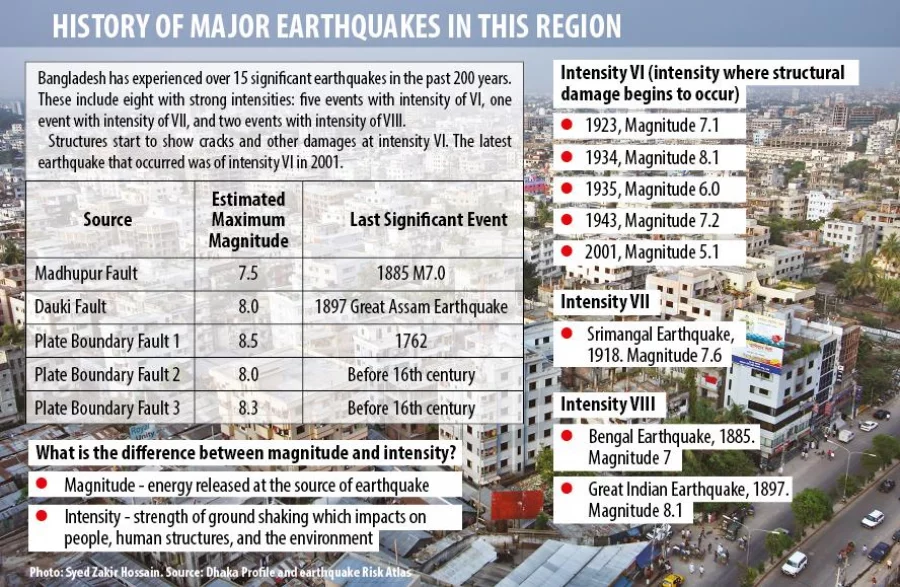
Experts predict that a massive earthquake of 8.2 to 9.0 magnitude is imminent, much like the great Bengal earthquake of 1897.
A 2016 study by a team of researchers, led by Dr Michael Steckler from Columbia University, titled “Locked and loading megathrust linked to active subduction beneath the Indo-Burman Ranges”, found a new megathrust fault line that runs through Myanmar, Bangladesh and India.
Dhaka, with a population of 11 million, is the second densest city in the world with very few earthquake-resistant buildings. With development on sand-filled land in recent times, Dhaka has been consistently named one of the riskiest cities in the world for an earthquake.
This newly discovered megathrust fault happens when the Earth’s tectonic plates collide with each other and when one of the plates try to move under the other. They are known to produce some of the biggest earthquakes, like the one in 2011 in Japan and the 2004 Banda Aceh earthquake, both of which created disastrous tsunamis.
Even when in April 2015, a 7.5 magnitude earthquake hit Nepal that killed over 9,000 people, the shock waves was felt in Bangladesh.
With the latest earthquake with 7.3 magnitude that hit Iran and Iraq on Sunday killing at least 413 people as of 10pm yesterday, it only reminds us of the vulnerability of Bangladesh given the fact that it sits directly under a fault line.
The earthquake was felt in several western provinces of Iran, but the hardest hit province was Kermanshah. More than 300 of the victims were in Sarpol-e Zahab county in Kermanshah province, about 15km from the Iraq border.
Iranian state television said the quake had caused heavy damage in some villages where houses were made of earthen bricks. Rescuers were labouring to find survivors trapped under collapsed buildings, reported Reuters.
Speaking to the Dhaka Tribune, Prof Mehedi Ahmed Ansary of the civil engineering department in Bangladesh University of Engineering and Technology (BUET), said there is very high chances of a massive earthquake in Bangladesh like the one in 1897, which was estimated to be the magnitude of 8 on the Richter scale. “In addition to faulty building construction practices, the rapid use of the city’s floodplain will play a role in possible building collapse and subsequent human causalities if an earthquake of 7.5 magnitude hits Dhaka,” he said.
The Ministry of Disaster Management and Relief commissioned a research named “Seismic Risk Assessment in Bangladesh” a few years ago, initiated by the Comprehensive Disaster Management Programme (CDMP).
The study, popularly known as “Dhaka Profile and Earthquake Risk Atlas 2014”, was conducted in two phases: CDMP I (2007-2009) and CDMP II (2012-2014). It assessed that if an earthquake of 7.5 magnitude strikes the capital, it will kill at least 50,000 people, injure 200,000 more, and cause damages worth as much as $5.7 billion.
The study was based on a probable model of a 7.5-magnitude tremor along the Madhupur fault line and was conducted by the Bangladesh Urban Earthquake Resilience Project with assistance from the World Bank and Earthquakes and Megacities Initiatives (EMI).
The research data estimated that around 88,000 buildings – over one quarter of the total in Dhaka – would be extensively damaged; Dhaka North could suffer the collapse of up to 54,000 buildings, while Dhaka South could face the collapse of 34,000 buildings.
The study further showed that the Dhaka North City Corporation (DNCC) could face an estimated bill of around $3.4billion, while the Dhaka South City Corporation (DSCC) might suffer damages of around $2.2 billion.
The study identified several aspects of construction which could compromise the structural integrity of buildings during a quake, which include soft storeys, flat slab, heavy overhang, torsional irregularity, slender and short column, non-parallel system, poor concrete, insufficient gap, non-structural vulnerability, soil liquefaction, narrow access and absence of fire protection.
Dr Md Humayun Kabir, a professor at the department of geography and environment in Dhaka University, said in the Dhaka city, more than 80% building are non-engineered.
“We have to focus on enforcing the Building Code so that buildings are made following the safety rules. We need to consult with the engineers, planners masons, building owners and developers to come up with coordinated solution,” he added.
When the earthquake in Nepal happened in 2015, many of its 94% non-engineered buildings miraculously survived, he further said.
“But you cannot surrender your life to the fate,” he added. “In Dhaka, a major earthquake will be fatal. As we have seen in the case of Rana Plaza collapse in Savar. We spent nearly a month just removing debris. If there is a strong earthquake in this city, or Chittagong, we can safely assume that it will be similarly disastrous as the population density is very high in these cities.”
When contacted, Bangladesh Fire Service and Civil Defence Director General Brig Gen Ali Ahmed Khan said the Fire Service had more post-earthquake rescue equipments, and disaster management plans were better than before.
However, intensive coordinated plans among organisations, public representatives and every member of society is also necessary, he added.
“In addition to faulty building construction practices, the rapid use of the city’s floodplain will play a role in possible building collapse and subsequent human causalities if an earthquake of 7.5 magnitude hits Dhaka,” he said.
The Ministry of Disaster Management and Relief commissioned a research named “Seismic Risk Assessment in Bangladesh” a few years ago, initiated by the Comprehensive Disaster Management Programme (CDMP).
The study, popularly known as “Dhaka Profile and Earthquake Risk Atlas 2014”, was conducted in two phases: CDMP I (2007-2009) and CDMP II (2012-2014). It assessed that if an earthquake of 7.5 magnitude strikes the capital, it will kill at least 50,000 people, injure 200,000 more, and cause damages worth as much as $5.7 billion.
The study was based on a probable model of a 7.5-magnitude tremor along the Madhupur fault line and was conducted by the Bangladesh Urban Earthquake Resilience Project with assistance from the World Bank and Earthquakes and Megacities Initiatives (EMI).
The research data estimated that around 88,000 buildings – over one quarter of the total in Dhaka – would be extensively damaged; Dhaka North could suffer the collapse of up to 54,000 buildings, while Dhaka South could face the collapse of 34,000 buildings.
The study further showed that the Dhaka North City Corporation (DNCC) could face an estimated bill of around $3.4billion, while the Dhaka South City Corporation (DSCC) might suffer damages of around $2.2 billion.
The study identified several aspects of construction which could compromise the structural integrity of buildings during a quake, which include soft storeys, flat slab, heavy overhang, torsional irregularity, slender and short column, non-parallel system, poor concrete, insufficient gap, non-structural vulnerability, soil liquefaction, narrow access and absence of fire protection.
Dr Md Humayun Kabir, a professor at the department of geography and environment in Dhaka University, said in the Dhaka city, more than 80% building are non-engineered.
“We have to focus on enforcing the Building Code so that buildings are made following the safety rules. We need to consult with the engineers, planners masons, building owners and developers to come up with coordinated solution,” he added.
When the earthquake in Nepal happened in 2015, many of its 94% non-engineered buildings miraculously survived, he further said.
“But you cannot surrender your life to the fate,” he added. “In Dhaka, a major earthquake will be fatal. As we have seen in the case of Rana Plaza collapse in Savar. We spent nearly a month just removing debris. If there is a strong earthquake in this city, or Chittagong, we can safely assume that it will be similarly disastrous as the population density is very high in these cities.”
When contacted, Bangladesh Fire Service and Civil Defence Director General Brig Gen Ali Ahmed Khan said the Fire Service had more post-earthquake rescue equipments, and disaster management plans were better than before.
However, intensive coordinated plans among organisations, public representatives and every member of society is also necessary, he added.
“In addition to faulty building construction practices, the rapid use of the city’s floodplain will play a role in possible building collapse and subsequent human causalities if an earthquake of 7.5 magnitude hits Dhaka,” he said.
The Ministry of Disaster Management and Relief commissioned a research named “Seismic Risk Assessment in Bangladesh” a few years ago, initiated by the Comprehensive Disaster Management Programme (CDMP).
The study, popularly known as “Dhaka Profile and Earthquake Risk Atlas 2014”, was conducted in two phases: CDMP I (2007-2009) and CDMP II (2012-2014). It assessed that if an earthquake of 7.5 magnitude strikes the capital, it will kill at least 50,000 people, injure 200,000 more, and cause damages worth as much as $5.7 billion.
The study was based on a probable model of a 7.5-magnitude tremor along the Madhupur fault line and was conducted by the Bangladesh Urban Earthquake Resilience Project with assistance from the World Bank and Earthquakes and Megacities Initiatives (EMI).
The research data estimated that around 88,000 buildings – over one quarter of the total in Dhaka – would be extensively damaged; Dhaka North could suffer the collapse of up to 54,000 buildings, while Dhaka South could face the collapse of 34,000 buildings.
The study further showed that the Dhaka North City Corporation (DNCC) could face an estimated bill of around $3.4billion, while the Dhaka South City Corporation (DSCC) might suffer damages of around $2.2 billion.
The study identified several aspects of construction which could compromise the structural integrity of buildings during a quake, which include soft storeys, flat slab, heavy overhang, torsional irregularity, slender and short column, non-parallel system, poor concrete, insufficient gap, non-structural vulnerability, soil liquefaction, narrow access and absence of fire protection.
Dr Md Humayun Kabir, a professor at the department of geography and environment in Dhaka University, said in the Dhaka city, more than 80% building are non-engineered.
“We have to focus on enforcing the Building Code so that buildings are made following the safety rules. We need to consult with the engineers, planners masons, building owners and developers to come up with coordinated solution,” he added.
When the earthquake in Nepal happened in 2015, many of its 94% non-engineered buildings miraculously survived, he further said.
“But you cannot surrender your life to the fate,” he added. “In Dhaka, a major earthquake will be fatal. As we have seen in the case of Rana Plaza collapse in Savar. We spent nearly a month just removing debris. If there is a strong earthquake in this city, or Chittagong, we can safely assume that it will be similarly disastrous as the population density is very high in these cities.”
When contacted, Bangladesh Fire Service and Civil Defence Director General Brig Gen Ali Ahmed Khan said the Fire Service had more post-earthquake rescue equipments, and disaster management plans were better than before.
However, intensive coordinated plans among organisations, public representatives and every member of society is also necessary, he added.