




 But a large number of relief teams, representing individual initiatives and various organisations, were not coordinating with it. Many of these teams distributed food, clothing, water, baby food, saline and other medicines on their own on Thursday avoiding government instructions.
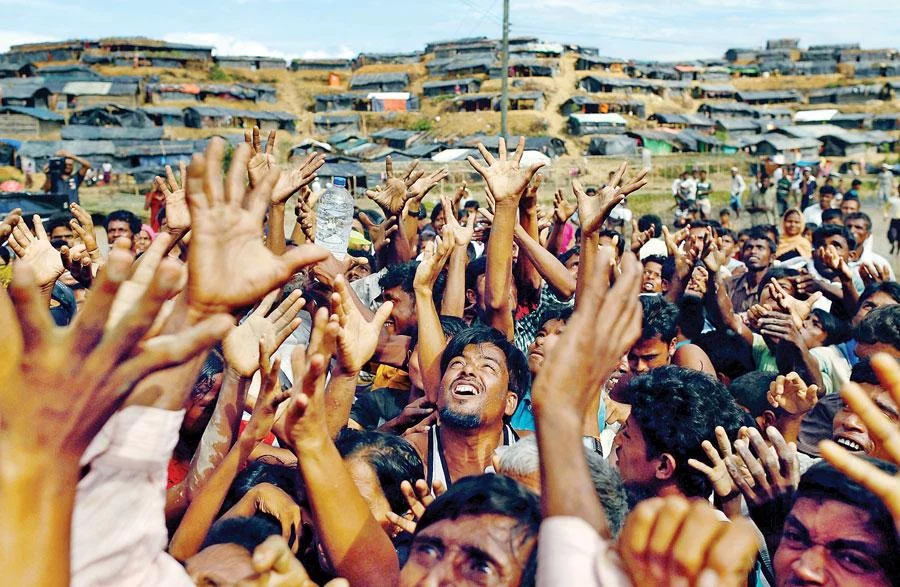
As a result, most of the distribution attempts were completely unorganised, leaving many refugees with relief and many without.
Many teams, mostly inexperienced, were seen throwing different items from trucks and vans at the refugees, resulting into waste of relief items.
“There are plenty of foods and clothing, but a roof over their [refugees] heads is a priority. Better coordination in providing aids has become a must,” said an NGO worker.
However, until Thursday evening, the International Organisation for Migration (IOM) erected 700 shelter homes in coordination with the Cox’s Bazar DC office at Kutupalong and Palongkhali. At least two or three families live in each home.
Around 2,000 families currently live in these homes, while the rest of the refugees are living under open sky across the district.
But a large number of relief teams, representing individual initiatives and various organisations, were not coordinating with it. Many of these teams distributed food, clothing, water, baby food, saline and other medicines on their own on Thursday avoiding government instructions.
As a result, most of the distribution attempts were completely unorganised, leaving many refugees with relief and many without.
Many teams, mostly inexperienced, were seen throwing different items from trucks and vans at the refugees, resulting into waste of relief items.
“There are plenty of foods and clothing, but a roof over their [refugees] heads is a priority. Better coordination in providing aids has become a must,” said an NGO worker.
However, until Thursday evening, the International Organisation for Migration (IOM) erected 700 shelter homes in coordination with the Cox’s Bazar DC office at Kutupalong and Palongkhali. At least two or three families live in each home.
Around 2,000 families currently live in these homes, while the rest of the refugees are living under open sky across the district.Rohingya refugees, who have fled brutal persecution in Myanmar’s Rakhine State, are severely suffering in Cox’s Bazar and Teknaf border areas due to absence of shelters, medicines, sanitation facilities and clean water.
To tackle the crisis swiftly, doctors and people involved in providing humanitarian assistance to the refugees have called for a strong central coordination and proper initiatives.
Until Thursday, over 350,000 refugees were staying either under open sky or at the new refugee camps and shelters at Ukhiya’s Kutupalong and Palongkhali, at Teknaf town, Nayapara and Shah Porir Dwip and many areas in Cox’s Bazar.
The UNHCR on Thursday said around 400,000 refugees have crossed over into Bangladesh since Myanmar army launched a counteroffensive against Rohingya insurgents in Rakhine in late August.
The government, NGOs and many voluntary organisations were seen providing aids in Ukhiya and Teknaf on Thursday. But medicines, sanitation facilities, clean water and shelter are both scarce and unavailable to most of the refugees.
Many suffering from diarrhoeal and different diseases were also not even getting saline, proper medicines and clean drinking water.
The Cox’s Bazar deputy commissioner’s (DC) office has already opened a control centre to receive donations and relief items for proper distribution.
DC Md Ali Hossain told the Dhaka Tribune that if everyone sent their donations and aid items to them, everything would be distributed equally to all refugees. But a large number of relief teams, representing individual initiatives and various organisations, were not coordinating with it. Many of these teams distributed food, clothing, water, baby food, saline and other medicines on their own on Thursday avoiding government instructions.
As a result, most of the distribution attempts were completely unorganised, leaving many refugees with relief and many without.
Many teams, mostly inexperienced, were seen throwing different items from trucks and vans at the refugees, resulting into waste of relief items.
“There are plenty of foods and clothing, but a roof over their [refugees] heads is a priority. Better coordination in providing aids has become a must,” said an NGO worker.
However, until Thursday evening, the International Organisation for Migration (IOM) erected 700 shelter homes in coordination with the Cox’s Bazar DC office at Kutupalong and Palongkhali. At least two or three families live in each home.
Around 2,000 families currently live in these homes, while the rest of the refugees are living under open sky across the district.
But a large number of relief teams, representing individual initiatives and various organisations, were not coordinating with it. Many of these teams distributed food, clothing, water, baby food, saline and other medicines on their own on Thursday avoiding government instructions.
As a result, most of the distribution attempts were completely unorganised, leaving many refugees with relief and many without.
Many teams, mostly inexperienced, were seen throwing different items from trucks and vans at the refugees, resulting into waste of relief items.
“There are plenty of foods and clothing, but a roof over their [refugees] heads is a priority. Better coordination in providing aids has become a must,” said an NGO worker.
However, until Thursday evening, the International Organisation for Migration (IOM) erected 700 shelter homes in coordination with the Cox’s Bazar DC office at Kutupalong and Palongkhali. At least two or three families live in each home.
Around 2,000 families currently live in these homes, while the rest of the refugees are living under open sky across the district.
But a large number of relief teams, representing individual initiatives and various organisations, were not coordinating with it. Many of these teams distributed food, clothing, water, baby food, saline and other medicines on their own on Thursday avoiding government instructions.
As a result, most of the distribution attempts were completely unorganised, leaving many refugees with relief and many without.
Many teams, mostly inexperienced, were seen throwing different items from trucks and vans at the refugees, resulting into waste of relief items.
“There are plenty of foods and clothing, but a roof over their [refugees] heads is a priority. Better coordination in providing aids has become a must,” said an NGO worker.
However, until Thursday evening, the International Organisation for Migration (IOM) erected 700 shelter homes in coordination with the Cox’s Bazar DC office at Kutupalong and Palongkhali. At least two or three families live in each home.
Around 2,000 families currently live in these homes, while the rest of the refugees are living under open sky across the district.