




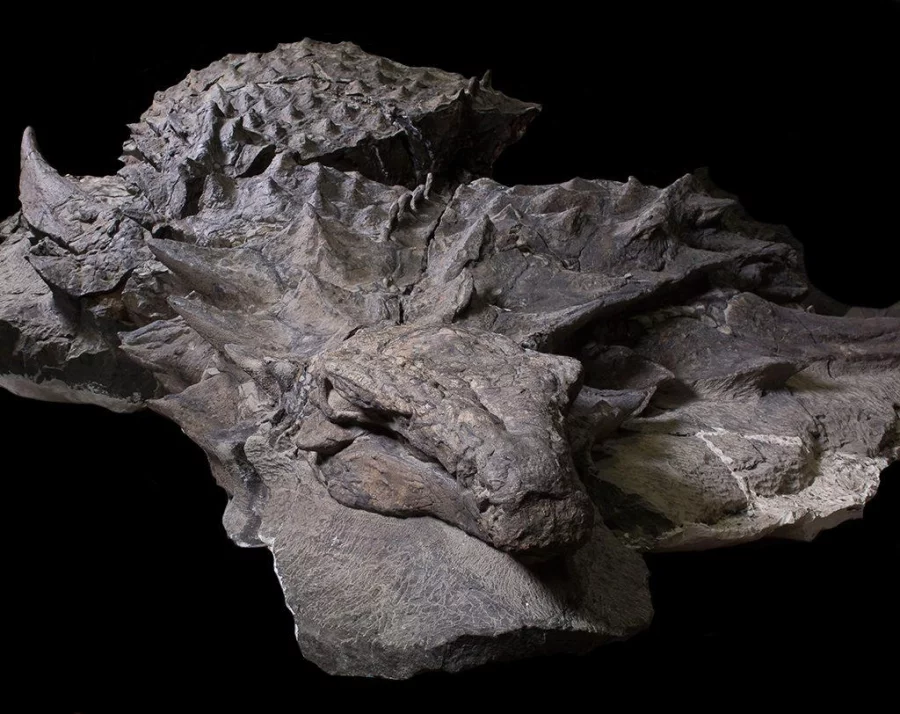
 An analysis of the 5.5 m specimen's form, complete with fully armored skin, suggests the creature had predators, despite the fact that it was the "dinosaur equivalent of a tank," weighing in at more than 1,300 kg AFP PHOTO /Royal Tyrrell Museum of PaleontologyAccording to Vinther, this discovery flies in the face of popular belief that predators such as Tyrannosaurus Rex were merely scavengers, as this pigment is commonly used in the animal kingdom to serve as camouflage through a method known as counter-shading. Gazelles are among the many animals alive today that serve as an example of the use of counter-shading.
“[Rhinos] also have horns and they can use those to dodge predation and things like that, but rhinos don’t have counter-shading and the reason is nobody messes with them,” said Vinther.
“That [this nodosaur] is camouflaged means that it still was experiencing predation regularly – these animals got gobbled up and eaten by the large theropod dinosaurs,” he added.
Vinther also praised the work of Mark Mitchell in extricating the fossil from the rock around it, describing the task as like "trying to expose a wet chocolate hobnob from a lump of concrete."
An analysis of the 5.5 m specimen's form, complete with fully armored skin, suggests the creature had predators, despite the fact that it was the "dinosaur equivalent of a tank," weighing in at more than 1,300 kg AFP PHOTO /Royal Tyrrell Museum of PaleontologyAccording to Vinther, this discovery flies in the face of popular belief that predators such as Tyrannosaurus Rex were merely scavengers, as this pigment is commonly used in the animal kingdom to serve as camouflage through a method known as counter-shading. Gazelles are among the many animals alive today that serve as an example of the use of counter-shading.
“[Rhinos] also have horns and they can use those to dodge predation and things like that, but rhinos don’t have counter-shading and the reason is nobody messes with them,” said Vinther.
“That [this nodosaur] is camouflaged means that it still was experiencing predation regularly – these animals got gobbled up and eaten by the large theropod dinosaurs,” he added.
Vinther also praised the work of Mark Mitchell in extricating the fossil from the rock around it, describing the task as like "trying to expose a wet chocolate hobnob from a lump of concrete."Evidence found on the fossilised remains of a dinosaur dubbed the best preserved of its kind by experts has revealed that it may not have been enough to be big and armoured to survive the Cretaceous period, according to a study published on Current Biology.
The extraordinarily well-preserved specimen, described as the "Mona Lisa of dinosaurs" by lead researcher of the study Caleb Brown, was discovered in 2011 by a mining machine operator in Alberta, Canada. The dinosaur was identified to be a new type of nodosaur and named Borealopelta markmitchelli, after museum technician Mark Mitchell who spent over 7,000 hours removing rock from around the remains, reported News.com.au.
The specimen is currently exhibited at Royal Tyrrell Museum of Paleontology in Alberta.
In addition to bones and armour plates, the creature's stomach contents and a thin film of organic material thought to be remnants of skin were also preserved.
“We could see that the organic compounds [in the film] were something that contained carbon, nitrogen and sulphur – that is something that we know is typical for [the pigment] red melanin,” said Jakob Vinther, co-author of the study from the University of Bristol published on Current Biology, as quoted by the Guardian. An analysis of the 5.5 m specimen's form, complete with fully armored skin, suggests the creature had predators, despite the fact that it was the "dinosaur equivalent of a tank," weighing in at more than 1,300 kg AFP PHOTO /Royal Tyrrell Museum of PaleontologyAccording to Vinther, this discovery flies in the face of popular belief that predators such as Tyrannosaurus Rex were merely scavengers, as this pigment is commonly used in the animal kingdom to serve as camouflage through a method known as counter-shading. Gazelles are among the many animals alive today that serve as an example of the use of counter-shading.
“[Rhinos] also have horns and they can use those to dodge predation and things like that, but rhinos don’t have counter-shading and the reason is nobody messes with them,” said Vinther.
“That [this nodosaur] is camouflaged means that it still was experiencing predation regularly – these animals got gobbled up and eaten by the large theropod dinosaurs,” he added.
Vinther also praised the work of Mark Mitchell in extricating the fossil from the rock around it, describing the task as like "trying to expose a wet chocolate hobnob from a lump of concrete."
An analysis of the 5.5 m specimen's form, complete with fully armored skin, suggests the creature had predators, despite the fact that it was the "dinosaur equivalent of a tank," weighing in at more than 1,300 kg AFP PHOTO /Royal Tyrrell Museum of PaleontologyAccording to Vinther, this discovery flies in the face of popular belief that predators such as Tyrannosaurus Rex were merely scavengers, as this pigment is commonly used in the animal kingdom to serve as camouflage through a method known as counter-shading. Gazelles are among the many animals alive today that serve as an example of the use of counter-shading.
“[Rhinos] also have horns and they can use those to dodge predation and things like that, but rhinos don’t have counter-shading and the reason is nobody messes with them,” said Vinther.
“That [this nodosaur] is camouflaged means that it still was experiencing predation regularly – these animals got gobbled up and eaten by the large theropod dinosaurs,” he added.
Vinther also praised the work of Mark Mitchell in extricating the fossil from the rock around it, describing the task as like "trying to expose a wet chocolate hobnob from a lump of concrete."
An analysis of the 5.5 m specimen's form, complete with fully armored skin, suggests the creature had predators, despite the fact that it was the "dinosaur equivalent of a tank," weighing in at more than 1,300 kg AFP PHOTO /Royal Tyrrell Museum of PaleontologyAccording to Vinther, this discovery flies in the face of popular belief that predators such as Tyrannosaurus Rex were merely scavengers, as this pigment is commonly used in the animal kingdom to serve as camouflage through a method known as counter-shading. Gazelles are among the many animals alive today that serve as an example of the use of counter-shading.
“[Rhinos] also have horns and they can use those to dodge predation and things like that, but rhinos don’t have counter-shading and the reason is nobody messes with them,” said Vinther.
“That [this nodosaur] is camouflaged means that it still was experiencing predation regularly – these animals got gobbled up and eaten by the large theropod dinosaurs,” he added.
Vinther also praised the work of Mark Mitchell in extricating the fossil from the rock around it, describing the task as like "trying to expose a wet chocolate hobnob from a lump of concrete."