Three years after initiating the process of collecting citizens’ data, the Dhaka Metropolitan Police (DMP) now has key information on eight million residents of the megacity, compiled with the aim to prevent possible crimes.
All that information is now stored in the DMP’s Citizen Information Management System (CIMS) database, DMP Commissioner Asaduzzaman Mia said on Tuesday.
“We stored the data to ensure sustainable security measures, which is a common practice in almost all developed cities around the world. We have updated the existing database and named it CIMS. This system will help us identify and track criminals and illicit activities throughout the city,” he said after inaugurating the Jahurul Islam City CCTV Control Room and the Police Service Week rally in the Aftab Nagar area, Dhaka.
However, many Dhaka residents, whose data was collected by police, have said this information depository exercise will be largely futile if there is no verification process in place, information is not routinely updated, and the menace of fake IDs is not sorted out.
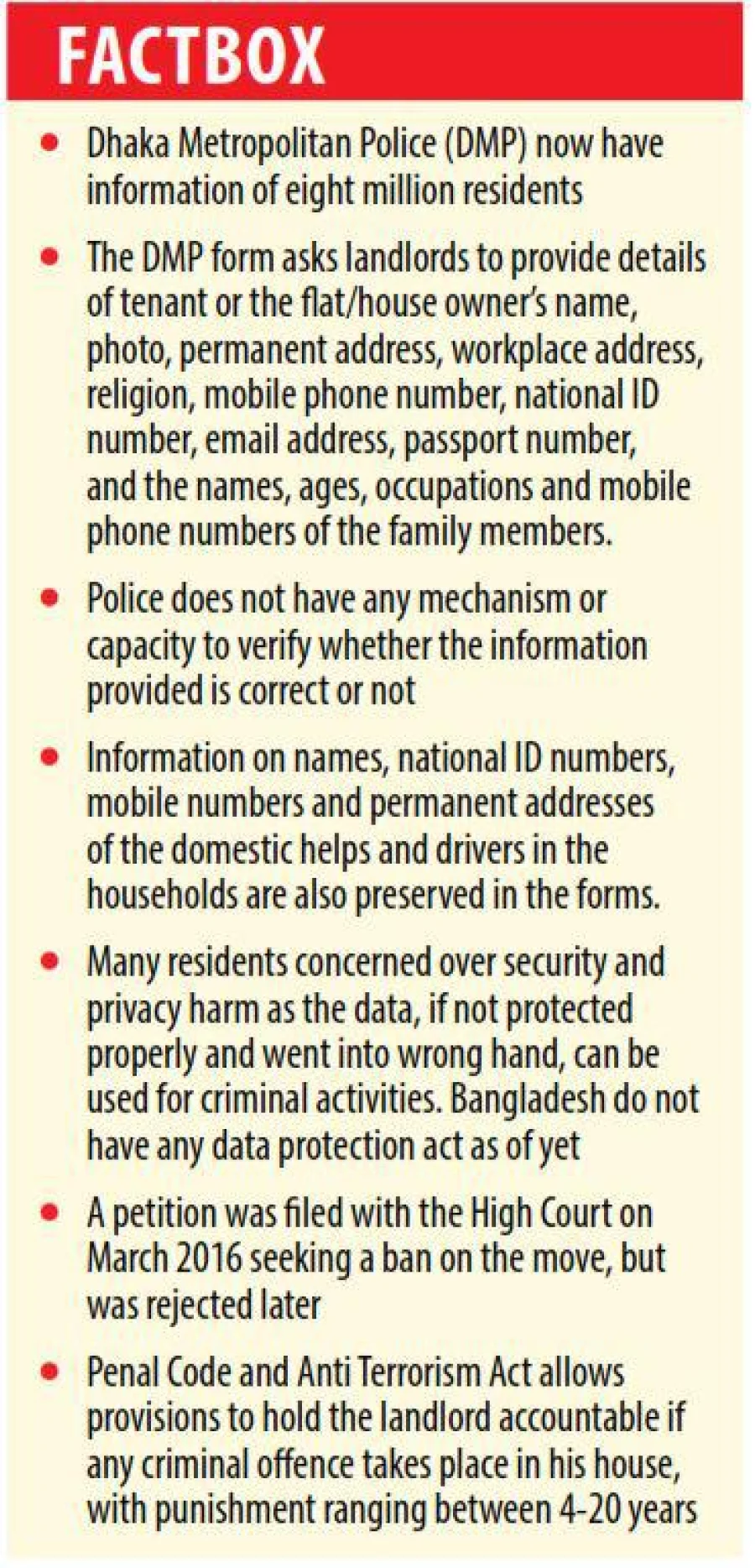
The DMP initiated collecting information on landlords and tenants in late 2015, after several militant hideouts were found in rented houses, to help police track down suspected criminals who may be hiding in the city.
However, since its launch, the initiative raised concerns among people associated with the process.
Till date, police have not been able to clarify how this information will help them nab criminals, since many of them frequently change their residency.
No mechanism to check the information
The DMP has yet to announce a concrete plan on whether they can verify the information provided by landlords and tenants living in the city.
Use of fake National ID (NID) cards while renting houses, which has previously been reported in many cases, still remains a problem.
In January 2018, a team of Rapid Action Battalion (RAB) busted a hideout of banned militant outfit Jama’atul Mujahideen Bangladesh (JMB) in Dhaka’s West Nakhalpara area, only 500 metres from the Prime Minister’s Office (PMO), where three militants were killed.
After the raid was over, RAB said they had found two NIDs in the flat, both carrying the photo of the same person but with different names. They said the flat had been rented with a fake NIDs.
In March 2017, law enforcement agencies busted three militant hideouts in Mirsarai and Sitakunda upazilas in Chittagong, where militants used fake NIDs to rent the places.
Speaking to the Dhaka Tribune, Mustafizur Rahman, a house owner in Mohammadpur, said he was concerned as to whether he was liable for any false information provided by his tenants.
“I do not have any mechanism to check that information; only police can do that. But no police officials have ever come to my house to verify the information. Now, if something happens in my house, why should I be held responsible, when I have already provided the information police asked for?” he said.
When contacted, DMP Deputy Commissioner (Tejgaon division) Biplab Kumar Sarkar said they did not have any mechanism to verify the landlord and tenant information.
“We do randomly check if the information seems suspicious, but we do not have the capacity to verify the massive amount of data,” he added.
According to Section 34 of the Penal Code, when a crime is committed by several individuals with a common intention, each person involved is guilty in the same manner as if it were committed by him or her alone.
Meanwhile, the Anti-Terrorism (Amendment) Act, 2012 allows police to hold landlords accountable for offences committed in their houses, for which they face 4-20 years in prison, with as much as Tk50lakh in fine.
Is the personal, sensitive information secure?
Many Dhaka residents have raised concern over the collection of personal and sensitive information, and how they may be affected if the data falls into wrong hands.
“The information was collected in paper. If the data was transferred to a database, we do not know what happened to the hard copies. If those papers, containing sensitive information on eight million people, fall into wrong hands, that will be a disaster,” said Mohammad Hasan, a resident of Khilkhet.
Kamal Uddin, who lives in Shantinagar, asked why it was necessary to collect this information when all of it is available in the NID database.
“Also, chauffeurs and domestic helps are changed frequently in many houses. If police do not update this information regularly, it can ultimately be used as a tool to harass people,” he added.
Supreme Court lawyer Barrister Jyotirmoy Barua filed a petition in March 2016 seeking a ban on the move, arguing that police had no legal jurisdiction to ask for personal information of any innocent citizen. The petition was rejected.
Jyotirmoy said there is no law for data protection in Bangladesh, which is why it is unclear as to what citizens can do if their personal information is leaked or misused.
“The papers that police used to collect the data were later found in Nilkhet, where computer shops were used to compile and compose the data. This makes us concerned about our privacy,” he told the Dhaka Tribune.
“Also, after the database was finished, what happened to the paper documents? We do not know that, and it is a matter of serious concern,” he added.