




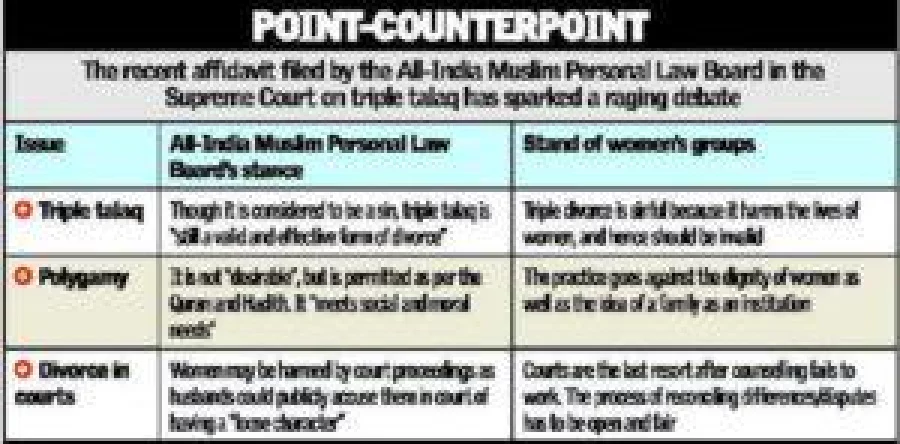
Gender equality is part of the basic structure of the Constitution and non-negotiable, the Centre told the Supreme Court on Friday while opposing the practices of triple talaq and polygamy in the Muslim community.
This is the first time the Indian government has officially taken a stand to oppose the contentious custom that has divided the community, with women’s groups and individuals advocating sweeping reforms in Muslim personal law that is heavily tilted against women.
Under Muslim personal law based on the Sharia, a Muslim man can divorce his wife by pronouncing talaq thrice. Muslim men are also allowed to have four wives. India has separate sets of personal laws for each religion governing marriage, divorce, succession, adoption and maintenance. While Hindu law overhaul began in the 1950s and continues, activists have long argued that Muslim personal law has remained mostly unchanged.
 Syed Mohammad Wali Rahmani, General Secretary of the All India Muslim Personal Law Board (AIMPLB) with Jamiat Ulema-e-Hind President Maulana Syed Arshad Madani (L) and others during a press conference in New Delhi. PTI
“Even though it may be true to say that only some women are directly and actually affected by these practices being divorced by talaq-e-bidat or being in a polygamous marriage, the fact remains that every woman to whom the law applies, lives under the threat, fear or prospect of being subject to these practices, which in turn impacts her status and her right to a life with confidence and dignity,” the government said in its affidavit to the top court.
The Centre’s stand was in response to the court asking whether an intervention would violate the Muslim community’s fundamental rights.
Gender equality is part of the basic structure of the Constitution and non-negotiable, the Centre told the Supreme Court on Friday while opposing the practices of triple talaq and polygamy in the Muslim community.
This is the first time the Indian government has officially taken a stand to oppose the contentious custom that has divided the community, with women’s groups and individuals advocating sweeping reforms in Muslim personal law that is heavily tilted against women.
Under Muslim personal law based on the Sharia, a Muslim man can divorce his wife by pronouncing talaq thrice. Muslim men are also allowed to have four wives.
[youtube id="cW1c6bAzWQM"]
India has separate sets of personal laws for each religion governing marriage, divorce, succession, adoption and maintenance. While Hindu law overhaul began in the 1950s and continues, activists have long argued that Muslim personal law has remained mostly unchanged.
“Even though it may be true to say that only some women are directly and actually affected by these practices being divorced by talaq-e-bidat or being in a polygamous marriage, the fact remains that every woman to whom the law applies, lives under the threat, fear or prospect of being subject to these practices, which in turn impacts her status and her right to a life with confidence and dignity,” the government said in its affidavit to the top court.
The Centre’s stand was in response to the court asking whether an intervention would violate the Muslim community’s fundamental rights.
The Supreme Court had opened the debate over triple talaq last year after it took cognisance of the age-old “customary” practice. Later, a petition was filed by Uttarakhand-based Shayara Bano seeking a ban on it. More Muslim women approached the court demanding reforms.
The petitioners said the “triple talaq” practice - which allows Muslim men an instant divorce through modern tools such as Facebook, Skype and text messages, violates women’s right to equality. In a related but separate development, the Law Commission on Friday sought people’s views on triple talaq and a uniform civil code, opposed by opposed by sections of minority communities.
Politics over Uniform Civil Code
In the face of strong opposition to Uniform Civil Code by Muslim outfits, Congress on Thursday said its implementation would be impossible while Bharatiya Janata Party (BJP) asserted that the move is aimed at moving towards a progressive society.
Other opposition parties like Janata Dal United (JDU) accused the BJP-led Central government of trying to polarise the people ahead of Assembly polls in several states, with leader of Majlis Ittehadul Muslimeen (MIM) Asaduddin Owaisi saying that bringing the Uniform Civil Code (UCC) will kill the diversity and plurality of India.
Earlier in the day, the All India Muslim Personal Law Board and some other outfits opposed the Law Commission’s questionnaire on Uniform Civil Code, including abolition of “triple talaq” and announced their boycott of the move, accusing the government of waging a “war” against the community.
Govt: Implementation of “Uniform” is duty of the State
The State has a “duty” to implement a Uniform Civil Code in the country but since the matter is sensitive and requires an in-depth study, it has been sent to the Law Commission for recommendations, the government told the Rajya Sabha on Friday.
Law minister Ravi Shankar Prasad was supposed to give a verbal response but due to a din in the House by lawmakers seeking action against AAP MP Bhagwant Mann for allegedly compromising the security of the Parliament by video-graphing the complex and putting it on social media, the Question Hour could not take place.
Implementation of a Uniform Civil Code is one of the core issues for the BJP and the wider Sangh Parivar but the NDA governments in 1989 and 1999 and the current Narendra Modi dispensation have put the contentious issues such as scrapping of Article 370 and construction of Ram temple on the back burner.
