World powers pledged billions of dollars for war-ravaged Afghanistan until 2020 at talks in Brussels on Wednesday amid fresh calls for the Taliban to make peace 15 years after they were driven from power.
Afghanistan's President Ashraf Ghani met officials from more than 70 countries and international groups, including US Secretary of State John Kerry and UN chief Ban Ki-moon, at the conference.
EU foreign policy chief Federica Mogherini announced that the 28-nation bloc will pledge $1.5bn a year and said "I would expect similar levels of engagement from our partners." "There will not be any donor fatigue on Afghanistan," she added.
[youtube id="GkwT8hKw0BU"]
Mogherini said a dinner of key regional players including China, India and Pakistan on Tuesday night had "found common ground" for the Afghan peace process. "The European Union will try to facilitate this as much as possible in the coming months," she said.
Kerry urged the Taliban to follow the example of notorious Afghan warlord Gulbuddin Hekmatyar and make an "honourable" peace with the Kabul government to end years of violence. Hekmatyar, the so-called "Butcher of Kabul" who heads the Hezb-i-Islami group and was a key figure in Afghanistan's civil war in the 1990s, signed a peace deal with Ghani in September.
"This is a model for what might be possible," Kerry added, urging Russia and Afghanistan's neighbours to play a role.
The Taliban continue to wage a bitter insurgency almost exactly a decade and a half after the US-led invasion that toppled the group in the wake of the 9/11 attacks, launching a major offensive on the city of Kunduz earlier this week.
Afghanistan remains dependent on foreign aid and a limited NATO military presence, despite having improved key life indicators including maternal mortality and lifespan.
But the brutal war in Syria and the worst migration crisis since World War II have left Afghanistan facing competition for dwindling international donor funds.
We will make peace
Ghani told the conference that Afghanistan was making progress on the economy, corruption and human rights but needed constructive international support to see the changes through. "Afghans can make peace, we will make peace, we are committed to constructive politics, not destructive politics," he said.
Total pledges in Brussels looked set to fall short of the four billion dollars a year for four years that the international community promised for Afghanistan at the last such conference in Tokyo in 2012.
The United States and the EU currently each provide about a third of all international aid to Afghanistan, with Japan the next largest donor.
For security, NATO nations have already committed at a summit in Warsaw in July to maintain troop numbers in Afghanistan and uphold a pledge of $5bn a year to fund local forces until 2020.
In exchange for the money in Brussels, donors will expect the Kabul government to promise it will tackle spiralling corruption and waste, while working on political reform and human rights.
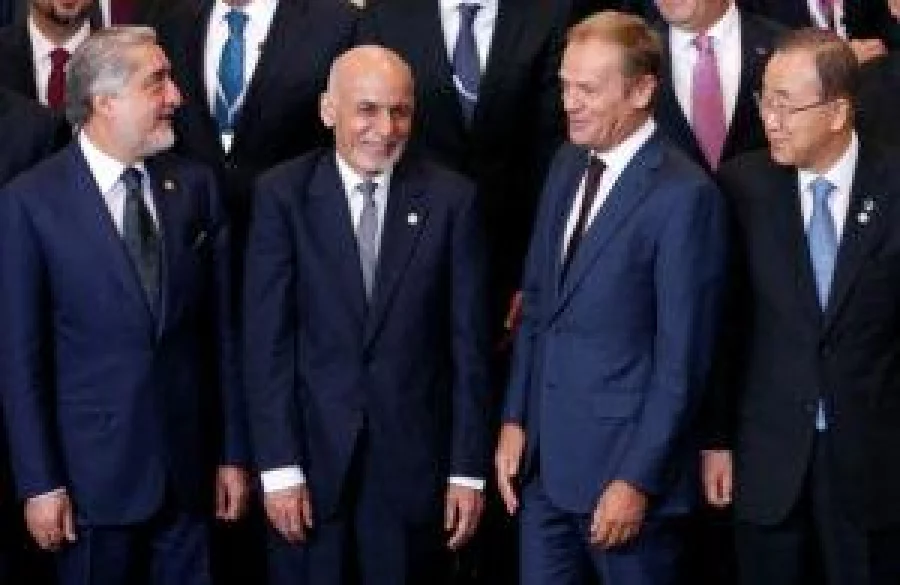
Afghan CEO, President Ghani, EU Council President Tusk and UN Secretary General Ban Ki-moon pose for the Brussels Conference on Afghanistan
REUTERSThe United States has spent around $110bn on Afghanistan's reconstruction since 2001, more than the cost of the Marshall Plan that rebuilt a devastated Europe after World War II, but with limited results.
On the eve of the conference the EU and Kabul published a controversial deal to speed up Afghanistan's taking back of migrants from the Europe, which faces its biggest refugee crisis since World War II.
The plan involves possibly building a dedicated terminal for deportees at Kabul airport. EU officials have however denied that aid pledges will depend on Kabul accepting the return of 80,000 asylum-seekers.
Zubaida Akbar of aid group Save the Children said the plan for forcible returns was "extremely concerning" given the violence still wrecking Afghanistan.
Would Taliban take part?
But there remain divisions about if, or when, to include Taliban militants. Even if they were invited, it is unclear whether the movement would take part.
Hope was briefly raised in 2015 when Taliban officials met the Afghan government in neighbouring Pakistan, but that process was shortlived, and the Taliban, under their second new leader in just over a year, insist that foreign forces must leave Afghanistan before peace talks can begin.
They are also on the offensive, and battlefield successes have exposed the defensive limits of Afghanistan's NATO-trained armed forces which are supposed to number 350,000 personnel but which have been heavily depleted by casualties and desertion.
Militants briefly penetrated the centre of the northern city of Kunduz on Monday, and they are also testing the defences of two other provincial capitals in the south of the country.
US and EU officials have been encouraged by a smaller peace agreement last month between the Afghan government and a local warlord. But Pakistan continues to harbour Afghan Taliban, according to the United States and India.
Traditionally tense relations between Pakistan and India are also a factor, and one Indian diplomat said New Delhi was not yet convinced the Taliban had changed since 2001, judging by the way they ruled the 10 percent of Afghan territory under their control.
Iran and Russia, two power brokers on the opposing sides of Syria's civil war, must also be involved, diplomats said.
"We are not running away from peace talks, but what evidence is there that the Taliban have abandoned their violent ways?" said the Indian diplomat. "We need a peace deal that doesn't run away from reality."




 Afghan CEO, President Ghani, EU Council President Tusk and UN Secretary General Ban Ki-moon pose for the Brussels Conference on Afghanistan REUTERSThe United States has spent around $110bn on Afghanistan's reconstruction since 2001, more than the cost of the Marshall Plan that rebuilt a devastated Europe after World War II, but with limited results.
On the eve of the conference the EU and Kabul published a controversial deal to speed up Afghanistan's taking back of migrants from the Europe, which faces its biggest refugee crisis since World War II.
The plan involves possibly building a dedicated terminal for deportees at Kabul airport. EU officials have however denied that aid pledges will depend on Kabul accepting the return of 80,000 asylum-seekers.
Zubaida Akbar of aid group Save the Children said the plan for forcible returns was "extremely concerning" given the violence still wrecking Afghanistan.
Afghan CEO, President Ghani, EU Council President Tusk and UN Secretary General Ban Ki-moon pose for the Brussels Conference on Afghanistan REUTERSThe United States has spent around $110bn on Afghanistan's reconstruction since 2001, more than the cost of the Marshall Plan that rebuilt a devastated Europe after World War II, but with limited results.
On the eve of the conference the EU and Kabul published a controversial deal to speed up Afghanistan's taking back of migrants from the Europe, which faces its biggest refugee crisis since World War II.
The plan involves possibly building a dedicated terminal for deportees at Kabul airport. EU officials have however denied that aid pledges will depend on Kabul accepting the return of 80,000 asylum-seekers.
Zubaida Akbar of aid group Save the Children said the plan for forcible returns was "extremely concerning" given the violence still wrecking Afghanistan.