




War crimes investigators collecting evidence of the Islamic State group’s elaborate operation to kidnap thousands of women as sex slaves say they have a case to try IS leaders with crimes against humanity but cannot get the global backing to bring current detainees before an international tribunal, reports The Associated Press.
Two years after the IS onslaught in northern Iraq, the investigators, as well as US diplomats, say the Obama administration has done little to pursue prosecution of the crimes that Secretary of State John Kerry has called genocide. Current and former State Department officials say that an attempt in late 2014 to have a legal finding of genocide was blocked by the Defence Department, setting back efforts to prosecute IS members suspected of committing war crimes.
“The West looks to the United States for leadership in the Middle East, and the focus of this administration has been elsewhere — in every respect,” Bill Wiley, the head of the independent investigative group, the Commission for International Justice and Accountability, said.
Based in Brussels, the commission was formed in 2012.
The war crimes commission’s file, painstakingly and often perilously gathered since 2014, is ready for a court that does not yet exist. The private organisation has pored over hard drives, leaked documents, phone records and interviews with captured Islamic State fighters — in addition to monitoring the Islamic State group’s own voluminous propaganda.
But whether the courts of Iraqi Kurdistan, where most IS prisoners are kept, are ready for the complexities of international criminal law is an open question. US officials worry that backing a special court in Iraqi Kurdistan raises sticky questions of sovereignty with the Iraqi central government in Baghdad, which is suspicious of Kurdish independence efforts.
Officials in Washington say that the Defence Department and ultimately the administration were concerned that court trials would distract from the military campaign. But the diplomats say that justice is essential in a region whose religious minorities have been terrorised. The officials spoke on condition of anonymity because they were not authorised to discuss the issue.
The US has no legal obligation to take on the genocide of the Yazidis, but President Barack Obama has said that “preventing mass atrocities and genocide is a core national security interest and a core moral responsibility of the United States of America.”
‘US should have acted early’
Stephen Rapp, who stepped down as the administration’s ambassador at large for war crimes last year, says the administration should have moved early to help secure evidence of IS atrocities and push for the creation of special Iraqi courts to try war crimes.
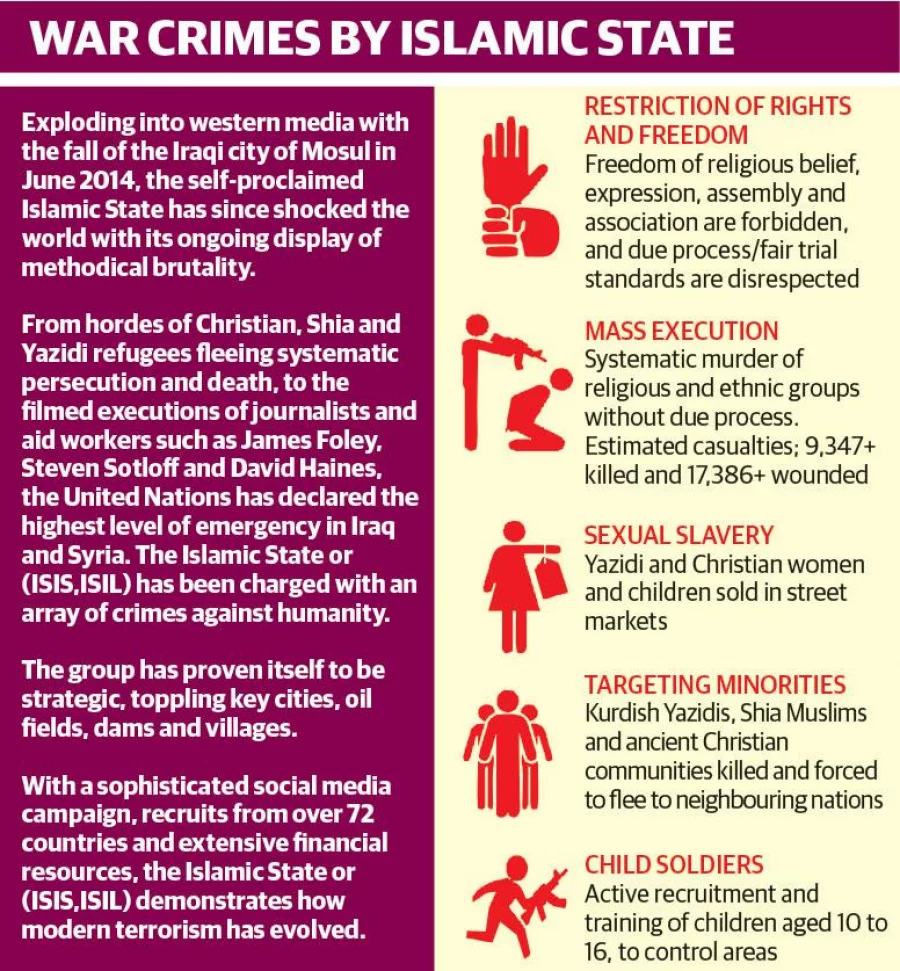
Rapp is now the chairman of the advisory board of the commission, whose investigators in Iraq work with the Kurdish regional government to formally document the IS group’s crimes, including those against the Yazidi minority group. They have built a case implicating the entire IS command structure in a plot to kidnap Yazidi women and girls and establish a sex-slave market.
The plan was executed by an organised bureaucracy at every step along the way, from the temporary sorting facilities — including a prison, schools and a curtained ballroom where the Yazidis were divided by age and willingness to convert to Islam — to the waiting buses that would haul them by the dozens across the border to Raqqa. The Islamic State group’s Shariah courts soon stepped in, to settle contract disputes and ensure that its finance hierarchy got its cut of the sex slaves proceeds.
Though there are at least dozens of Islamic State extremists in custody in Iraq, there have been no prosecutions for the crimes against humanity that the US — among many others — insist have taken place. On Tuesday, the Obama administration’s envoy for the coalition to counter Islamic State, Brett McGurk, tweeted that he “pledged full accountability” for Islamic State crimes against the Yazidis, whom IS militants consider infidels because of their religion.
In 2012, Obama stood at the US Holocaust Memorial Museum to announce what he called a comprehensive strategy to prevent and respond to war crimes with the establishment of an atrocities prevention board, noting that “as president I’ve done my utmost to back up those words with deeds.”
But in fact, though the US has backed limited efforts to secure evidence of Islamic State atrocities in Iraq, there have been few tangible steps toward prosecution. In a recent investigation the AP found that even in territories liberated from IS militants by Kurdish forces, dozens of mass graves have been left unsecured.
“It’s a tragedy that we are not getting in there and securing these sites where we can and doing things like collecting DNA evidence,” said Rapp.
$6.6m needed to start trials
A measure by the House that calls on the US to fund precisely the kind of court envisioned by the investigators is unlikely to advance anytime soon in an election year. With full international backing, the war crimes commission says it would need about $6.6m and about six months to get the trials going.
The State Department said the US was promoting accountability, and spokesman Mark Toner specified that the administration is “supporting ongoing efforts to collect, document, preserve and analyse evidence of atrocities for transitional justice processes.” He provided no specifics.
Rapp and other critics say that the commission is the only organisation that has built the kind of legal case necessary for a genuine tribunal, but the group said none of its work in Iraq is funded by the US Neither the US nor Iraq is a party to the International Criminal Court in the Hague, which is a court of last resort when national judicial efforts have failed.
The war crimes commission is best known for collecting evidence against Syrian President Bashar Assad but quietly branched out to document atrocities committed by IS and other extremist groups. The office, based in Europe, has changed cities four times since it was founded in 2012, and security is paramount: No sign on the door, no Wi-Fi, no website.
The commission has a staff of 20 in Iraq split into three teams, collecting court-ready evidence analysed at the group’s main offices. It says its legal file is the answer to multiple calls for Islamic State extremists to face justice beyond coalition airstrikes, which Wiley said is the sole focus of questioning.
“The intelligence gathering is geared almost entirely toward targeting,” he said.
A Kurdish security official, speaking on condition of anonymity to release sensitive information, knew of dozens of detainees directly linked to Islamic State militants. At least some, Wiley said, could be prosecuted as soon as a court could be up and running.
But the Kurdish government is bankrupt and riven by internal struggles. The Erbil-based Ministry of Martyrs and Anfal Affairs, which is named in memory of Saddam Hussein’s devastating 1988 campaign against the Kurds, has taken up the cause to try extremists.
“Because we believe in the rule of law and in human rights, and we think these people must be tried properly, following international standards, under international supervision, not just in a security court,” said Mahmud Haji Salih, head of the ministry.
The word “symbolic” arises frequently when Wiley and his colleagues discuss possible prosecutions. No one harbors any expectation that the Islamic State group’s leadership will ever face a judge. But he thinks the charges of crimes against humanity would serve a tangible purpose, even beyond jailing those responsible for the horror against the Yazidi people.
“You have to show that the guys dying for IS, they may think they’re dying for Mohammad but they’re not,” Wiley said. “They’re definitely not.”
