




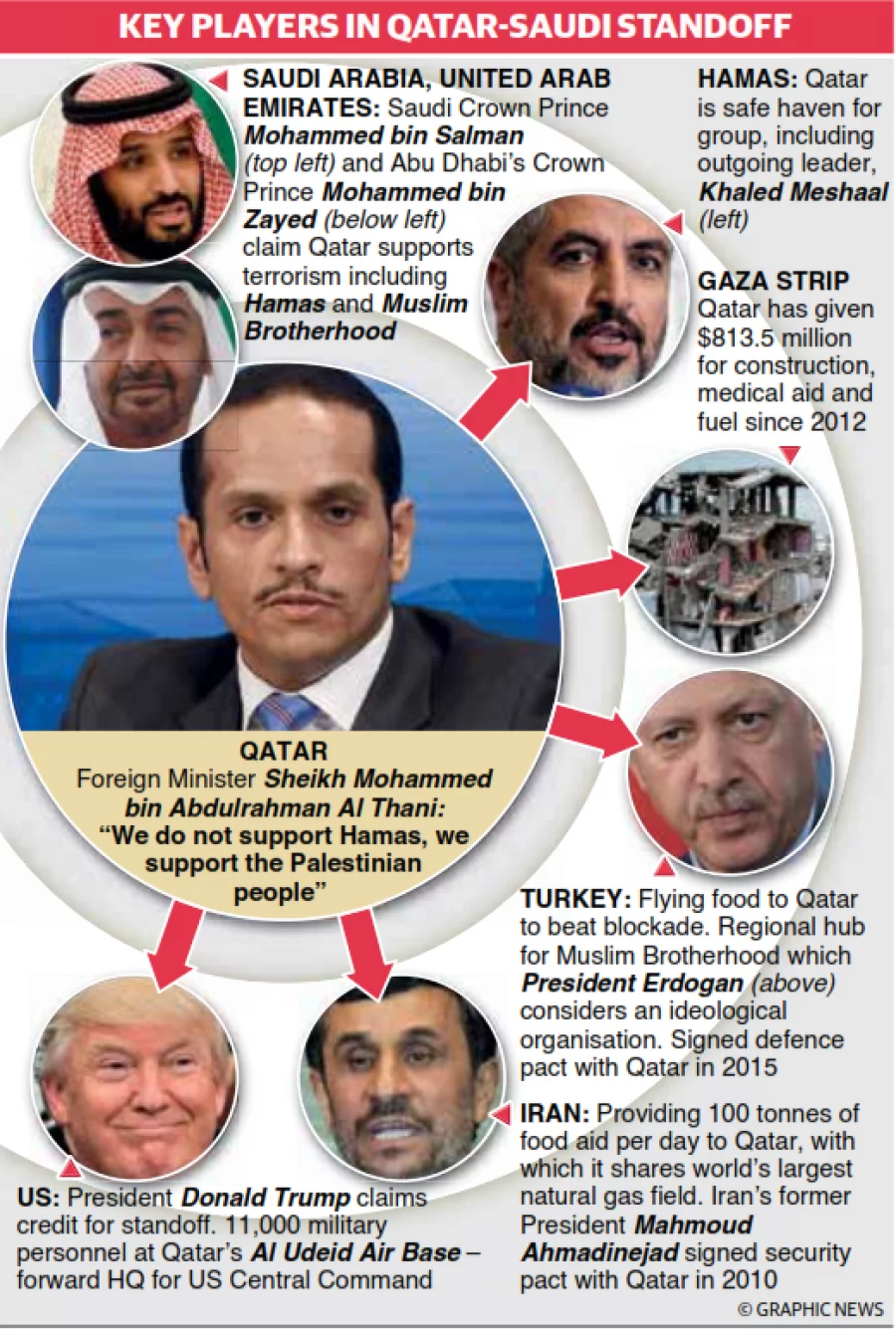
 What is this all about?Qatar has been accused of supporting extremist groups after simmering tensions with its neighbouring powers finally boiled over. Two events seem to have played a key role in sparking the ongoing crisis.
In April, the gas-rich country was reported to have paid a $1bn ransom to release members of its royal family captured on a hunting trip in Iraq.
In May, Qatar blamed hackers for a story published on the website of its state news agency that quoted its ruler Sheikh Tamim bin Hamad al-Thani criticising US “hostility” towards Iran.
The subsequent storm added to long-running sores over Qatar’s backing for Islamists, including the Muslim Brotherhood group which is banned and classed as a terror group in Saudi Arabia, UAE and Egypt.
Qatar has also been accused of supporting Houthi rebels in Yemen, who are currently engaged in a bloody civil war with the country’s Saudi Arabia-allied government.What are the demands?The 13 demands include closing down Qatar’s much-talked-about satellite TV network, Al Jazeera, which has long been a thorn in the side of its conservative neighbours. Another demand is the closing of a Turkish military base, recently reinforced by a contingent of troops and armoured vehicles.
And a further demand is the scaling back of diplomatic ties with Iran, with whom Qatar shares the largest offshore natural gas field.
The list of demands was prompted by US frustration that the Arab bloc had failed to state clearly what they expected of Qatar in this dispute. The US, which is trying to mediate the dispute, asked for the demands to be “reasonable and actionable”.What position does the US hold?The United States has some 10,000 troops in Qatar, which is a key staging post for its military in conflicts against Islamic State and in Afghanistan.
It is allied to both sides in the dispute and US President Donald Trump has publicly urged unity and restraint.
But on Twitter he has repeated the allegations that Qatar funds terrorism and in remarks reported from a private dinner he stated that the US was in “dispute” with the emirate.Does Qatar have a case to answer?For years now, Qatar has had close links with political Islamist groups like the Muslim Brotherhood, Hamas in Gaza and Islamist factions in Libya and Syria. Al Jazeera stands accused of airing the views of extremist preachers who support acts most people would consider as terrorism.
The conservative, tribal monarchies that surround Qatar - the al-Saud in Saudi Arabia, the al-Nahyans in Abu Dhabi and the al-Khalifa in Bahrain - all view these Islamist groups as a threat to their rule and in some cases they accuse the Muslim Brotherhood of being synonymous with terrorism.Does Saudi Arabia have a case to answer?For many, the notion of Saudi Arabia accusing another country of supporting Islamic extremism is a strange one. Fifteen of the 19 suicide hijackers in the 9/11 attacks of 2001 were Saudis (not one was Qatari). More than 4,000 Saudis have gone to join IS, although the Saudi authorities did belatedly try to stop them.
More importantly, there is a commonality of extremist views and practices that are shared by IS and thousands of religious conservatives in Saudi Arabia, known as Wahhabis. These centre around the notion of takfir, meaning declaring another Muslim to be an “apostate” if they don’t adhere to your ultra-strict version of Islam. But Saudi Arabia’s funding of mosques, schools and textbooks around the world continues to bring accusations that it is supporting extremism.Could it lead to war?The UAE government spokesman has said his country has no plans to “militarise” the row and certainly any outbreak of armed conflict would be disastrous for all sides.
Qatar has a longstanding military agreement with Turkey and hosts a Turkish base as well as a US one. The Qatari Ambassador to Russia, Fahad al-Attiyah, has said last week he believed the presence of reinforced Turkish troops in Qatar had helped to deter an invasion.Why are Turkey and Iran getting involved?Turkish government is backing Qatar, flying in troops and materiel to help it survive the severing of air links with Gulf Arab neighbours.
Turkey and Qatar both support political Islam and last week a high-level Qatari delegation was in Ankara, meeting the Turkish defence minister to discuss future cooperation as well as joint manoeuvres. An added complication here is that Turkey, already embroiled in the Syrian civil war, is a Nato member.
Iran is a maritime neighbour of Qatar’s and they share the vast North Dome gas field beneath the waters of the Gulf. Since Qatar has to import much of its food supplies and the land border with Saudi Arabia is now closed, Iran has been flying in regular plane loads of food, something the Qataris have compared to the Berlin Airlift of 1948.What happens now?So far, mediation efforts by both Kuwait and the US have been unable to bridge the very wide gap between the two sides. The Saudis say their demands are non-negotiable, the Emiratis say there is zero trust with the Qataris and Qatar says it will not negotiate while it is “under siege with an illegal blockade”.
It’s unclear what further steps Arab countries now isolating Qatar could take after the deadline passes. They could look at financial sanctions, though Qatari investments around the world include Harrods department store in London, Volkswagen in Germany and the company owning New York’s Empire State Building. They could attempt to block Qatari shipments of liquefied natural gas, though that could spark hostilities. Qatar has yet to retaliate, but could shut down an undersea natural gas pipeline running to the United Arab Emirates, a crucial power source for a desert nation that relies on desalination plants for water and air conditioners to cope with the scorching heat.
Even if some face-saving formula is found to at least partially lift the current sanctions and patch up differences on the surface, the wounds from this row go too deep now. The GCC, the Arab Gulf Cooperation Council founded in 1981, is effectively broken and is unlikely to be able to be stitched back together as a functioning, unified entity in its present form.
One thing is for sure – this dispute is shaping the future of the region.
What is this all about?Qatar has been accused of supporting extremist groups after simmering tensions with its neighbouring powers finally boiled over. Two events seem to have played a key role in sparking the ongoing crisis.
In April, the gas-rich country was reported to have paid a $1bn ransom to release members of its royal family captured on a hunting trip in Iraq.
In May, Qatar blamed hackers for a story published on the website of its state news agency that quoted its ruler Sheikh Tamim bin Hamad al-Thani criticising US “hostility” towards Iran.
The subsequent storm added to long-running sores over Qatar’s backing for Islamists, including the Muslim Brotherhood group which is banned and classed as a terror group in Saudi Arabia, UAE and Egypt.
Qatar has also been accused of supporting Houthi rebels in Yemen, who are currently engaged in a bloody civil war with the country’s Saudi Arabia-allied government.What are the demands?The 13 demands include closing down Qatar’s much-talked-about satellite TV network, Al Jazeera, which has long been a thorn in the side of its conservative neighbours. Another demand is the closing of a Turkish military base, recently reinforced by a contingent of troops and armoured vehicles.
And a further demand is the scaling back of diplomatic ties with Iran, with whom Qatar shares the largest offshore natural gas field.
The list of demands was prompted by US frustration that the Arab bloc had failed to state clearly what they expected of Qatar in this dispute. The US, which is trying to mediate the dispute, asked for the demands to be “reasonable and actionable”.What position does the US hold?The United States has some 10,000 troops in Qatar, which is a key staging post for its military in conflicts against Islamic State and in Afghanistan.
It is allied to both sides in the dispute and US President Donald Trump has publicly urged unity and restraint.
But on Twitter he has repeated the allegations that Qatar funds terrorism and in remarks reported from a private dinner he stated that the US was in “dispute” with the emirate.Does Qatar have a case to answer?For years now, Qatar has had close links with political Islamist groups like the Muslim Brotherhood, Hamas in Gaza and Islamist factions in Libya and Syria. Al Jazeera stands accused of airing the views of extremist preachers who support acts most people would consider as terrorism.
The conservative, tribal monarchies that surround Qatar - the al-Saud in Saudi Arabia, the al-Nahyans in Abu Dhabi and the al-Khalifa in Bahrain - all view these Islamist groups as a threat to their rule and in some cases they accuse the Muslim Brotherhood of being synonymous with terrorism.Does Saudi Arabia have a case to answer?For many, the notion of Saudi Arabia accusing another country of supporting Islamic extremism is a strange one. Fifteen of the 19 suicide hijackers in the 9/11 attacks of 2001 were Saudis (not one was Qatari). More than 4,000 Saudis have gone to join IS, although the Saudi authorities did belatedly try to stop them.
More importantly, there is a commonality of extremist views and practices that are shared by IS and thousands of religious conservatives in Saudi Arabia, known as Wahhabis. These centre around the notion of takfir, meaning declaring another Muslim to be an “apostate” if they don’t adhere to your ultra-strict version of Islam. But Saudi Arabia’s funding of mosques, schools and textbooks around the world continues to bring accusations that it is supporting extremism.Could it lead to war?The UAE government spokesman has said his country has no plans to “militarise” the row and certainly any outbreak of armed conflict would be disastrous for all sides.
Qatar has a longstanding military agreement with Turkey and hosts a Turkish base as well as a US one. The Qatari Ambassador to Russia, Fahad al-Attiyah, has said last week he believed the presence of reinforced Turkish troops in Qatar had helped to deter an invasion.Why are Turkey and Iran getting involved?Turkish government is backing Qatar, flying in troops and materiel to help it survive the severing of air links with Gulf Arab neighbours.
Turkey and Qatar both support political Islam and last week a high-level Qatari delegation was in Ankara, meeting the Turkish defence minister to discuss future cooperation as well as joint manoeuvres. An added complication here is that Turkey, already embroiled in the Syrian civil war, is a Nato member.
Iran is a maritime neighbour of Qatar’s and they share the vast North Dome gas field beneath the waters of the Gulf. Since Qatar has to import much of its food supplies and the land border with Saudi Arabia is now closed, Iran has been flying in regular plane loads of food, something the Qataris have compared to the Berlin Airlift of 1948.What happens now?So far, mediation efforts by both Kuwait and the US have been unable to bridge the very wide gap between the two sides. The Saudis say their demands are non-negotiable, the Emiratis say there is zero trust with the Qataris and Qatar says it will not negotiate while it is “under siege with an illegal blockade”.
It’s unclear what further steps Arab countries now isolating Qatar could take after the deadline passes. They could look at financial sanctions, though Qatari investments around the world include Harrods department store in London, Volkswagen in Germany and the company owning New York’s Empire State Building. They could attempt to block Qatari shipments of liquefied natural gas, though that could spark hostilities. Qatar has yet to retaliate, but could shut down an undersea natural gas pipeline running to the United Arab Emirates, a crucial power source for a desert nation that relies on desalination plants for water and air conditioners to cope with the scorching heat.
Even if some face-saving formula is found to at least partially lift the current sanctions and patch up differences on the surface, the wounds from this row go too deep now. The GCC, the Arab Gulf Cooperation Council founded in 1981, is effectively broken and is unlikely to be able to be stitched back together as a functioning, unified entity in its present form.
One thing is for sure – this dispute is shaping the future of the region.Four Arab states refrained on Wednesday from slapping further sanctions on Qatar but voiced disappointment at its “negative” response to their demands and said their boycott of the tiny Gulf nation would continue.
Qatar earlier in the day accused Saudi Arabia, the United Arab Emirates, Bahrain, and Egypt of “clear aggression” and said the accusations cited when they severed ties a month ago “were clearly designed to create anti-Qatar sentiment in the West”.
“The response the four states got was overall negative and lacked any content. We find it did not provide a basis for Qatar to retreat from its policies,” Egyptian Foreign Minister Sameh Shoukry said, reading out a joint statement after the meeting, reports Reuters.
“The political and economic boycott will continue until Qatar changes its policies for the better,” Saudi Foreign Minister Adel al-Jubeir told a news conference.
The United Arab Emirates’ minister of state for foreign affairs, Anwar Gargash, said in a tweet that Qatar faced “greater isolation, incremental measures and reputational damage” if it did not heed the Arab demands.
The four foreign ministers said they would next meet in the Bahraini capital Manama though gave no date. Intelligence chiefs from the four countries also met in Cairo on Tuesday night, officials said.
Qatar’s response to the demands has not been made public. What is this all about?Qatar has been accused of supporting extremist groups after simmering tensions with its neighbouring powers finally boiled over. Two events seem to have played a key role in sparking the ongoing crisis.
In April, the gas-rich country was reported to have paid a $1bn ransom to release members of its royal family captured on a hunting trip in Iraq.
In May, Qatar blamed hackers for a story published on the website of its state news agency that quoted its ruler Sheikh Tamim bin Hamad al-Thani criticising US “hostility” towards Iran.
The subsequent storm added to long-running sores over Qatar’s backing for Islamists, including the Muslim Brotherhood group which is banned and classed as a terror group in Saudi Arabia, UAE and Egypt.
Qatar has also been accused of supporting Houthi rebels in Yemen, who are currently engaged in a bloody civil war with the country’s Saudi Arabia-allied government.What are the demands?The 13 demands include closing down Qatar’s much-talked-about satellite TV network, Al Jazeera, which has long been a thorn in the side of its conservative neighbours. Another demand is the closing of a Turkish military base, recently reinforced by a contingent of troops and armoured vehicles.
And a further demand is the scaling back of diplomatic ties with Iran, with whom Qatar shares the largest offshore natural gas field.
The list of demands was prompted by US frustration that the Arab bloc had failed to state clearly what they expected of Qatar in this dispute. The US, which is trying to mediate the dispute, asked for the demands to be “reasonable and actionable”.What position does the US hold?The United States has some 10,000 troops in Qatar, which is a key staging post for its military in conflicts against Islamic State and in Afghanistan.
It is allied to both sides in the dispute and US President Donald Trump has publicly urged unity and restraint.
But on Twitter he has repeated the allegations that Qatar funds terrorism and in remarks reported from a private dinner he stated that the US was in “dispute” with the emirate.Does Qatar have a case to answer?For years now, Qatar has had close links with political Islamist groups like the Muslim Brotherhood, Hamas in Gaza and Islamist factions in Libya and Syria. Al Jazeera stands accused of airing the views of extremist preachers who support acts most people would consider as terrorism.
The conservative, tribal monarchies that surround Qatar - the al-Saud in Saudi Arabia, the al-Nahyans in Abu Dhabi and the al-Khalifa in Bahrain - all view these Islamist groups as a threat to their rule and in some cases they accuse the Muslim Brotherhood of being synonymous with terrorism.Does Saudi Arabia have a case to answer?For many, the notion of Saudi Arabia accusing another country of supporting Islamic extremism is a strange one. Fifteen of the 19 suicide hijackers in the 9/11 attacks of 2001 were Saudis (not one was Qatari). More than 4,000 Saudis have gone to join IS, although the Saudi authorities did belatedly try to stop them.
More importantly, there is a commonality of extremist views and practices that are shared by IS and thousands of religious conservatives in Saudi Arabia, known as Wahhabis. These centre around the notion of takfir, meaning declaring another Muslim to be an “apostate” if they don’t adhere to your ultra-strict version of Islam. But Saudi Arabia’s funding of mosques, schools and textbooks around the world continues to bring accusations that it is supporting extremism.Could it lead to war?The UAE government spokesman has said his country has no plans to “militarise” the row and certainly any outbreak of armed conflict would be disastrous for all sides.
Qatar has a longstanding military agreement with Turkey and hosts a Turkish base as well as a US one. The Qatari Ambassador to Russia, Fahad al-Attiyah, has said last week he believed the presence of reinforced Turkish troops in Qatar had helped to deter an invasion.Why are Turkey and Iran getting involved?Turkish government is backing Qatar, flying in troops and materiel to help it survive the severing of air links with Gulf Arab neighbours.
Turkey and Qatar both support political Islam and last week a high-level Qatari delegation was in Ankara, meeting the Turkish defence minister to discuss future cooperation as well as joint manoeuvres. An added complication here is that Turkey, already embroiled in the Syrian civil war, is a Nato member.
Iran is a maritime neighbour of Qatar’s and they share the vast North Dome gas field beneath the waters of the Gulf. Since Qatar has to import much of its food supplies and the land border with Saudi Arabia is now closed, Iran has been flying in regular plane loads of food, something the Qataris have compared to the Berlin Airlift of 1948.What happens now?So far, mediation efforts by both Kuwait and the US have been unable to bridge the very wide gap between the two sides. The Saudis say their demands are non-negotiable, the Emiratis say there is zero trust with the Qataris and Qatar says it will not negotiate while it is “under siege with an illegal blockade”.
It’s unclear what further steps Arab countries now isolating Qatar could take after the deadline passes. They could look at financial sanctions, though Qatari investments around the world include Harrods department store in London, Volkswagen in Germany and the company owning New York’s Empire State Building. They could attempt to block Qatari shipments of liquefied natural gas, though that could spark hostilities. Qatar has yet to retaliate, but could shut down an undersea natural gas pipeline running to the United Arab Emirates, a crucial power source for a desert nation that relies on desalination plants for water and air conditioners to cope with the scorching heat.
Even if some face-saving formula is found to at least partially lift the current sanctions and patch up differences on the surface, the wounds from this row go too deep now. The GCC, the Arab Gulf Cooperation Council founded in 1981, is effectively broken and is unlikely to be able to be stitched back together as a functioning, unified entity in its present form.
One thing is for sure – this dispute is shaping the future of the region.
What is this all about?Qatar has been accused of supporting extremist groups after simmering tensions with its neighbouring powers finally boiled over. Two events seem to have played a key role in sparking the ongoing crisis.
In April, the gas-rich country was reported to have paid a $1bn ransom to release members of its royal family captured on a hunting trip in Iraq.
In May, Qatar blamed hackers for a story published on the website of its state news agency that quoted its ruler Sheikh Tamim bin Hamad al-Thani criticising US “hostility” towards Iran.
The subsequent storm added to long-running sores over Qatar’s backing for Islamists, including the Muslim Brotherhood group which is banned and classed as a terror group in Saudi Arabia, UAE and Egypt.
Qatar has also been accused of supporting Houthi rebels in Yemen, who are currently engaged in a bloody civil war with the country’s Saudi Arabia-allied government.What are the demands?The 13 demands include closing down Qatar’s much-talked-about satellite TV network, Al Jazeera, which has long been a thorn in the side of its conservative neighbours. Another demand is the closing of a Turkish military base, recently reinforced by a contingent of troops and armoured vehicles.
And a further demand is the scaling back of diplomatic ties with Iran, with whom Qatar shares the largest offshore natural gas field.
The list of demands was prompted by US frustration that the Arab bloc had failed to state clearly what they expected of Qatar in this dispute. The US, which is trying to mediate the dispute, asked for the demands to be “reasonable and actionable”.What position does the US hold?The United States has some 10,000 troops in Qatar, which is a key staging post for its military in conflicts against Islamic State and in Afghanistan.
It is allied to both sides in the dispute and US President Donald Trump has publicly urged unity and restraint.
But on Twitter he has repeated the allegations that Qatar funds terrorism and in remarks reported from a private dinner he stated that the US was in “dispute” with the emirate.Does Qatar have a case to answer?For years now, Qatar has had close links with political Islamist groups like the Muslim Brotherhood, Hamas in Gaza and Islamist factions in Libya and Syria. Al Jazeera stands accused of airing the views of extremist preachers who support acts most people would consider as terrorism.
The conservative, tribal monarchies that surround Qatar - the al-Saud in Saudi Arabia, the al-Nahyans in Abu Dhabi and the al-Khalifa in Bahrain - all view these Islamist groups as a threat to their rule and in some cases they accuse the Muslim Brotherhood of being synonymous with terrorism.Does Saudi Arabia have a case to answer?For many, the notion of Saudi Arabia accusing another country of supporting Islamic extremism is a strange one. Fifteen of the 19 suicide hijackers in the 9/11 attacks of 2001 were Saudis (not one was Qatari). More than 4,000 Saudis have gone to join IS, although the Saudi authorities did belatedly try to stop them.
More importantly, there is a commonality of extremist views and practices that are shared by IS and thousands of religious conservatives in Saudi Arabia, known as Wahhabis. These centre around the notion of takfir, meaning declaring another Muslim to be an “apostate” if they don’t adhere to your ultra-strict version of Islam. But Saudi Arabia’s funding of mosques, schools and textbooks around the world continues to bring accusations that it is supporting extremism.Could it lead to war?The UAE government spokesman has said his country has no plans to “militarise” the row and certainly any outbreak of armed conflict would be disastrous for all sides.
Qatar has a longstanding military agreement with Turkey and hosts a Turkish base as well as a US one. The Qatari Ambassador to Russia, Fahad al-Attiyah, has said last week he believed the presence of reinforced Turkish troops in Qatar had helped to deter an invasion.Why are Turkey and Iran getting involved?Turkish government is backing Qatar, flying in troops and materiel to help it survive the severing of air links with Gulf Arab neighbours.
Turkey and Qatar both support political Islam and last week a high-level Qatari delegation was in Ankara, meeting the Turkish defence minister to discuss future cooperation as well as joint manoeuvres. An added complication here is that Turkey, already embroiled in the Syrian civil war, is a Nato member.
Iran is a maritime neighbour of Qatar’s and they share the vast North Dome gas field beneath the waters of the Gulf. Since Qatar has to import much of its food supplies and the land border with Saudi Arabia is now closed, Iran has been flying in regular plane loads of food, something the Qataris have compared to the Berlin Airlift of 1948.What happens now?So far, mediation efforts by both Kuwait and the US have been unable to bridge the very wide gap between the two sides. The Saudis say their demands are non-negotiable, the Emiratis say there is zero trust with the Qataris and Qatar says it will not negotiate while it is “under siege with an illegal blockade”.
It’s unclear what further steps Arab countries now isolating Qatar could take after the deadline passes. They could look at financial sanctions, though Qatari investments around the world include Harrods department store in London, Volkswagen in Germany and the company owning New York’s Empire State Building. They could attempt to block Qatari shipments of liquefied natural gas, though that could spark hostilities. Qatar has yet to retaliate, but could shut down an undersea natural gas pipeline running to the United Arab Emirates, a crucial power source for a desert nation that relies on desalination plants for water and air conditioners to cope with the scorching heat.
Even if some face-saving formula is found to at least partially lift the current sanctions and patch up differences on the surface, the wounds from this row go too deep now. The GCC, the Arab Gulf Cooperation Council founded in 1981, is effectively broken and is unlikely to be able to be stitched back together as a functioning, unified entity in its present form.
One thing is for sure – this dispute is shaping the future of the region.
What is this all about?Qatar has been accused of supporting extremist groups after simmering tensions with its neighbouring powers finally boiled over. Two events seem to have played a key role in sparking the ongoing crisis.
In April, the gas-rich country was reported to have paid a $1bn ransom to release members of its royal family captured on a hunting trip in Iraq.
In May, Qatar blamed hackers for a story published on the website of its state news agency that quoted its ruler Sheikh Tamim bin Hamad al-Thani criticising US “hostility” towards Iran.
The subsequent storm added to long-running sores over Qatar’s backing for Islamists, including the Muslim Brotherhood group which is banned and classed as a terror group in Saudi Arabia, UAE and Egypt.
Qatar has also been accused of supporting Houthi rebels in Yemen, who are currently engaged in a bloody civil war with the country’s Saudi Arabia-allied government.What are the demands?The 13 demands include closing down Qatar’s much-talked-about satellite TV network, Al Jazeera, which has long been a thorn in the side of its conservative neighbours. Another demand is the closing of a Turkish military base, recently reinforced by a contingent of troops and armoured vehicles.
And a further demand is the scaling back of diplomatic ties with Iran, with whom Qatar shares the largest offshore natural gas field.
The list of demands was prompted by US frustration that the Arab bloc had failed to state clearly what they expected of Qatar in this dispute. The US, which is trying to mediate the dispute, asked for the demands to be “reasonable and actionable”.What position does the US hold?The United States has some 10,000 troops in Qatar, which is a key staging post for its military in conflicts against Islamic State and in Afghanistan.
It is allied to both sides in the dispute and US President Donald Trump has publicly urged unity and restraint.
But on Twitter he has repeated the allegations that Qatar funds terrorism and in remarks reported from a private dinner he stated that the US was in “dispute” with the emirate.Does Qatar have a case to answer?For years now, Qatar has had close links with political Islamist groups like the Muslim Brotherhood, Hamas in Gaza and Islamist factions in Libya and Syria. Al Jazeera stands accused of airing the views of extremist preachers who support acts most people would consider as terrorism.
The conservative, tribal monarchies that surround Qatar - the al-Saud in Saudi Arabia, the al-Nahyans in Abu Dhabi and the al-Khalifa in Bahrain - all view these Islamist groups as a threat to their rule and in some cases they accuse the Muslim Brotherhood of being synonymous with terrorism.Does Saudi Arabia have a case to answer?For many, the notion of Saudi Arabia accusing another country of supporting Islamic extremism is a strange one. Fifteen of the 19 suicide hijackers in the 9/11 attacks of 2001 were Saudis (not one was Qatari). More than 4,000 Saudis have gone to join IS, although the Saudi authorities did belatedly try to stop them.
More importantly, there is a commonality of extremist views and practices that are shared by IS and thousands of religious conservatives in Saudi Arabia, known as Wahhabis. These centre around the notion of takfir, meaning declaring another Muslim to be an “apostate” if they don’t adhere to your ultra-strict version of Islam. But Saudi Arabia’s funding of mosques, schools and textbooks around the world continues to bring accusations that it is supporting extremism.Could it lead to war?The UAE government spokesman has said his country has no plans to “militarise” the row and certainly any outbreak of armed conflict would be disastrous for all sides.
Qatar has a longstanding military agreement with Turkey and hosts a Turkish base as well as a US one. The Qatari Ambassador to Russia, Fahad al-Attiyah, has said last week he believed the presence of reinforced Turkish troops in Qatar had helped to deter an invasion.Why are Turkey and Iran getting involved?Turkish government is backing Qatar, flying in troops and materiel to help it survive the severing of air links with Gulf Arab neighbours.
Turkey and Qatar both support political Islam and last week a high-level Qatari delegation was in Ankara, meeting the Turkish defence minister to discuss future cooperation as well as joint manoeuvres. An added complication here is that Turkey, already embroiled in the Syrian civil war, is a Nato member.
Iran is a maritime neighbour of Qatar’s and they share the vast North Dome gas field beneath the waters of the Gulf. Since Qatar has to import much of its food supplies and the land border with Saudi Arabia is now closed, Iran has been flying in regular plane loads of food, something the Qataris have compared to the Berlin Airlift of 1948.What happens now?So far, mediation efforts by both Kuwait and the US have been unable to bridge the very wide gap between the two sides. The Saudis say their demands are non-negotiable, the Emiratis say there is zero trust with the Qataris and Qatar says it will not negotiate while it is “under siege with an illegal blockade”.
It’s unclear what further steps Arab countries now isolating Qatar could take after the deadline passes. They could look at financial sanctions, though Qatari investments around the world include Harrods department store in London, Volkswagen in Germany and the company owning New York’s Empire State Building. They could attempt to block Qatari shipments of liquefied natural gas, though that could spark hostilities. Qatar has yet to retaliate, but could shut down an undersea natural gas pipeline running to the United Arab Emirates, a crucial power source for a desert nation that relies on desalination plants for water and air conditioners to cope with the scorching heat.
Even if some face-saving formula is found to at least partially lift the current sanctions and patch up differences on the surface, the wounds from this row go too deep now. The GCC, the Arab Gulf Cooperation Council founded in 1981, is effectively broken and is unlikely to be able to be stitched back together as a functioning, unified entity in its present form.
One thing is for sure – this dispute is shaping the future of the region.