




French voters decided Sunday whether to back pro-business independent Emmanuel Macron or far-right populist Marine Le Pen as their next president, casting ballots in an unusually tense and important presidential election that also could decide Europe’s future.VIDEO: Catch up on the drama of the French election in 90 seconds. Read all of @AP's coverage here: https://t.co/EbQ8vediky pic.twitter.com/yPzoy8IpIh
— AP Europe (@AP_Europe) May 7, 2017
Why is it important?
France is the eurozone's second-biggest economy as well as a global military and diplomatic heavyweight, with veto power as a permanent member of the UN Security Council. The second round has boiled down to a battle between the pro-European, pro-globalisation vision of Macron and Le Pen's hostility to the EU and Nato. If Le Pen wins, it would further shake up the West's postwar order, already rattled by Britain's vote to leave the EU and Donald Trump's election to the White House.NEVER seen such queues so early in the morning, not even for Aus election #frenchelection2017 #deuxiemetour #Presidentielle2017 #Melbourne pic.twitter.com/4unJZSOsGP— Patrick Mougin (@patrickmougin) May 7, 2017
President's powers
Directly elected, the French president looms large over the political landscape of the Fifth Republic. He or she can serve a maximum of two five-year terms and has the final word on all foreign policy.
The president has the power to appoint and replace the prime minister and presides over the cabinet. He or she can propose laws and, with the prime minister, can force them through parliament unless there is a successful no-confidence vote.
The French leader has the power to propose a referendum without needing approval from parliament. As head of the armed forces, he or she has the power to order the use of nuclear weapons.
The president is immune from prosecution and has the power to pardon convicted criminals.
Hey @MalcolmNance 'Who is FancyBear' asks @RichardLui today on @MSNBC related to the #Macronhack #frenchelection2017 pic.twitter.com/fzbHrdDETU
— Chris Sampson (@TAPSTRIMEDIA) May 6, 2017
How is the president elected?
The president is elected in a direct popular vote of one or two rounds.
Sunday's run-off comes after neither candidate obtained an absolute majority in the first round. Every French presidential election since 1965 has gone to a second round.
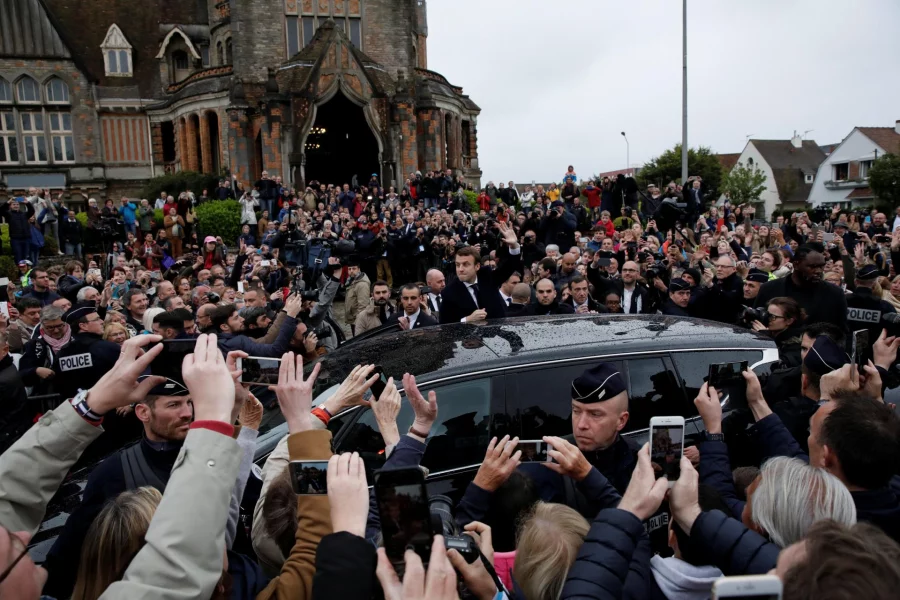 French presidential election candidate Emmanuel Macron, head of the political movement En Marche !, or Onwards ! greets supporters as leaves a polling station during the the second round of 2017 French presidential election, in Le Touquet, France, May 7, 2017 REUTERS
What happened in the first round?
Macron won 24% of the vote and Le Pen finished second with 21.3% as France's traditional left and right parties were eliminated in the first round for the first time since the start of the Fifth Republic in 1958.
How does the election work?
A total of 47.58 million people are registered to vote. The country's 66,546 polling stations will open at 0600GMT and most will close at 1700GMT, while those in Paris and other big cities will remain open an hour longer.
The first estimated results could come as early as 1745GMT.
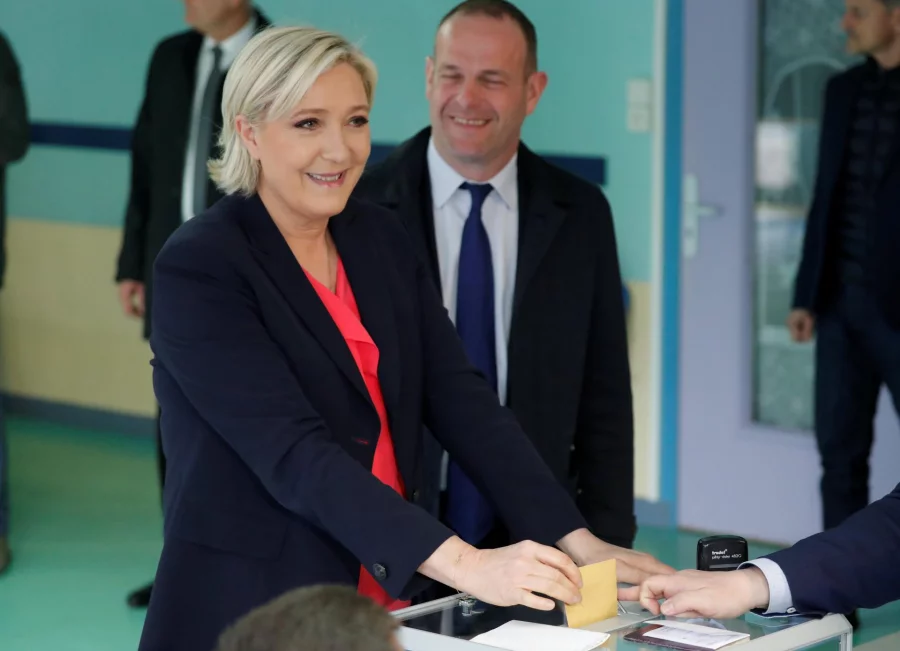 Marine Le Pen, French National Front (FN) political party candidate for French 2017 presidential election, casts her ballot in the second round of 2017 French presidential election at a polling station in Henin-Beaumont, France, May 7, 2017 REUTERS
What happens next?
The new president will take over from Socialist Francois Hollande and is expected to be sworn in by May 14.
