




 “It’s a monumental step forward,” US Secretary of State John Kerry said as he left the talks in the Rwandan capital of Kigali late on Friday.
Under the pact, developed nations, including much of Europe and the United States, commit to reducing their use of the gases incrementally, starting with a 10% cut by 2019 and reaching 85% by 2036.
Many wealthier nations have already begun to reduce their use of HFCs.
Two groups of developing countries will freeze their use of the gases by either 2024 or 2028, and then gradually reduce their use. India, Iran, Iraq, Pakistan and the Gulf countries will meet the later deadline.
They refused the earlier date because they have fast-expanding middle classes who want air conditioning in their hot climates, and because India feared damaging its growing industries.
“It’s a monumental step forward,” US Secretary of State John Kerry said as he left the talks in the Rwandan capital of Kigali late on Friday.
Under the pact, developed nations, including much of Europe and the United States, commit to reducing their use of the gases incrementally, starting with a 10% cut by 2019 and reaching 85% by 2036.
Many wealthier nations have already begun to reduce their use of HFCs.
Two groups of developing countries will freeze their use of the gases by either 2024 or 2028, and then gradually reduce their use. India, Iran, Iraq, Pakistan and the Gulf countries will meet the later deadline.
They refused the earlier date because they have fast-expanding middle classes who want air conditioning in their hot climates, and because India feared damaging its growing industries.Nearly 200 nations have agreed a legally binding deal to cut back on greenhouse gases used in refrigerators and air conditioners, a major step against climate change that prompted loud cheers when it was announced on Saturday.
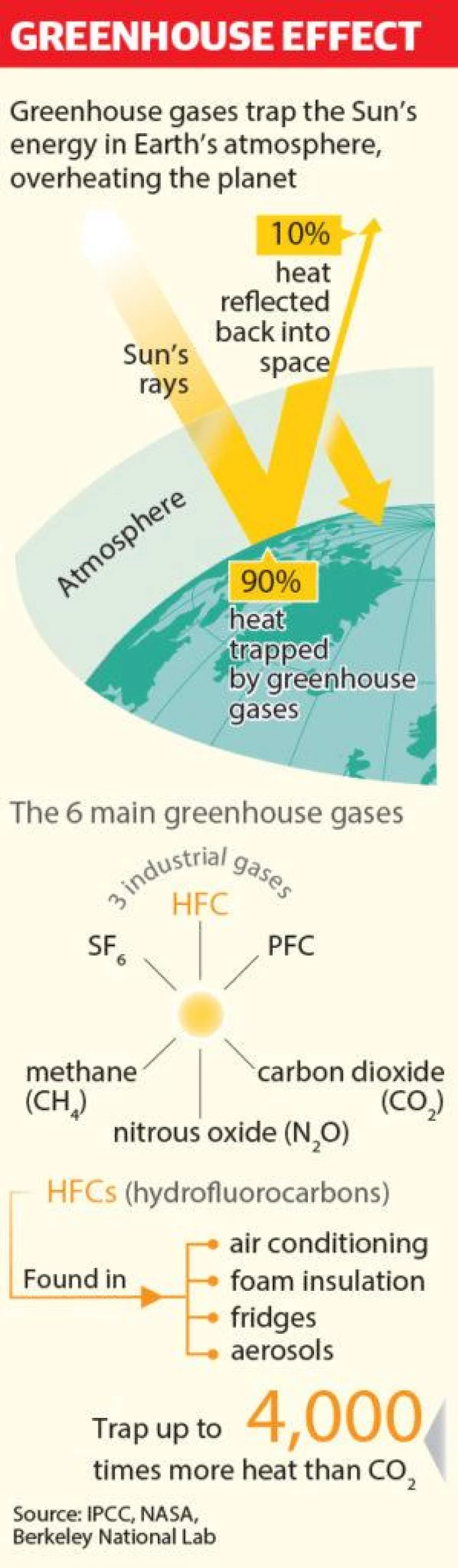
The deal, which includes the world’s two biggest economies, the United States and China, divides countries into three groups with different deadlines to reduce the use of factory-made hydrofluorocarbon (HFC) gases, which can be 10,000 times more powerful than carbon dioxide as greenhouse gases. “It’s a monumental step forward,” US Secretary of State John Kerry said as he left the talks in the Rwandan capital of Kigali late on Friday.
Under the pact, developed nations, including much of Europe and the United States, commit to reducing their use of the gases incrementally, starting with a 10% cut by 2019 and reaching 85% by 2036.
Many wealthier nations have already begun to reduce their use of HFCs.
Two groups of developing countries will freeze their use of the gases by either 2024 or 2028, and then gradually reduce their use. India, Iran, Iraq, Pakistan and the Gulf countries will meet the later deadline.
They refused the earlier date because they have fast-expanding middle classes who want air conditioning in their hot climates, and because India feared damaging its growing industries.
“It’s a monumental step forward,” US Secretary of State John Kerry said as he left the talks in the Rwandan capital of Kigali late on Friday.
Under the pact, developed nations, including much of Europe and the United States, commit to reducing their use of the gases incrementally, starting with a 10% cut by 2019 and reaching 85% by 2036.
Many wealthier nations have already begun to reduce their use of HFCs.
Two groups of developing countries will freeze their use of the gases by either 2024 or 2028, and then gradually reduce their use. India, Iran, Iraq, Pakistan and the Gulf countries will meet the later deadline.
They refused the earlier date because they have fast-expanding middle classes who want air conditioning in their hot climates, and because India feared damaging its growing industries.
“It’s a monumental step forward,” US Secretary of State John Kerry said as he left the talks in the Rwandan capital of Kigali late on Friday.
Under the pact, developed nations, including much of Europe and the United States, commit to reducing their use of the gases incrementally, starting with a 10% cut by 2019 and reaching 85% by 2036.
Many wealthier nations have already begun to reduce their use of HFCs.
Two groups of developing countries will freeze their use of the gases by either 2024 or 2028, and then gradually reduce their use. India, Iran, Iraq, Pakistan and the Gulf countries will meet the later deadline.
They refused the earlier date because they have fast-expanding middle classes who want air conditioning in their hot climates, and because India feared damaging its growing industries.