



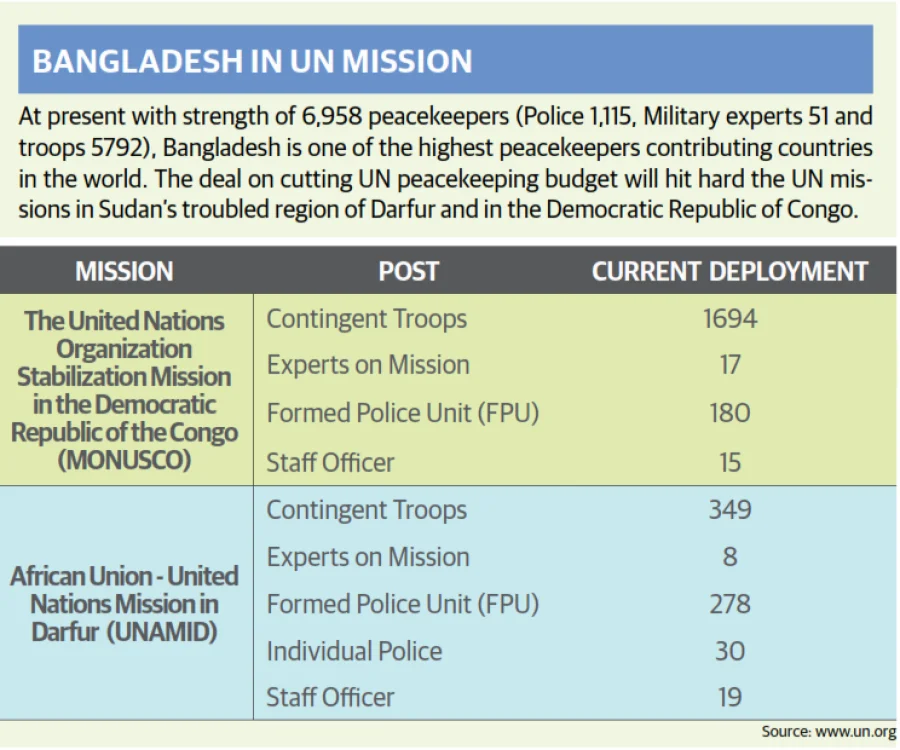
 Hardest hit by the cuts will be the UN missions in Sudan’s troubled region of Darfur and in the Democratic Republic of Congo, the two costliest operations with budgets that run over $1bn.
Washington pays 28.5% of the peacekeeping budget and 22% of the UN’s core budget of $5.4bn.
The deal falls short of the request from UN Secretary-General Antonio Guterres, who had asked for $7.97bn for the annual budget which runs from July 1 to June 30 of next year. It also is less than what African countries had proposed: they wanted $7.7bn for the UN missions.
The deal is expected to be approved by the UN General Assembly on Friday.Big cuts to Darfur missionThe Security Council is expected to vote as early as Thursday on significant cuts to the 17,000-strong joint African Union-UN mission in Darfur known as UNAMID.
Britain on Wednesday circulated a draft resolution that provides for a two-stage drawdown over the next 12 months, in line with the recommendations of a joint AU-UN report released last month.
The measure would cut UNAMID force levels to reach 8,735 troops and 2,500 police by June 2018, a 44% cut in military personnel and nearly 30% in police, according to the draft text.
The drawdown could be reviewed if the Sudanese government fails to ensure protection in those areas from where the peacekeepers will withdraw.
Under the proposed measure, Guterres will report to the council after six months on whether “conditions on the ground remain conducive to further reductions.”
The draft resolution welcomes a “reduction in military confrontations between government forces and rebel groups,” but rights groups maintain that the conflict in Darfur is far from over.
Human Rights Watch has criticised the proposed cuts as “misguided,” saying civilians in Darfur still need protection.
Darfur has been engulfed in conflict since 2003, when ethnic minority insurgents mounted a rebellion against President Omar al-Bashir, complaining that his Arab-dominated government was marginalising the region.
A deal on cutting nearly $600m from the UN peacekeeping budget was reached Wednesday following weeks of negotiations over US demands for sharp cost reductions, UN diplomats said.
Under the deal reached by a General Assembly budget committee, the United Nations will spend $7.3bn on peacekeeping in the coming year, down from the current $7.87bn – roughly a seven percent cut – according to diplomats familiar with the negotiations.
The United States, the biggest financial contributor to peacekeeping, had sought a nearly $1bn cut to the bill and the European Union had also pushed for savings to bring costs down to $7.3bn.
US Ambassador Nikki Haley claimed victory in a statement, saying “just five months into our time here, we’ve already been able to cut over half a billion dollars from the UN peacekeeping budget and we’re only getting started.” Hardest hit by the cuts will be the UN missions in Sudan’s troubled region of Darfur and in the Democratic Republic of Congo, the two costliest operations with budgets that run over $1bn.
Washington pays 28.5% of the peacekeeping budget and 22% of the UN’s core budget of $5.4bn.
The deal falls short of the request from UN Secretary-General Antonio Guterres, who had asked for $7.97bn for the annual budget which runs from July 1 to June 30 of next year. It also is less than what African countries had proposed: they wanted $7.7bn for the UN missions.
The deal is expected to be approved by the UN General Assembly on Friday.Big cuts to Darfur missionThe Security Council is expected to vote as early as Thursday on significant cuts to the 17,000-strong joint African Union-UN mission in Darfur known as UNAMID.
Britain on Wednesday circulated a draft resolution that provides for a two-stage drawdown over the next 12 months, in line with the recommendations of a joint AU-UN report released last month.
The measure would cut UNAMID force levels to reach 8,735 troops and 2,500 police by June 2018, a 44% cut in military personnel and nearly 30% in police, according to the draft text.
The drawdown could be reviewed if the Sudanese government fails to ensure protection in those areas from where the peacekeepers will withdraw.
Under the proposed measure, Guterres will report to the council after six months on whether “conditions on the ground remain conducive to further reductions.”
The draft resolution welcomes a “reduction in military confrontations between government forces and rebel groups,” but rights groups maintain that the conflict in Darfur is far from over.
Human Rights Watch has criticised the proposed cuts as “misguided,” saying civilians in Darfur still need protection.
Darfur has been engulfed in conflict since 2003, when ethnic minority insurgents mounted a rebellion against President Omar al-Bashir, complaining that his Arab-dominated government was marginalising the region.
Hardest hit by the cuts will be the UN missions in Sudan’s troubled region of Darfur and in the Democratic Republic of Congo, the two costliest operations with budgets that run over $1bn.
Washington pays 28.5% of the peacekeeping budget and 22% of the UN’s core budget of $5.4bn.
The deal falls short of the request from UN Secretary-General Antonio Guterres, who had asked for $7.97bn for the annual budget which runs from July 1 to June 30 of next year. It also is less than what African countries had proposed: they wanted $7.7bn for the UN missions.
The deal is expected to be approved by the UN General Assembly on Friday.Big cuts to Darfur missionThe Security Council is expected to vote as early as Thursday on significant cuts to the 17,000-strong joint African Union-UN mission in Darfur known as UNAMID.
Britain on Wednesday circulated a draft resolution that provides for a two-stage drawdown over the next 12 months, in line with the recommendations of a joint AU-UN report released last month.
The measure would cut UNAMID force levels to reach 8,735 troops and 2,500 police by June 2018, a 44% cut in military personnel and nearly 30% in police, according to the draft text.
The drawdown could be reviewed if the Sudanese government fails to ensure protection in those areas from where the peacekeepers will withdraw.
Under the proposed measure, Guterres will report to the council after six months on whether “conditions on the ground remain conducive to further reductions.”
The draft resolution welcomes a “reduction in military confrontations between government forces and rebel groups,” but rights groups maintain that the conflict in Darfur is far from over.
Human Rights Watch has criticised the proposed cuts as “misguided,” saying civilians in Darfur still need protection.
Darfur has been engulfed in conflict since 2003, when ethnic minority insurgents mounted a rebellion against President Omar al-Bashir, complaining that his Arab-dominated government was marginalising the region.