



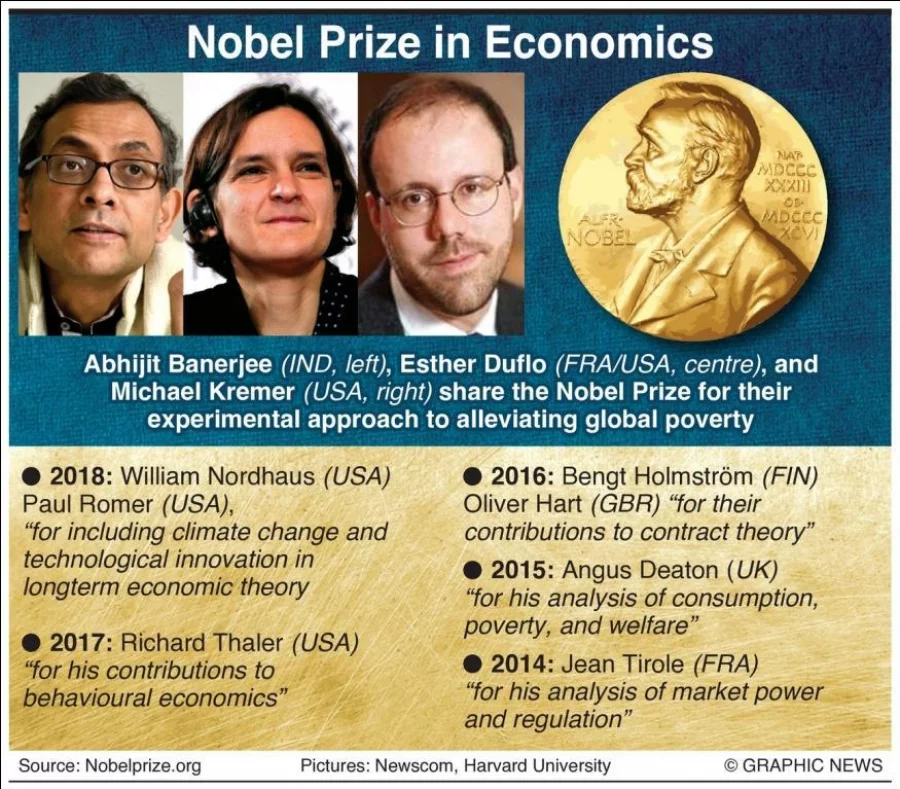
A trio of economists on Monday won the Nobel Economics Prize for their work in the fight against poverty, including with new approaches in education and healthcare, the Royal Swedish Academy of Sciences said.
Indian-born Bangali Abhijit Banerjee is an American citizen while Esther Duflo is French-American. Michael Kremer is also from the US.
Banerjee, his wife Duflo and Kremer were honoured "for their experimental approach to alleviating global poverty," the jury said.
"This year's laureates have introduced a new approach to obtaining reliable answers about the best ways to fight global poverty," the jury said.
The three found efficient ways of combatting poverty by breaking down difficult issues into smaller, more manageable questions, which can then be answered through field experiments, the jury said.
"They have shown that these smaller, more precise, questions are often best answered via carefully designed experiments among the people who are most affected," it said.
JUST IN: The 2019 Nobel Prize in economics has been awarded to a trio of international economists for their pioneering approach to reducing global poverty https://t.co/zFVoFSwQeo
— CNN International (@cnni) October 14, 2019
"As a direct result of one of their studies, more than five million Indian children have benefitted from effective programmes of remedial tutoring in schools. Another example is the heavy subsidies for preventive healthcare that have been introduced in many countries," the jury said.
Duflo is only the second woman to win the Nobel Economics Prize in its 50-year existence, following Elinor Ostrom in 2009.
Banerjee, 58, was educated at the University of Calcutta, Jawaharlal Nehru University and Harvard University, where he received his PhD in 1988.
His wife Duflo, 47, was born in Paris and is currently a professor at Massachusetts Institute of Technology. She also has a PhD from MIT.
Michael Kremer, 55, is a professor at Harvard University and has a PhD from the university. The prize amount of $914,000 will be shared equally between the three Laureates.
Only Nobel not in will
Unlike the other Nobels awarded since 1901, the Economics Prize was not created by the prizes' founder, philanthropist and dynamite inventor Alfred Nobel, in his 1895 will. It was devised in 1968 to mark the 300th anniversary of Sweden's central bank, and first awarded in 1969.
Each of the Nobels comes with a prize sum of $914,000, to be shared if there is more than one winner in the discipline.
But unluckily for recent winners, the prize's value has lost around $185,000 in the past two years, due to the depreciation of the Swedish krona.
The trio will receive the prize from King Carl XVI Gustaf at a formal ceremony in Stockholm on December 10, the anniversary of the 1896 death of Alfred Nobel.
Last year, the prize went to William Nordhaus and Paul Romer of the US for constructing "green growth" models that show how innovation and climate policies can be integrated with economic growth.
The Economics Prize wraps up a Nobel season that stands out for its crowning of two literature laureates, Polish writer Olga Tokarczuk for 2018 - delayed by a year due to a sexual harassment scandal - and Austrian novelist Peter Handke for 2019, whose selection sparked controversy because of his pro-Serb support during the Balkan wars.
Prior to that, the laureates in the fields of medicine, physics and chemistry were announced.
On Friday, Ethiopian Prime Minister Abiy Ahmed won the Peace Prize for his efforts to resolve the long-running conflict with neighbouring foe Eritrea.
